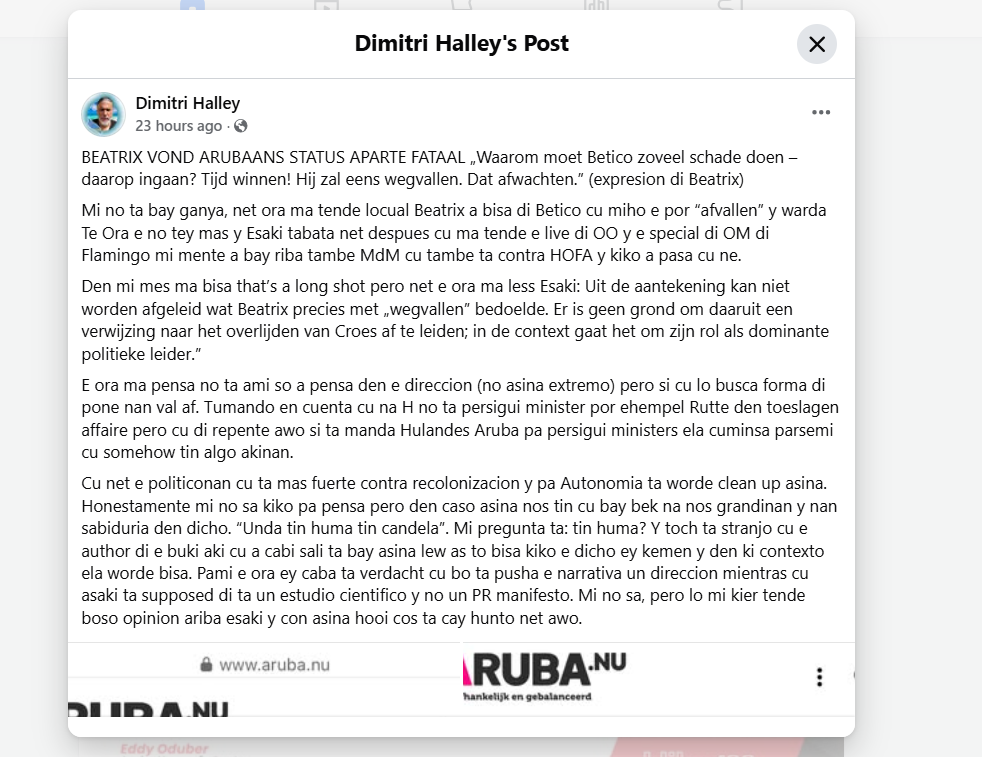
A recent publication on social media by Dimitri Halley has raised debate and concern in the local political and media environment, where he analyzes fragments of a new historical book regarding the role of the Dutch Crown during Aruba’s Status Aparte process.
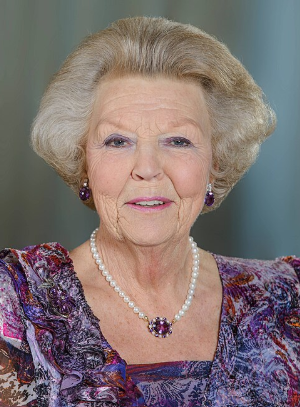
According to the shared text, the book refers to statements attributed to Queen Beatrix, who allegedly described Aruba’s Status Aparte as “fatal”.
Among the highlighted quotes mentioned is the sentence: “Waarom moet Betico zoveel schade doen – daarop ingaan? Tijd winnen! Hij zal eens wegvallen. Dat afwachten”.
However, the reality is that since Aruba obtained its status aparte, Aruba is a Country that has moved forward, not a country that stayed behind as at the moment when it was under Curaçao and instructions came from the Netherlands. Betico Croes’s decision was the best directional decision that the Country made where Arubans can make decisions about their own Country. Now why is Princess Beatrix the opposite of this? Perhaps because they want control of Aruba? Perhaps keep Arubans down and privilege the Dutch instead of an Aruban Dutch person? Do they want power? What is the reason according to Princess Beatrix that the decision was not good?
Interpretation and discussion on the historical context
The content of the book explicitly clarifies that it cannot be deduced from the notes that the expression “fall away/disappear” (wegvallen) referred to the passing of political leader Gilberto François “Betico” Croes, but rather to the neutralization or weakening of his role as the dominant political figure on the island.
However, Halley’s publication questions the way the authors of this historical work justify or steer the interpretation of those statements. In his opinion, when research that presents itself as a scientific study tries to push the narrative in a specific direction, is there a risk that it turns into a public relations manifesto (PR manifesto)? What is really the intention of the Netherlands with Aruba?
Tension over autonomy and justice in the Kingdom
Halley’s analysis goes further than the purely historical plane to connect these revelations with today’s political situation. In the writing, a critical reflection is raised on the contrast in the actions of judicial bodies in the Dutch Kingdom, comparing the lack of criminal prosecution against high-ranking officials in the Netherlands (like in the case of the toeslagenaffaire) with sending prosecutors to Aruba to prosecute local ministers.
The author of the message concludes by marking the popular saying “where there’s smoke, there’s fire”, questioning whether the politicians who are strongest against the process of recolonization and for the autonomy of the country are being systematically removed from the path. Looking at this landscape, citizens are invited to reflect and debate on the coincidences and implications that these facts may have in today’s reality.
Now has colonization, slavery really ended, is the apology that was given a real or fake apology?