

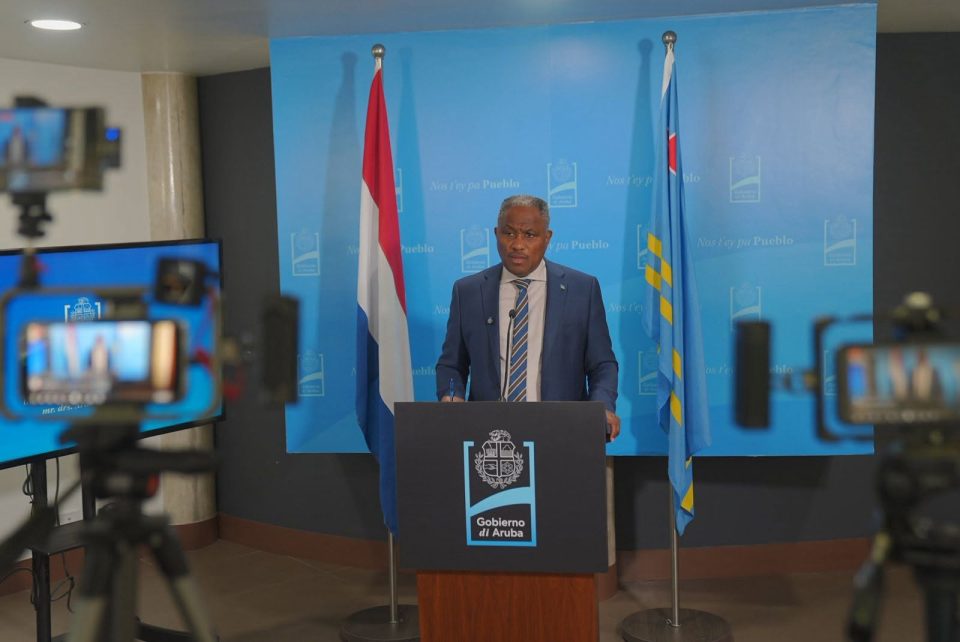
Minister Dowers appeals to complete regularization on time
With the first temporary permits granted in the final phase of “Hunto pa Progreso” (Together for Progress) beginning to expire at the end of October, the Minister of Justice, Integration, Public Transport, and Energy, Mr. Dr. Arthur Dowers, is appealing to participants not to wait until the last moment to complete their regularization process.
The final phase of “Hunto pa Progreso” provided about 1,500 people with a temporary permit with a maximum duration of one year. The intention was to give this group an opportunity to enter the formal labor market, secure an employer, and, within the provided period, transition to the regular permit process.
Minister Dowers emphasized that the temporary permit grants the right to stay legally in Aruba only during the period it is valid. Therefore, participants who have not yet completed their process must act in a timely manner.
According to the official, the first batch of permits will begin to expire at the end of October. Those who do not yet have an employer must actively ensure they find one and arrange their documentation before the expiration date.
“Do not wait until the last day. If your permit expires, ensure in time that you have an employer and can enter the regular process,” Minister Dowers emphasized.
Government connects job seekers with employers
Concurrently, the Government is taking steps to facilitate the connection between job seekers and companies in need of personnel.
Minister Dowers indicated that there is currently a database of people looking for employment. When an employer presents a need for personnel in a specific area, the Government makes an effort to connect the company with candidates who are already available in Aruba.
This approach is part of the effort to organize and formalize the labor market while providing an opportunity to individuals willing to work and comply with legal conditions.
The Minister clarified that every person has the right to apply for a permit. However, the granting of a work permit is evaluated in accordance with current regulations and the actual needs of the labor market.
Avoiding falling back into illegality
Dowers emphasized that the intention of “Hunto pa Progreso” was never to create a permanent permit, but rather to provide a temporary path to regularization.
If a participant fails to complete the regular process before their permit expires, the recommendation is to leave Aruba voluntarily and avoid their stay becoming illegal.
This is not a punishment. A person who leaves on time can, if they find an employer in the future and meet the current conditions, apply for a new permit to return to Aruba through the regular process.
However, Minister Dowers warned that the situation is different when a person consciously stays in Aruba without legal status. If the person is subsequently detained and deported, this can bring additional consequences, including a ban on entering Aruba for a specified period.
Responsibility also for employers
The Government is also intensifying its focus on employers who hire individuals without a valid permit.
Minister Dowers indicated that employers who consciously facilitate work for persons who do not have the legal right to work can face severe fines. Depending on the circumstances, the Government may also evaluate whether a case should be referred to the Public Prosecutor’s Office.
According to the official, formalizing the labor market is a shared responsibility. Not only the employee, but also the employer has the obligation to verify that the person they employ has the necessary documentation.
DIMAS continues to improve processing time
Minister Dowers also reported that DIMAS is recording progress in permit processing times. Currently, new requests are being processed in approximately three to four weeks, depending on the type of request and whether the documentation is complete.
At the same time, there are extension cases that, when all documents are in order, have been successfully processed in a considerably shorter period. According to Dowers, this is the result of continuous efforts to increase efficiency and improve service to citizens.
The Government continues to work on creating an immigration and labor system that provides opportunities, but at the same time demands compliance with the rules.