

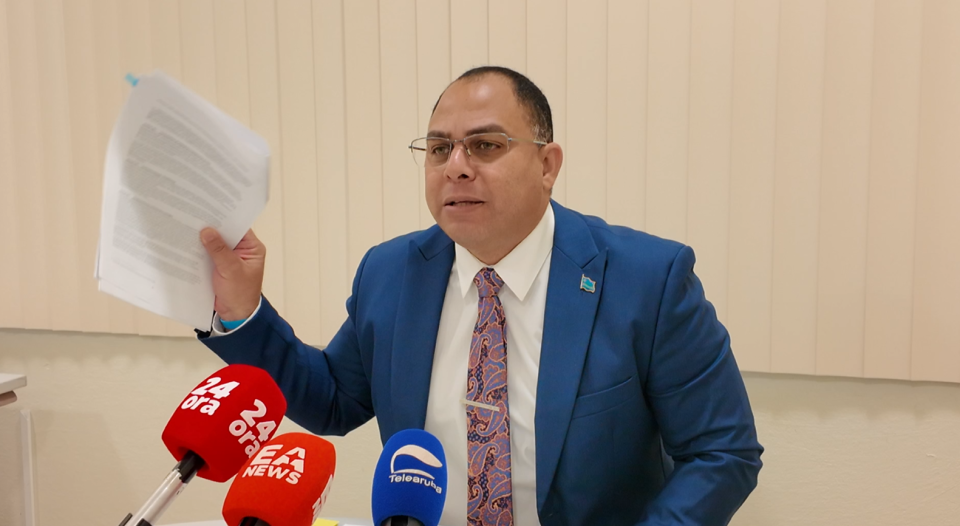
“Aruban politicians do not want supervision”; for PPA faction leader Eduard Pieters, that is a false narrative created around the discussion of the HOFA Kingdom Act (Rijkswet HOFA). The PPA is not against financial supervision. On the contrary, Pieters states that Aruba must maintain strong control over public finances.
However, he sets a fundamental condition: supervision must be anchored in Aruban law and respect the democratic authority of the Parliament of Aruba. “We believe in supervision. But do not come and say that if we question the Kingdom Act, we do not want supervision.”
Control yes! Surrendering power, no! Pieters makes a distinction that must remain central to the debate. Supervision is necessary to ensure that the Government manages public money correctly, maintains budgetary discipline, and prevents the country’s finances from getting out of hand. But that does not automatically justify any form of supervision.
Pieters even points out that Aruba can strengthen its own system of control, for example, with a strong budgetary chamber (begrotingskamer). His point is that financial control can and should be organized within Aruba’s own rule of law. For Pieters, the problem begins when supervision shifts from controlling the Government to determining what Aruba can or cannot do. That is no longer just a financial debate; it is a debate about autonomy.
“A bank does not tell you what to eat” Pieters used a simple example to explain his concern. A citizen with a mortgage at a certain interest rate might go to another bank offering a lower interest rate. Naturally, the new bank may set financial requirements before refinancing the debt. But there is a limit.
“The bank cannot tell you, today you can eat this, tomorrow you must eat something else, and then determine what you can buy.” The comparison touches directly on the PPA’s concern: “How much power do we surrender, breaking our Constitution, in exchange for a supposedly more favorable financing condition?”
According to Pieters, this question must be asked before Aruba commits to a system that could have consequences for many more years than the current Government.
Who has the final word? For Pieters, the most sensitive point is the position of Parliament. If Aruba’s essential decisions must be evaluated or greenlit externally (from the Netherlands) before the Parliament of Aruba can fully exercise its authority, the democratic relationship changes.
“You are placing a body above the Parliament of Aruba. That does not exist in our Constitution and is not our democracy. Parliament will NO LONGER be able to represent the Aruban people, but will become an executor of Dutch instructions. That is not parliamentary democracy.”
Autonomy is also responsibility Defending autonomy, according to Pieters, is not defending financial irresponsibility. The PPA does not argue for the Government to spend without limits, create uncontrolled debt, or avoid accountability. On the contrary: autonomy demands responsibility. But taking personal responsibility is not the same as surrendering one’s own authority.
Pieters recalls that Aruba has historically honored its financial obligations and “has always been a good payer.” Therefore, he rejects any image suggesting that without an external construct, Aruba cannot automatically manage its finances.
For the PPA, the line is clear: supervision yes, financial discipline yes, responsibility yes, but within a system that respects the Constitution, the Statute, the law, and the democracy of Aruba. And precisely there, Pieters asks the question that goes far beyond HOFA: “If we accept that an external body can determine what Aruba can decide today, where exactly will we draw the line tomorrow?”