

The Bonaire Human Rights Organization (BHRO) is issuing a public alert following the launch of a social media campaign by the Netherlands Institute for Human Rights. Their campaign aims to inform the residents of Bonaire, Statia, and Saba about human rights in daily life, including the cost of living, housing, healthcare, education, and other basic living conditions.
BHRO strongly supports human rights education. However, our primary concern is that the information presented to the public must accurately reflect the lived realities and human rights violations that our people experience on our islands. Therefore, BHRO encourages residents to critically evaluate the information presented through this campaign.
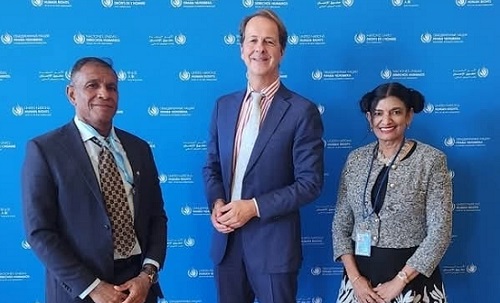
This concern is grounded in BHRO’s direct experience during the review of the Netherlands’ compliance with its obligations by the United Nations Committee on Economic, Social and Cultural Rights (CESCR), which took place in Geneva on September 16 and 17, 2025. During that process, BHRO traveled to the UN in Geneva to submit and voice concerns regarding information related to Bonaire that, according to our assessment, did not adequately reflect the reality lived by the population daily.
It is important to note that the subsequent UN conclusions identified serious inequalities and ongoing concerns regarding the guarantee and full exercise of economic, social, and cultural rights. The Committee also expressed concern about the lack of information regarding the implementation of these rights in Bonaire, Saba, and Sint Eustatius.
For BHRO, these conclusions are particularly significant because they validate our concern that the realities experienced by people on the islands were not being adequately reflected in the information presented internationally.
BHRO submitted information to the United Nations directly from the community regarding poverty, the high cost of living, housing, healthcare, education, discrimination, inequality, and the lack of equal guarantees for fundamental rights. BHRO’s contributions helped bring the daily reality of the people directly before international human rights mechanisms.
BHRO is also concerned about the fact that the Dutch Government funds the Institute. When an institution receives funding from the very State that is expected to comply with its human rights obligations and which it must evaluate independently and critically, transparency and effective safeguards are essential. Such a relationship raises legitimate questions regarding institutional independence, potential influence over the information presented, and the narrative communicated to the public and to international human rights bodies.
Why does the Netherlands Institute for Human Rights not question whether the incorporation of Bonaire into the Dutch constitutional order—ignoring the expressed desire and democratic decision of the Bonairean people and under conditions of unequal rights—violates Article 1 of both the International Covenant on Civil and Political Rights (ICCPR) and the International Covenant on Economic, Social and Cultural Rights (ICESCR)? This concerns the fundamental human right of all peoples, including Bonaire, to self-determination, by virtue of which they freely determine their political status and freely pursue their economic, social, and cultural development.
Therefore, BHRO urges the peoples of Bonaire, Statia, and Saba to stay informed, ask questions, document their experiences, and critically evaluate whether the information presented corresponds to the reality they live every day.
Human rights education is vital, but our people deserve information that is independent, accurate, transparent, and rooted in their lived reality.
Bonaire Human Rights Organization