

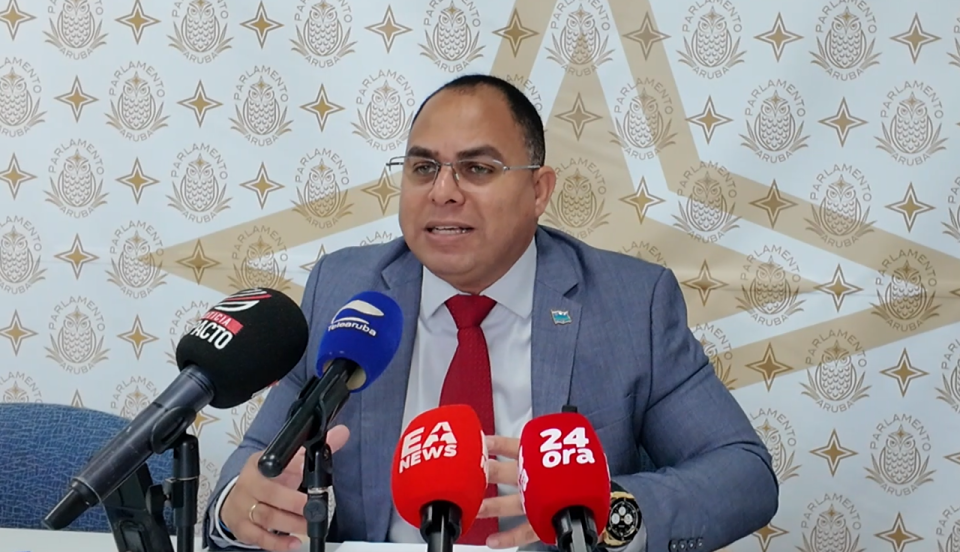
At the start of a new school year, PPA fraction leader Eduard Pieters wished the children, parents, and teachers much success and perseverance, but immediately raised a serious concern: according to Pieters, Aruba is investing millions of florins in educational material that is diametrically opposed to the path the country itself has chosen for multilingual education. Pieters began by emphasizing the crucial role of teachers. “You are the architects of our society. The impact a teacher has on a child’s life is enormous. We must ensure that no child is left behind.”
However, during the vacation, according to Pieters, PPA received several calls from teachers and principals, from both public and Catholic schools, expressing concerns about the direction of education and, in particular, how public funds are used.
Multilingual education, but material in Dutch Pieters recalled that a few years ago (2023) Aruba chose to move in the direction of multilingual education, taking into account the child’s native language. The process started in the first grade and continued progressively. But now, according to Pieters, a fundamental contradiction arises. While children are learning to read and write in Papiamento, various school boards, including public schools, are investing considerable sums in new math material in Dutch.
“You cannot let a child learn to read and write in one language, and then force them to process math in another language. Where is the logic?” Pieters compared Aruba to other countries, where initial education in reading, writing, and mathematics generally forms part of the same linguistic context. For PPA, the problem is not the Dutch language. The problem is coherence in educational policy.
“This is capital destruction” (kapitaalvernietiging) Pieters questioned why schools have to invest anew in Dutch material, while Aruba has already developed material to teach mathematics in Papiamento, namely Conta Cu Mi, which aligns with the core goals of basic education in the country of Aruba.
“We have invested a lot of taxpayers’ money to develop these materials. If we now set them aside and spend millions again on other material, this is capital destruction.” According to the fraction leader, the cost can rise to approximately Awg. 400,000 to 500,000 per school, while these same funds could be directed toward urgent needs. Pieters mentioned deteriorated infrastructure, desks and chairs, modern classroom materials, and digital media that teachers need to provide quality education.
Pieters noted that he himself visited EPB and observed the great infrastructure needs, while other schools also struggle with major and minor maintenance. For PPA, this makes the question even more urgent: if education funds are limited, why spend millions replacing material while schools have basic, unresolved needs?
Pieters holds political leadership responsible Pieters’s strongest criticism is directed at the leadership of the Ministry of Education. According to Pieters, the problem is not just a purchasing decision. There is a lack of consistent direction between educational policy, teacher preparation, didactic material, and the investments made by school boards.
“This is a lack of leadership. You cannot announce a direction for education and then allow investments that go diametraly against that same direction.” Pieters maintains that if Aruba truly wants multilingual education, the Government must create the conditions to do so successfully: prepare the teachers, give them adequate material, and create a coherent transition from other languages.
PPA’s message at the start of the school year is therefore twofold: confidence in the teachers and the children, but a demand for direct political leadership from the Government. “We can ask teachers to give their maximum and we can ask children to try their best. But the Government must also do its part. Education must have direction, coherence, and leadership.”