

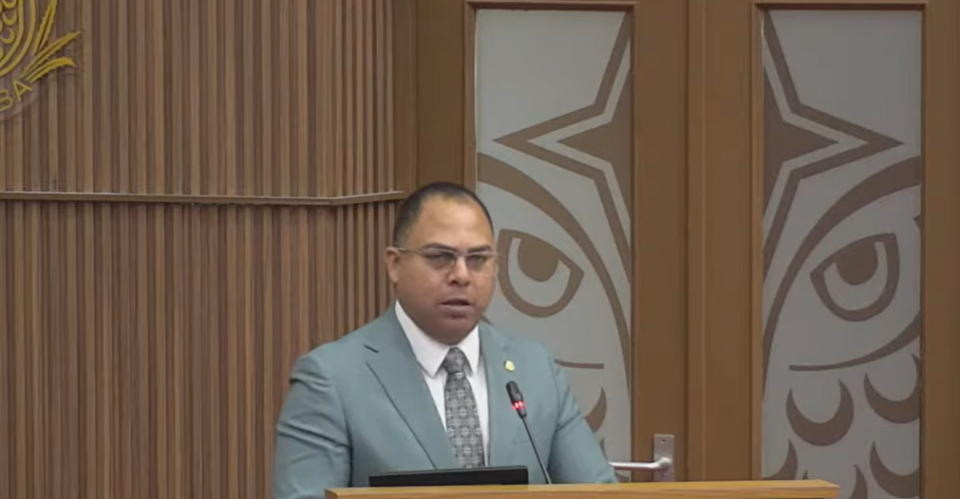
Today the Government wants to know what Parliament thinks and seeks its opinion. But where was the interest in Parliament’s opinion when the Government allowed an exception to the Top Incomes Standardization Act (Landsverordening Normering Topinkomens – LNT) for the director of the Aruba Airport Authority? With that question, PPA Member of Parliament Eduard Pieters confronted the Government during a public meeting in which Minister Wever requested the “feelings” of Parliament regarding the revision of the LNT. For Pieters, the request to learn Parliament’s stance cannot be viewed in isolation from what the Government has already done previously.
An exception the Government already granted
Pieters’ point has a concrete precedent. On November 6, 2025, the Government authorized an exception under Article 12 of the LNT, allowing the Aruba Airport Authority and Schiphol International to agree on a remuneration of Afl. 1,089,396 for the CEO presented by Schiphol International. The National Decree (Landsbesluit) mentions, among other things, operational continuity, essential expertise, management stability, and the airport’s international position as the reasons for the exception.
However, this is precisely where Pieters highlights the political contradiction. According to Pieters, the Government did not come to Parliament first to ask if the people’s representatives agreed with making that exception. “At that time, did the Minister and the AVP-FUTURO Government come to Parliament before signing? No, Mr. President! So why is Parliament’s opinion suddenly important to the Government?” Pieters expressed.
Pieters: The Government bowed to Schiphol
Pieters went further and presented a strong political accusation: according to him, the exception was not merely an administrative decision, but the result of pressure from Royal Schiphol Group. The National Decree itself confirms that the strategic relationship between AAA and Royal Schiphol Group, in place since 2004, was a central element in the Government’s decision. The document also indicates that Schiphol proposes the candidates for AAA’s general management. However, it appears that Schiphol made the decision for the Government.
Pieters, however, interprets the political outcome differently: “The Government bowed to the interests of Schiphol Group.” According to the MP, the Government should have stood firm on its own law and defended opportunities for local professionals, instead of accommodating external pressure.
And what did Aruba get in return?
Pieters then posed a question that shifts the debate from salaries to results: What did Aruba get in return for this exception? He referred to the current situation around the airport to support his argument: a lack of sufficient parking spaces, difficulties with traffic and passenger flow, and a general impression of a lack of logistical planning.
Pieters questioned how this aligns with the argument of “essential expertise” used by the Government to justify the salary exception. “Where is the return on investment?” A renovated building that cost Aruba millions is not enough if the user experience upon entry and exit remains characterized by disorder.
It is not just about the LNT
Today’s official debate is for Parliament to express its feelings regarding the revision of the LNT. But for the PPA, the Government cannot treat Parliament’s opinion as something important only when it is convenient. If Parliament’s opinion holds value today, Pieters’ question is simple: “Why didn’t it hold the same value when the Government made an exception of more than one million florins for the airport’s CEO? Respect for Parliament cannot be selective. We must take our work as parliamentarians seriously. This is a respected body, and we must give ourselves that respect,” Pieters stated.
For the PPA, the Government cannot ask for Parliament’s feelings today while making yesterday’s major decisions without that same consideration. Because Parliament is not an instrument to legitimize decisions after the fact. Parliament is the body that the Government must respect before making a decision.