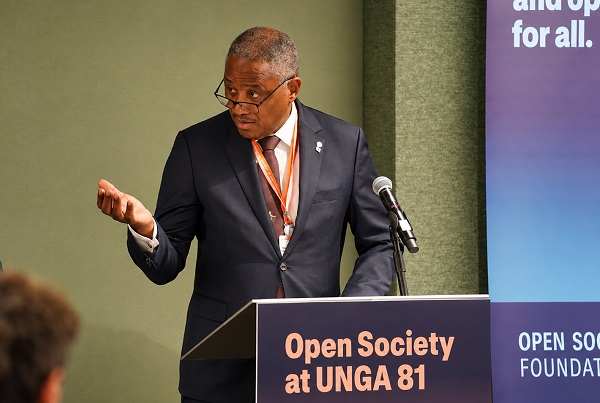
As part of his participation in the High-Level Week of the United Nations General Assembly in New York, Minister of Justice Mr. Drs. Arthur Dowers was the keynote speaker during a session dedicated to Artificial Intelligence (AI): Rights, Remedies and AI Jurisprudence: Upholding Justice, Rule of Law and Human Rights in the Age of Agentic AI.
During his speech, Minister Dowers focused on the rapid development of artificial intelligence and the challenges it brings to the protection of human rights. As AI systems become increasingly advanced and autonomous, the question of who bears responsibility for decisions and outcomes becomes ever more critical.
Minister Dowers focused his address on three main points: the application of existing legal frameworks, the responsibility of AI developers and users, and transparency.
One of the key points Minister Dowers emphasized is that the introduction of new technology does not mean that existing laws and rights lose their validity. Universal human rights and current legal frameworks remain applicable, even when decisions are made using artificial intelligence.
In this context, the minister referenced a 2020 case in the Netherlands, where the Hague District Court ruled that the government’s use of an algorithm to detect fraud in the welfare system violated the European Convention on Human Rights. According to Minister Dowers, this case demonstrates that existing legal frameworks can also be applied to technology-driven decisions.
A significant portion of his speech was dedicated to responsibility. Minister Dowers stated that both public and private organizations should only deploy technology capable of impacting human rights if they can bear the accompanying responsibility and mitigate the associated risks.
“If humans decide to delegate tasks to AI-systems, regardless of their autonomous capabilities, they cannot delegate responsibility.”
Behind every technology-driven decision is a framework built on human choices. Humans make decisions or delegate tasks to AI systems. Therefore, regardless of how autonomous a system may become, ultimate responsibility rests with the individuals and organizations that develop and use the technology.
“Organizations cannot hide responsibility behind technology. AI can execute a task, but responsibility for the outcome cannot be delegated to a machine,” stated Minister Dowers.
The third central theme of his address was transparency. When a decision assisted by AI is made that could have legal consequences for an individual, that person must know that AI played a role and must have access to sufficient information to contest the decision. Without the necessary information, the ability to seek legal remedies loses its effectiveness.
Minister Dowers also referenced various international and regional instruments that place this principle at their core, including United Nations principles on the ethical use of AI, the Council of Europe’s Framework Convention on AI, and the European Union’s AI Act.
Special attention was also given to the role of the judiciary. According to Minister Dowers, judges do not need to become technical experts in artificial intelligence, but they must have a general understanding of the technology and its inherent risks to interpret and apply the law in cases involving AI. The exchange of experiences between judicial systems is crucial to determine whether existing instruments are sufficient or if additional measures are required.
Minister Dowers concluded that technological progress and the protection of human rights must continue to go hand in hand. Technology can alter how decisions are made, but it cannot change the fundamental principle of responsibility.
“Algorithms and AI-systems may cause harm, but only humans can be held accountable.”
Minister Dowers’ participation as a keynote speaker is part of his itinerary in New York during the High-Level Week of the 81st United Nations General Assembly, where he is attending as part of the delegation of the Kingdom of the Netherlands.