

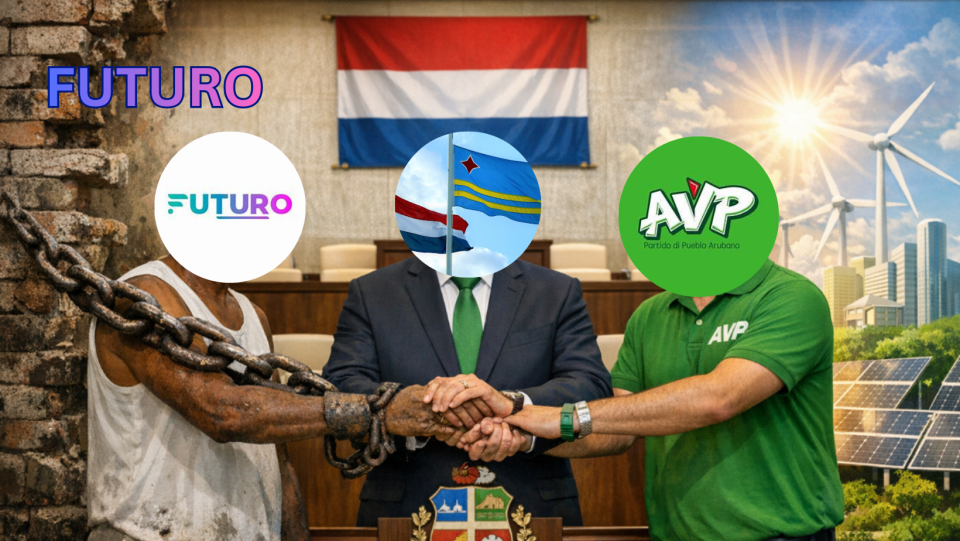
Various political observers and analysts in Aruba have strongly criticized the parliamentary faction of the Arubaanse Volkspartij (AVP) and Futuro in the Parliament of Aruba. They indicate that the way the faction is handling the proposed Kingdom Law HOFA could have negative consequences for the future of the country and for their own role as representatives of the people. According to the critics, the AVP–FUTURO faction is showing a political “weakness” that limits Parliament’s ability to exercise its authority and defend the interests of the people of Aruba—as well as their own responsibilities as parliamentarians.
Lack of decision-making and dependence
Analysts have pointed out that parliamentarians from the faction appear to be following a passive stance, “sleeping through the green light,” without truly defending the people of Aruba. According to the criticism, they seem more focused on protecting their personal future as parliamentarians and remaining in their seats rather than prioritizing the welfare and progress of Aruba.
According to the analysis, this attitude reflects a form of political immaturity within the new generation of parliamentarians, where material interests and personal gain appear to take precedence over public duty and long-term decisions that affect the country.
Consequences for autonomy
It appears that the AVP–FUTURO faction may not be fully aware that their own power as parliamentarians will be limited in the process surrounding the Kingdom Law HOFA. The law has already been sent to the Council of State and will await advice before being forwarded to the Tweede Kamer (Dutch Parliament). After that, it will return to Aruba, but the Parliament of Aruba will not have the possibility to truly debate or vote on the law.
Their role will be limited to submitting written questions and viewpoints, which represents a serious limitation on the sovereignty, autonomy, and power of the Parliament of Aruba. According to critics, this is a situation that the AVP–FUTURO faction itself helped create—ultimately causing parliamentarians to lose their own authority and leaving the people of Aruba without a true voice.
Political embarrassment and responsibility
Observers say the situation is creating a sense of political embarrassment because the AVP–FUTURO faction is not demonstrating the responsibility or leadership that the public would expect from a new generation of politicians. Critics emphasize that the way the law is being handled suggests that the faction is more interested in personal benefits—remaining comfortably in office and collecting a salary—than in protecting national interests.
According to analysts, the situation serves as a warning to Aruba about the risks the country faces if parliamentarians place personal interests above the public interest. The AVP–FUTURO faction is therefore being described by some critics as a symbol of political weakness and as one of the weakest parliamentary factions Aruba has experienced in its political history