

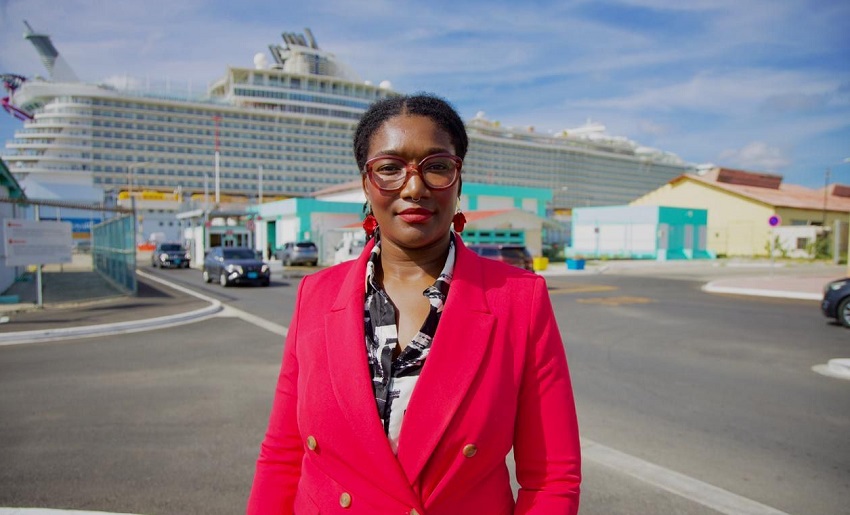
AVP Member of Parliament Otami Thomasia clarifies her reaction regarding the situation that occurred last Sunday during the celebration of Sinterklaas and Zwarte Piet. According to Thomasia, her concern and disapproval are directed toward elements within the tradition that can create an offensive or harmful image — for both children and adults.
Thomasia, who grew up in San Nicolas and is “from the other side of the bridge,” states that she is not against the celebration itself, but understands why others may view it more innocently. “If someone wants to wear the traditional costume, that is their right, but when you add attributes that indicate race — such as wigs, deep black face paint, bright red lips — then that crosses a line,” she explains.
The AVP parliamentarian emphasizes that the symbolism behind these visual traits cannot be ignored. According to Thomasia, they create subliminal messages that can cause children to feel inferior. Even today, this leads to bullying in schools, where children feel ‘less than’ because of their skin color — something that can develop into mental health issues over time.
“I myself am a person of color and stand firmly in my identity. There is nothing about me that suggests I have any kind of complex, but now I hold a position where I can speak on behalf of many who have no platform or voice.”
Thomasia urges the community to visit the social media post and read the comments, because they reveal a reality that can no longer be hidden — the reality of what many people still think and feel.
“The criticism clearly shows why the tradition, in its current form, can no longer continue. We are in 2025; our direction must change. Traditions must evolve to be inclusive and to honor all children, without excluding or offending anyone.”
She clarifies that her comments are not directed toward Minister Mike Eman or the team that organized the event, but rather serve as a reminder that discussions have been ongoing for years about painting the Piets in different colors. “If someone knows the symbol is offensive and still chooses to paint their face black, that is a personal decision. But as a community, we must look further.”
Last Sunday was not the group’s first performance, and in previous years the agreed-upon portrayal of Piet was respected. Yet this time, without the organizers’ awareness, they chose an appearance that the majority rejects. According to Thomasia, this shows a lack of empathy for those who do not feel comfortable with the tradition, or who are affected by the historical pain the symbolism carries. “Such a decision is not innocent; it shows that the sensitivities of others are still not being taken into account.”
Thomasia concludes with a call to look forward and think about the new generation.
“Aruba, think of our children. We have many other beautiful celebrations we can expand: Dia di Mucha, for example, can become a large-scale celebration — an event of joy and unity. It is time for new traditions that are inclusive and reflect who we truly are as a people.”
Press release: AVP