

For the past 16 years, we have been witnessing the exact same scenario where economy ministers put on a political show, taking nice photos and signing handshaking agreements with promises to open new markets and do business with countries like Colombia, the Dominican Republic, Brazil, Panama, Suriname, and the South American region.
However, the truth behind the cameras of this propaganda is a cruel reality that Aruba’s commerce and consumers face daily, which remains completely unaddressed. A country without connectivity remains a country with challenges, which creates departments like AFTA, after which the government turns around to question commerce about their prices, and even more so the logistics companies, wholesalers, and retail centers.
Although it must be said that the initiative to connect local merchants with international parties is very positive, this effort remains useless and incomplete if logistics are not structurally arranged. The lack of vision and planning from successive ministers over the last 16 years is merely a show; instead of materializing connectivity together with NGOs on the logistics side, it remains useless and incomplete. This creates a critical situation where the supply chain is inefficient, ultimately leading to extremely high prices for Aruba.
Current Logistics Challenges: Air and Maritime
The deficiencies in our cargo transportation are the main cause of the high prices the public is paying.
• Air Freight: Speaking of cargo arriving by air, it accounts for roughly 90%, which is transported via commercial airlines. Here, we are talking about commercial airlines where cargo is not their core business. Passengers receive priority over cargo, and air freight costs are not cheap. Naturally, merchants must cover their expenses and ultimately pass these costs on to the consumer.
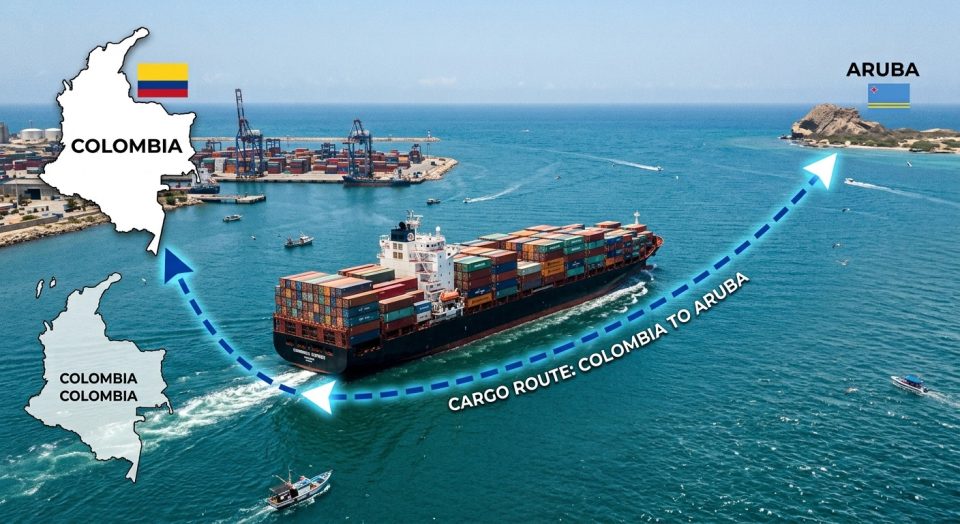
• Maritime Freight: Currently, Aruba is 100% dependent on large container shipping lines, such as King Ocean, which operates its own terminal with a direct route from Miami to Aruba. Most containers originating from Colombia go to Miami and then from Miami to Aruba, taking 10 to 12 days to reach Aruba, not including the Customs clearing process before reaching the client.
Key Questions for the Government and Responsible Ministers
If there is truly a willingness to lower product costs and support the commercial sector, the show must STOP and work must begin on concrete facts. The central question is: What is the Government willing to do or facilitate to provide a real, genuine solution for Aruba’s logistics and connectivity?
For instance, an initiative for local merchants and NGOs willing to invest in a container line service—such as smaller vessels departing directly from a Colombian port to Aruba, taking 2 to 3 days instead of 10 to 12 days—would bring more attractive prices and fresher products. Is the government willing to provide some form of limited-time compensation so local investors can launch this route? Currently, there are merchants in Aruba ready to step up and bring a solution for better prices in Aruba.
Compensation and Facilitation: What type of lateral incentives—such as tax relief, reduction of port authority fees, or compensation from the Government and APA—could make a significant difference for a limited period? This would allow the project to take off, directly benefiting Aruba with lower prices and fresher goods.
Once again, I must emphasize that the B2B initiative is indeed a good effort.
However, if the minister concerned is truly serious about trade missions and lowering costs in Aruba, they should support this group of merchants who are ready to sit at the table to work on the necessary steps to create a path toward better prices and close the loop that keeps Aruba’s costs so high today.
True commercial integration is not achieved in conference halls or through press photos. It is achieved when cargo reaches its destination on time, at a reasonable price, and backed by solid logistics. Let’s stop the show, sit down with NGOs, and start implementing the incentives and infrastructure that Aruba truly needs.