

473 million SURPLUS for 2025 and a positive, encouraging outlook for Aruba
On November 27, 2025, the CAFT issued its reaction to the third-quarter 2025 Implementation Report (UR), published on November 28. The CAFT is very positive about Aruba’s financial development, comparing January–September 2024 with January–September 2025. From the content, it is clear the CAFT praises the Wever-Croes I and II Cabinets and appreciates that Geoffrey Wever of the Eman-Croes I Cabinet continued the vision and financial management path set by Wever-Croes II toward sustainable and solid public finances for Aruba.
6% SURPLUS, equivalent to 473 million up to September 2025
In December 2024, Aruba closed the year with a 500 million surplus, left by the previous government for the new administration. The CAFT states in its review and reaction to the third-quarter execution report that the collective sector shows a 6% surplus relative to GDP—this amounts to 473 million through September 2025. It also notes that tax revenues are higher than budgeted due to stable economic growth. This means Aruba complies with LAFT law, article 14 paragraph b, which requires a 1% surplus. It is expected that Aruba will end 2025 with additional “positive windfalls,” and the CAFT advises using these extra funds, per LAFT article 14 letter d, to continue paying off debt, reduce the national debt, and lower interest burdens.
National debt decreasing in a way even the Netherlands has never achieved
The national debt must be divided into two phases. Pre-Covid, the Eman I and II Cabinets borrowed 2.2 billion to cover their budget deficits, doubling Aruba’s national debt without any crisis occurring. This brought Aruba’s debt-to-GDP ratio to 92%, placing the country on the brink of bankruptcy. Many still remember Mike Eman’s speech in Parliament proudly defending that debt, which future generations would have to repay.
In phase 2, Aruba borrowed 916 million from the Netherlands as the 2020 “covid loan,” raising the national debt to 116% of GDP. Through the vision, management and tireless work of Evelyn Wever-Croes, Xiomara Maduro and their professional teams, a recovery plan was implemented. The IMF reported that since 2022 and 2023 Aruba has been on the right track. By the end of 2024, the national debt had dropped from 116% (2020) to 69% (2024). Congratulations Aruba!
The CAFT reports that by the end of 2025 the national debt will fall further to 63%. If this financial approach continues in the coming years, Aruba’s debt-to-GDP ratio will reach 47% in 2029—eleven years earlier than the CAFT originally anticipated and as anchored in LAFT article 14 paragraph c, stating the debt must fall to 50% by 2040.
Aruba does not need any Kingdom Law (Rijkswet)
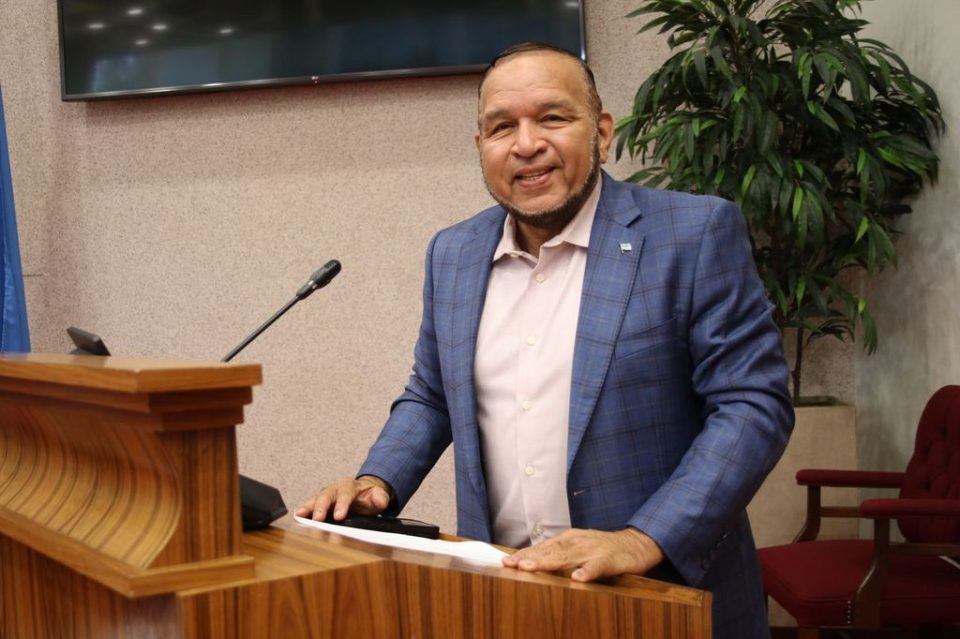
Parliamentarian Endy Croes immediately questions why the current government of Mike and Gerlien wants to give up Aruba’s struggle and autonomy so easily now that the figures are so positive. What is the value of a Rijkswet under these circumstances?
Thanks to the strong financial foundation laid by Wever-Croes I and II, Aruba can now enjoy these good results. As the CAFT’s praise demonstrates, Aruba does not need a KINGDOM LAW that allows politicians in The Hague to make decisions for us. We ourselves are fully capable of remaining the masters of our own house!
Press Release – Parliamentarian Endy Croes