

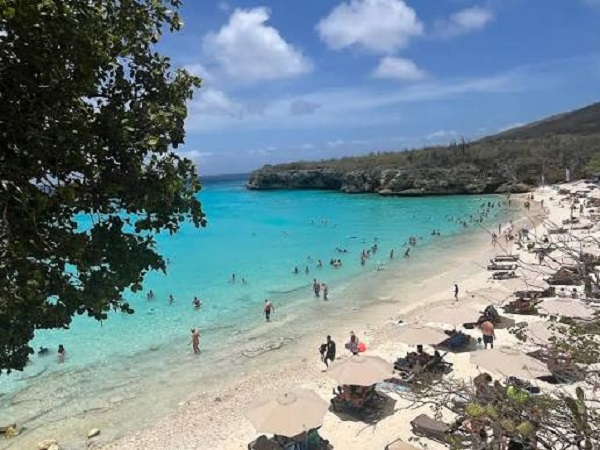
The MAN-PIN faction in Parliament has evaluated the current situation of Curaçao’s beaches and coastline. The evaluation shows that, (1) alongside beaches accessible via public roads, (2) many parts of our coastline and beaches remain surrounded by private land—a legacy rooted in the colonial period of the WIC.
Of the beaches accessible via public roads, many lack real accessibility for a large segment of our community. This occurs when lounge chairs, umbrellas, and commercial setups are positioned on the beach in such a way that hardly any space remains for people bringing their own towels and coolers.
For beaches that require crossing private land to access, visitors are often required to pay an entrance fee, or are simply denied passage under any condition.
This situation creates a barrier for the community and restricts the fundamental right to enjoy our natural heritage: our beaches and coastline.
Categorization of beaches
To protect our beaches and coastline, the MAN-PIN faction proposes categorizing all beaches into 5 groups:
*Natural Beach: Priority: nature, protection of flora and fauna. No commercial activity, except for traditional fishing.
*Tranquil Beach: Priority: quiet and peaceful public recreation. Highly limited commercial activity (e.g., restroom facilities).
*Recreational Beach: Priority: public recreation and opportunities for local entrepreneurs. Permits and conditions must be clearly defined.
*Tourist Beach: Greater opportunities for commercial activity, but always within the beach’s carrying capacity, with a defined maximum limit of visitors.
*Balanced Multifunctional Beach: A combination of fishing (fishermen’s beach), recreation, tourism, and local entrepreneurship.
Proposals to improve public access
To establish a fair and sustainable system, the MAN-PIN faction proposes, among other measures:
*Trails and monitoring: The Minister of VVRP must identify access paths and prevent illegal blockades to the coast and beaches.
*Purchase of private land: The government should acquire portions of private land to create public access to beaches.
*Introduction of “publieke erfdienstbaarheid” (public easement): A legal mechanism to guarantee that the public can pass over private land to reach the beach without obstacles. MAN-PIN will soon submit an initiative bill to enable this mechanism.
Role of government
In its evaluation, the MAN-PIN faction established that the Minister of GMN must manage environmental and nature policies; the Minister of VVRP must handle construction management on land and sea; and the Minister of MEO must manage commercial activity through a balanced vendor policy (“standplaatsenbeleid”), rather than the model presented, which commercializes all beaches without regard for nature, the environment, or construction regulations. The policy introduced by Minister Middelhof fails to safeguard authenticity, nature, or real public accessibility to our beaches, while ignoring the authority of ministerial colleagues.
Conclusion and public call
The MAN-PIN faction emphasizes that Curaçao must move forward with a clear policy to establish and protect public access to beaches, remove unnecessary barriers, and ensure that everyone can enjoy our coastline.
We invite the community, non-governmental organizations (NGOs), and the private sector to participate in this dialogue to reach a sustainable solution for our coastline and beaches.