

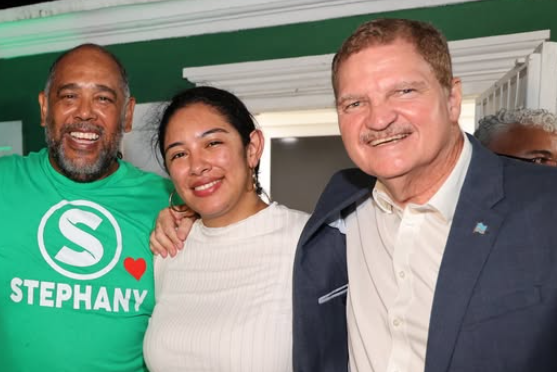
After the Supreme Court (Hoge Raad) handed down the final verdict in the Avestruz case, the political landscape in Aruba has entered a phase of high tension. While the AVP faction asks for “privacy” for their parliamentary colleague Stephany Sevinger, internal sources indicate that the daughter of the convicted former minister is exerting strong pressure to secure a pardon for her father, Benny Sevinger.
The Supreme Court’s decision dealt a heavy blow to the “green party,” confirming the conviction of one of its most influential figures of the last decades. However, the fight has not ended there. According to circulating information, there is a legal window of 9 days in which those convicted—Benny Sevinger, Leoncita Arends, and Pieter Susebeek—can submit a petition for a pardon to avoid entering prison.
Pressure in the heart of AVP Beyond official communiqués, tension within the AVP is evident. Stephany Sevinger, who now holds a seat in Parliament, is in a key position to apply internal pressure. The main argument is based on the loyalty Benny Sevinger demonstrated over many years, serving as an electoral engine and helping the party grow through the same foundation that is now the basis of his conviction.
In political circles, many question the origin of the “orders” given at that time. There is a feeling that many involved in the case were more tied to the friendship of the former Prime Minister (and current Prime Minister once again) Mike Eman than they were to Sevinger himself, raising uncomfortable questions about who should bear the ultimate responsibility.
AVP faction requests privacy Through an official statement, the AVP faction reacted to the sentence, attempting to maintain a posture of respect for the Rule of Law while focusing their empathy on the daughter: “The AVP faction has taken note of the sentence in the Avestruz case. We express our sincere empathy and support to our colleague Stephany Sevinger and her family. We respect her privacy and dignity during these moments.”
Additionally, the party took the opportunity to ask judicial authorities to accelerate other cases of alleged corruption that are still pending—a move many see as an attempt to deflect attention from the reality that two former AVP ministers must now serve their sentences.
The “Legal Door” of Pardon Before pursuing the path of a pardon, an attempt was made via the “Enkelband” (electronic monitoring) route, but this is a relatively new and difficult process. Therefore, the path of Pardon was chosen, which is currently putting significant pressure on Minister Arthur Dowers.
A petition for a pardon is processed by the Minister of Justice. A pardon is an extraordinary instrument that can reduce, change, or completely eliminate a sentence. This situation places an enormous weight on the political dimension. The community is watching with great skepticism, interpreting this move as a desperate attempt by the convicts to “get away” with their actions. The fundamental question remains: will there be the political will to set aside a decision from the highest court?
Meanwhile, the largest corruption novel of recent years in Aruba enters its final chapter, where the line between family loyalty, political pressure, and justice is becoming increasingly thin.