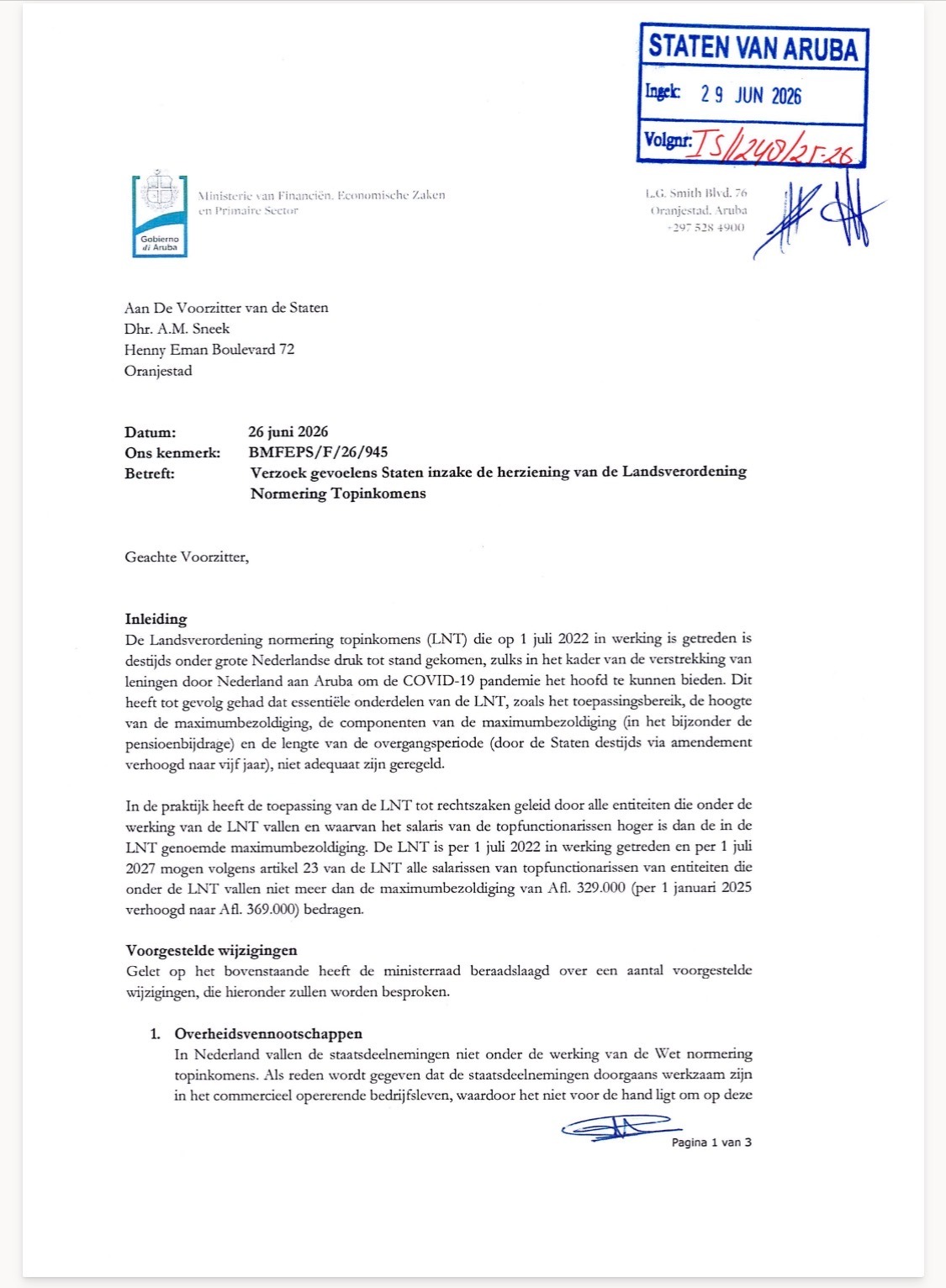
Minister Wever is proposing four major changes to the LNT (Top Incomes Standardization Act). The main question is: who will control top salaries afterward, according to what standard, and how will Parliament and the public be able to verify this?
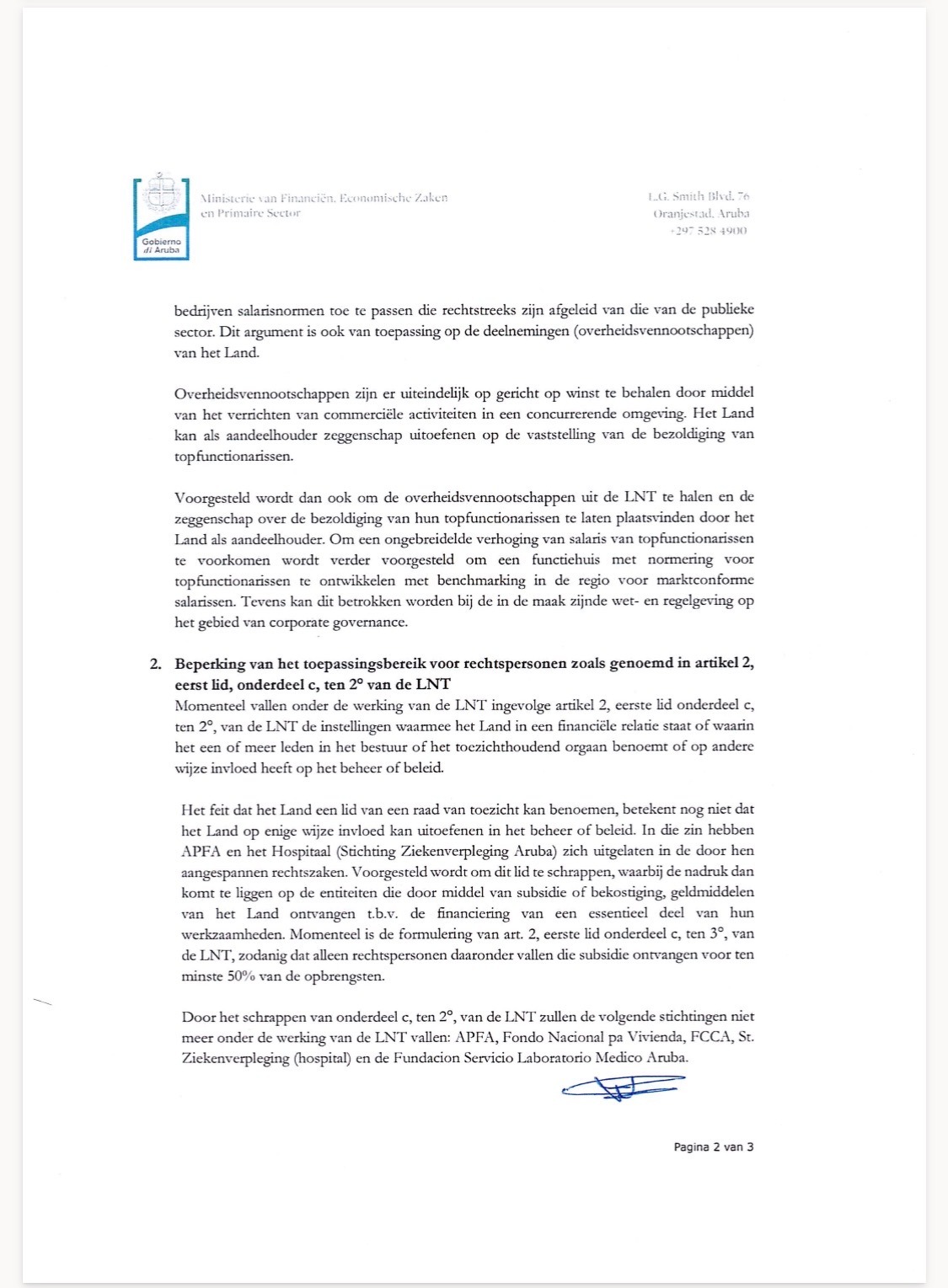
1. Removing government-owned companies from the LNT
The Minister states that these companies operate commercially and that the Government, as shareholder, can control the remuneration of their top executives.
However, if they are removed from the LNT, the statutory limit will disappear. Control will shift to decisions made by the Government as a shareholder. This could mean that each administration applies its own criteria. Furthermore, not all government-owned companies operate in free competition; some hold exclusive positions or provide essential public services.
The Minister must present:
A list of all companies to be removed.
Which ones truly operate in a competitive market.
Their current remuneration compared to the LNT limit.
The system that will replace legal control.
How Parliament and the public will be able to oversee salary decisions.
2. Removing various public entities from the LNT
The Minister proposes removing Article 2, paragraph 1, sub c, item 2°. Consequently, APFA, FCCA, National Housing Foundation, the Hospital, and the Medical Laboratory would fall outside the scope of the LNT.
These entities manage pensions, social housing, medical care, and other vital public interests. If removed from the LNT, their top officials will no longer be bound by salary caps under this provision.
The Government must explain:
Whether only these five entities or others will be removed.
The individual rationale for removing each entity.
What public funds each entity receives or manages.
The financial consequences.
What safeguards will prevent uncapped salary increases without public oversight.
The question is: if an entity manages public funds or public services, is it responsible to remove the salary standard without specifying what oversight mechanism will replace it?
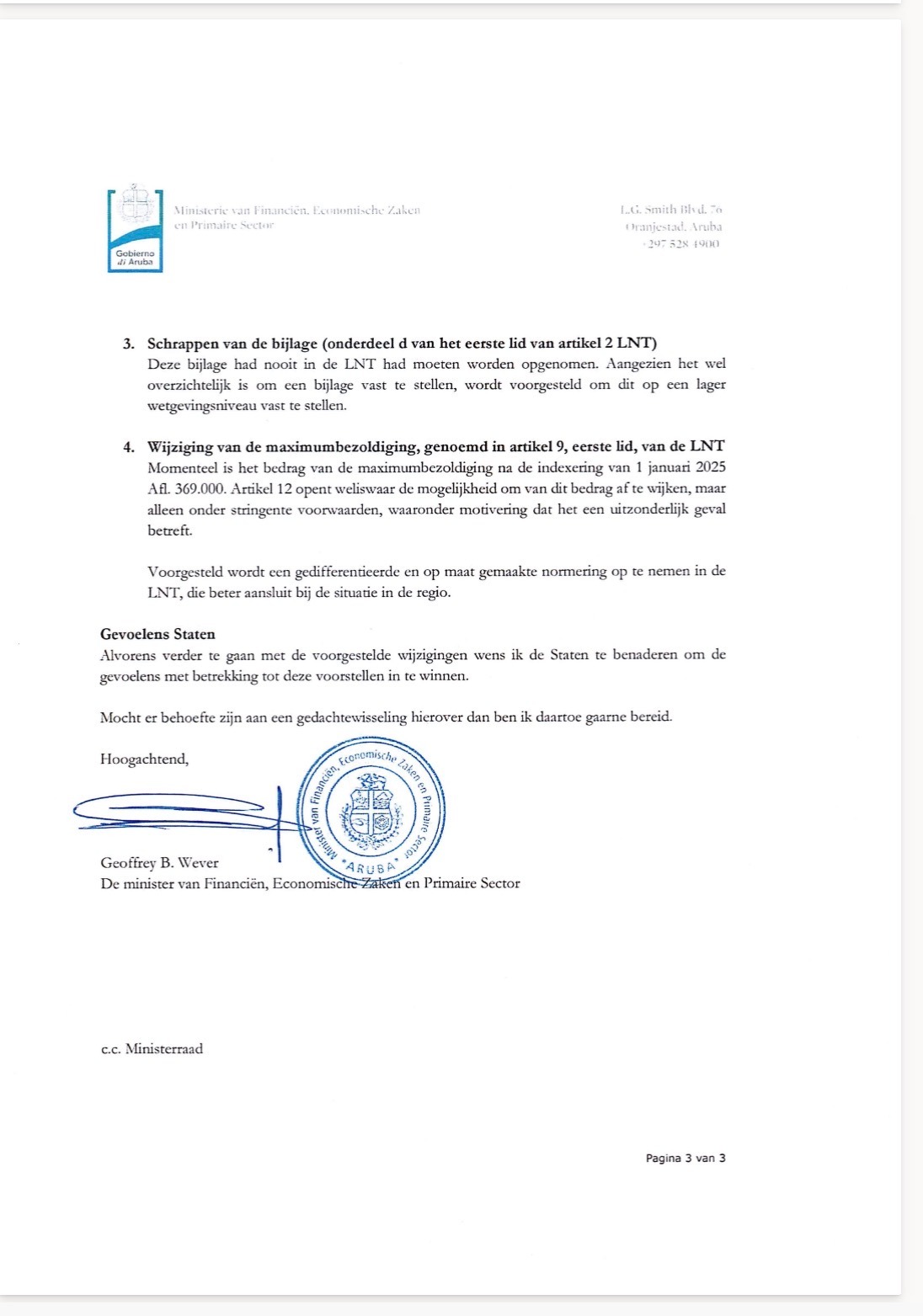
3. Removing the schedule (bijlage) from formal law
Currently, the LNT schedule forms part of the formal law and can only be amended with Parliamentary approval. The Minister wants to move the list to a lower legislative level.
While this change might make the system more flexible, it could also diminish democratic oversight. The Government would be able to add or remove entities more easily, without full debate and potentially without prior Parliamentary approval.
The Minister must explain:
At what legislative level the list will be regulated.
Who will be authorized to amend the list.
What criteria will determine whether an entity is added or removed.
What role Parliament will retain.
How the Government will prevent political or insufficiently justified decisions.
Greater flexibility must not mean less transparency or reduced oversight.
4. Replacing the general maximum threshold
Currently, the LNT establishes a general cap of Afl. 369,000. The Minister aims to replace this with differentiated caps tailored to specific roles, sectors, and regional standards.
A differentiated system can account for job responsibilities and professional shortages. However, without clear criteria, it risks creating inequality, broad exceptions, and salary inflation. If almost every role receives its own custom benchmark, the LNT could lose its function as an effective ceiling.
Parliament must be informed of:
Concrete amounts and categories.
The benchmark countries and institutions used for comparison.
The methodology used to calculate each cap.
The number of top officials who will receive a higher cap.
The additional cost to the public sector.
Why Article 12, which already allows for exceptions, is insufficient.
What will be left of the LNT?
The Government intends to remove companies and entities from the LNT, shift the list to a lower legislative tier, and replace the general salary cap with differentiated standards.
However, the Government has not yet presented the framework that will replace current controls. Without clarity on who remains subject to the LNT, which caps apply, who can alter the rules, and how Parliament can exercise oversight, Parliament cannot form a responsible opinion.