

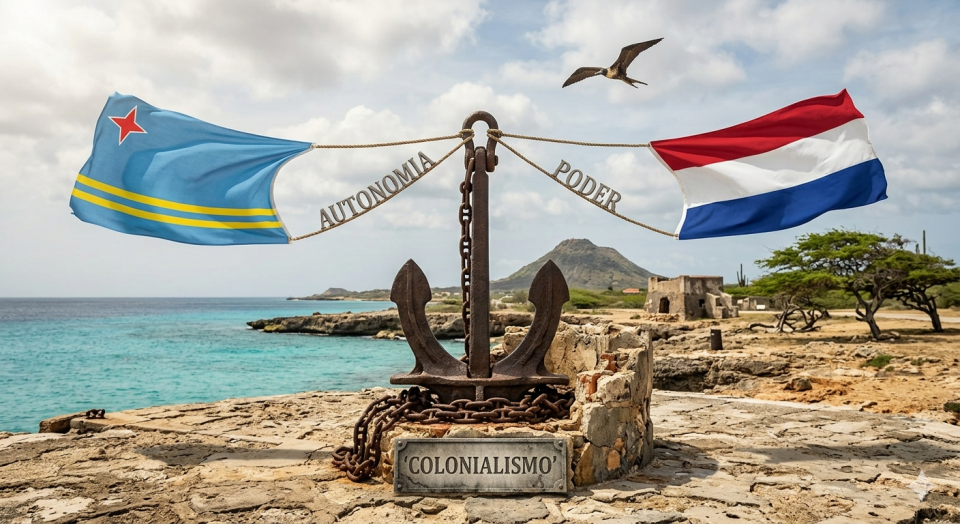
The presentation of the HOFA Kingdom Law (Houdbare Overheidsfinanciën Aruba) is not merely a name change for what we previously knew as the LAft. It represents a fundamental shift in the island’s legal foundation, where financial supervision is now anchored within the highest tier of law in the Kingdom. This “anchoring” creates a structure that, in practice, is impossible for Aruba to dismantle without explicit permission from the Netherlands.
While previous laws and protocols were more temporary or renegotiable in nature, HOFA seeks to institutionalize financial control within the Charter for the Kingdom (Statuut). This has profound implications for the balance of power between Oranjestad and The Hague.
The Hierarchy of Power: Loss of Legislative Control The most significant point regarding Aruba’s autonomy is the legal rank of this supervision. Unlike a local law (Landsverordening), which can be amended or abolished by a majority in the Parliament of Aruba, a Kingdom Law (Rijkswet) is a superior rank of law. This means that even if all 21 members of the Parliament of Aruba vote unanimously to end the supervision, they no longer have the legal power to do so if the Kingdom Law passes. The key to “unlocking” this supervision remains in the hands of the Dutch Parliament and the Kingdom Council of Ministers (RMR).
The Voting Power of The Hague By embedding it in a Kingdom Law, supervision becomes a “Kingdom affair.” For this to be eliminated in the future, a new Kingdom Law would be required to revoke HOFA. In this process:
- The Netherlands holds the absolute majority: In the Kingdom Council of Ministers, the Dutch vote carries the deciding weight.
- Aruba has a voice, but no vote: The Minister Plenipotentiary of Aruba can offer an opinion, but cannot block a decision made by the Dutch majority. In this scenario, financial supervision becomes a permanent condition until the Netherlands decides Aruba is “ready” to govern its own finances independently again.
Tied to the Charter: A Point of No Return? The document mentions that the basis for this supervision is being placed within the Charter for the Kingdom, the supreme constitution of the four countries. This formalizes the idea that sound finances in Aruba are no longer a purely internal matter, but a shared responsibility where the Kingdom plays the role of structural watchdog. This weakens the negotiating position of any future Aruban Government. When a rule is in the Charter, you cannot easily renegotiate it every time there is a crisis; it becomes the “golden norm” that dictates what Aruba can and cannot spend.
Conclusion: Autonomy Under Condition For journalism and political analysis, this point is the core of the debate: Is this a protection for the citizen against financial mismanagement, or is it a legal prison for the island’s autonomy? The HOFA Kingdom Law means that the “brake” on Aruba’s economy has been installed with a security system that Aruba itself cannot remove. For future generations of politicians, the freedom to move within the budget will remain limited by a law drafted in August 2025, but which possesses a legal lifespan that could last decades far beyond the reach of the Aruban voter.