

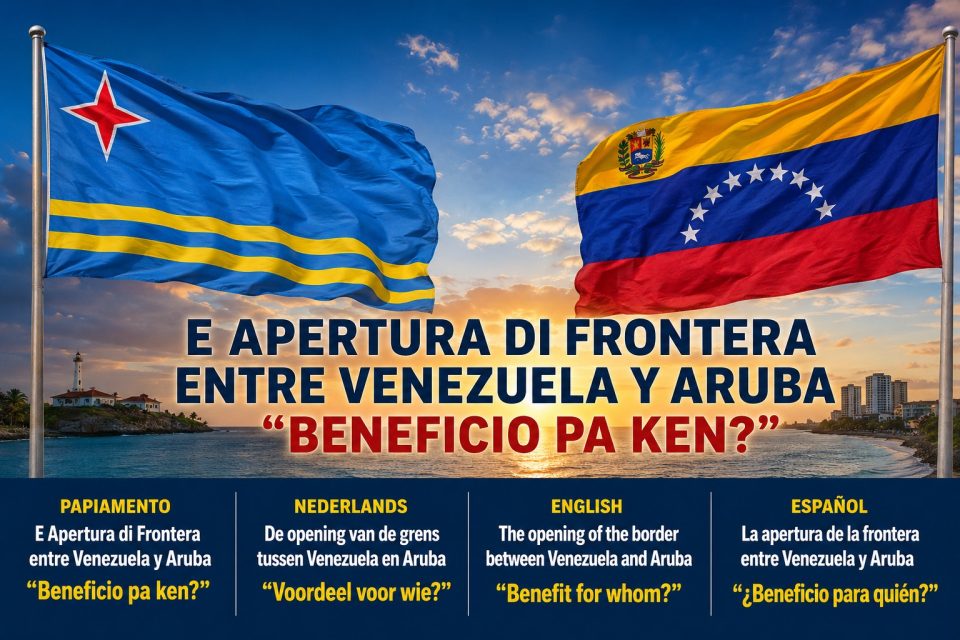
The geopolitical and economic relationship between Aruba and Venezuela has always been close, but at the same time caught in the hurricane of tension, structural challenges, and security requirements. The discussion about opening the border is not simply about trade exchanges or air connections; it touches the sensitive fiber of our country’s sustainability, our island’s vulnerability, and the supreme responsibility of leaders to protect the well-being of the people of Aruba.
When analyzing whether this decision is truly for the benefit of Aruba or Venezuela, it is imperative to look at the realities without the veil of political romanticism.
Benefit for whom? Aruba or Venezuela, can Aruba keep carrying this? The fundamental question is: who truly profits from this opening?
Venezuela’s perspective: For Venezuela, opening the border represents crucial economic oxygen. The country faces a deep crisis, severe inflation, and a lack of markets to export basic necessity products. Aruba functions as a logistical relief channel and a source of foreign currency for the Venezuelan economy. Is the border desired to be opened for this? What would the benefit be for Aruba?
Aruba’s perspective: The pro-opening argument revolves around certain products and the resumption of small-scale trade. However, for a small island like Aruba with limited carrying capacity, the uncontrolled influx of human flow and pressure on infrastructure impose enormous challenges on what Aruba already has. The balance tilts forcefully in favor of the pressures that Venezuela projects onto our island, while the economic gain for Aruba is marginal and unbalanced.
Venezuela’s challenges and structural problems for Aruba The Venezuelan crisis is not temporary; it is structural. To understand the danger lurking over Aruba, the following factors must be considered:
• Pressure on the healthcare and education system: A continuous influx of migrants and visitors burdens clinics, the hospital (IMSAN and Horacio Oduber Hospital), and schools, which are already operating at maximum capacity.
• National security and criminality: The social crisis in Venezuela facilitates the profile of organized crime, drug trafficking, firearms, and human trafficking. Open borders without rigorous control open the door to criminal elements who can easily infiltrate the island by sea or air. Is this good for Aruba?
• Informal sector and pressure on the labor market: Unfair competition in the construction and service sectors depresses local wages and increases the informal economy, which weakens the protection of the local worker. Is this what we want for Aruba?
How vulnerable is Aruba? Aruba is an island microstate with limited natural resources, particularly water, energy, and physical space.
• Carrying capacity: Our waste infrastructure, water supply (WEB), and electricity (NV Elmar) are designed for a specific population. Every extra inhabitant means additional pressure on the island’s fragile ecosystem. Opening the border with Aruba means more pressure and basically nothing is in order at home; Aruba itself is not empowering its system, but rather the AVP-FUTURO government shows the poor management that exists and the management of breaking Aruba that is illustrated every day.
• Fiscal sustainability: Our public finances are emerging from a heavy post-pandemic crisis period. Additional burdens on social spending, emergency medical care, and security put the national budget under severe pressure. The hospital still has unpaid debt from illegals; now, opening the border, what will happen with the debt of the next ones who might enter due to opening the border with Venezuela?
The uncomfortable question: Peace and tranquility or calculated risk? It is entirely legitimate to question whether opening the border contributes to the peace and tranquility of Aruba. A country cannot feel tranquil when it bears the weight of a regional crisis while its own infrastructure is fractured.
Aruba cannot continue carrying the structural problems of another country without first fixing its own house. When solutions come from the outside and leaders keep looking for approval or guidance abroad instead of leading with their own vision.
The role of governance and current political reality The current situation calls into question the responsibility of the ruling class. Citizens ask themselves: Do these politicians really love the country of Aruba? Does the AVP-FUTURO government really see the benefit for Aruba?
When measures are taken without a transparent management plan, without protecting the primordial interest of the local citizen, and without showing firm leadership in the face of major challenges that have arisen since the current coalition took power, trust in governance erodes.
A basic leader is not one who opens doors to please external interests, but one who puts the well-being, security, and future of the people of Aruba above everything else. It is time for a deep reflection regarding what the price of sovereignty and sustainable development is for our island.