

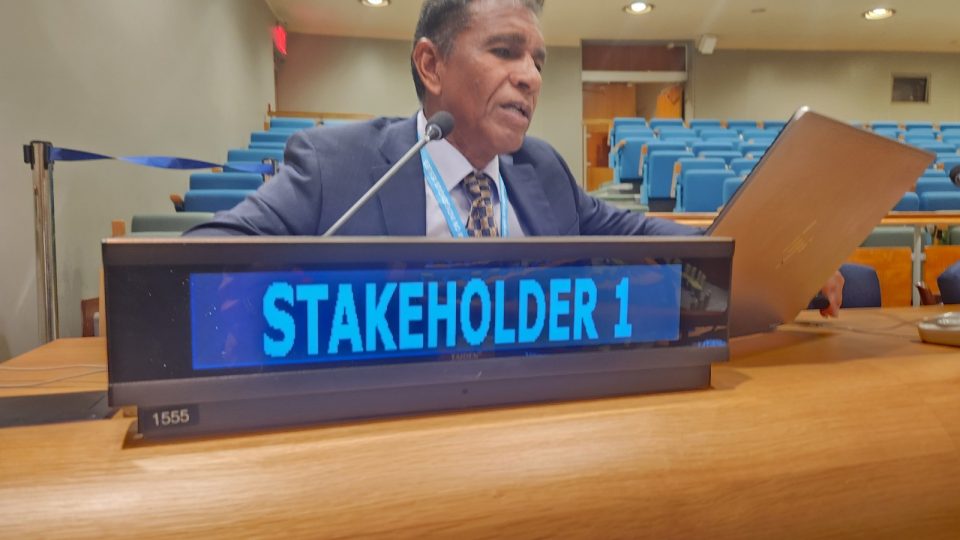
James Finies announces to the people of Bonaire that, in recognition of the 1863 abolition of slavery in the colonized Antillean islands of the Caribbean, the Bonaire Draft Resolution—sponsored by two Caribbean CARICOM nations—was formally submitted and registered into the administrative process of the 80th United Nations General Assembly on June 10, 2026, for consideration.
Since 1955, when the Netherlands removed Bonaire and the former islands of the Netherlands Antilles from the United Nations list of Non-Self-Governing Territories (NSGT), this marks the most significant constitutional step taken regarding the colonized Dutch islands in the Caribbean.
The Bonaire Draft Resolution, which has entered the processing pipeline of this 80th General Assembly, urges the recognition of Bonaire as a Non-Self-Governing Territory under the UN Charter. It declares that under Article 73 of the Charter, the Kingdom of the Netherlands, as the Administering Power of the Territory of Bonaire, has an obligation to transmit information regarding the island. It also requests the Special Committee on Decolonization to consider the “Question of Bonaire” at its next session and to report on it to the General Assembly during its eighty-first session. The draft proposal has been registered into the system by the UN General Assembly Secretariat, granting worldwide access—including to all 192 UN Member States—via the e-Delegate system.
What does this mean for Bonaire?
Being back on the list means that the Netherlands will have to be accountable and report to the UN General Assembly regarding the social, economic, cultural, political, and educational development of the native Bonairean people, in accordance with the UN Charter and the treaties the Netherlands accepted and signed in 1945. This has happened only three times in world history: New Caledonia in 1986, French Polynesia in 2013, and now, for the first time in this part of the world, with Bonaire in June 2026.
How did this happen?
2003 – 2010: James Finies publicly raised his voice and opposed the divisive and polarizing direction chosen by politicians in Bonaire and the Netherlands Antilles.
2010 – 2016: Finies abandoned his career and life as a commercial banker to become a full-time, volunteer human rights defender in Bonaire and across the Antilles, fighting for a referendum and the right to self-determination.
2016 – 2026: After the outcome of the 2015 Bonaire referendum was ignored, Finies embarked on an international journey of continuous awareness-raising and lobbying missions across the Caribbean, Central and Latin America, Europe, and the United Nations in Geneva and New York, fighting for the re-listing of Bonaire under UN protection.
The rights defense group led by Mr. Finies is the only civil society organization that, consistently and continuously from 2003 up to the present day in 2026, has worked to demonstrate and justify the need for international community intervention in Bonaire and the Dutch Caribbean islands.
Why Bonaire?
The people of Bonaire were left unprotected and abandoned by the “CAS” islands when Curaçao, Aruba, and Sint Maarten, together with the Netherlands following the dissolution of the Netherlands Antilles in 2010, unilaterally removed Bonaire from the protection of the Kingdom Charter (Statuut). The people of Bonaire were incorporated, against their wishes and without their consent, into the Dutch Constitution, subordinated and placed at the mercy of an external government from The Hague.
Unlike Curaçao, Aruba, Sint Maarten, Saba, and Sint Eustatius, Bonaire’s situation has since developed into a major, silent humanitarian crisis. Bonaire is in a critical state, facing immediate demographic and cultural erasure. Native Bonaireans, who according to CBS figures represented more than 70% of the population before 2010, have been systematically reduced by institutionalized policies to less than 30% today. Projections indicate that in less than ten years, by 2035, they will represent less than 15% of the population. Fortunately, Bonaire has a large diaspora within the Dutch Kingdom. Even so, Bonaireans face the danger of disappearing on their own island in the coming decades if the world and the international community do not intervene to protect the Bonairean people.