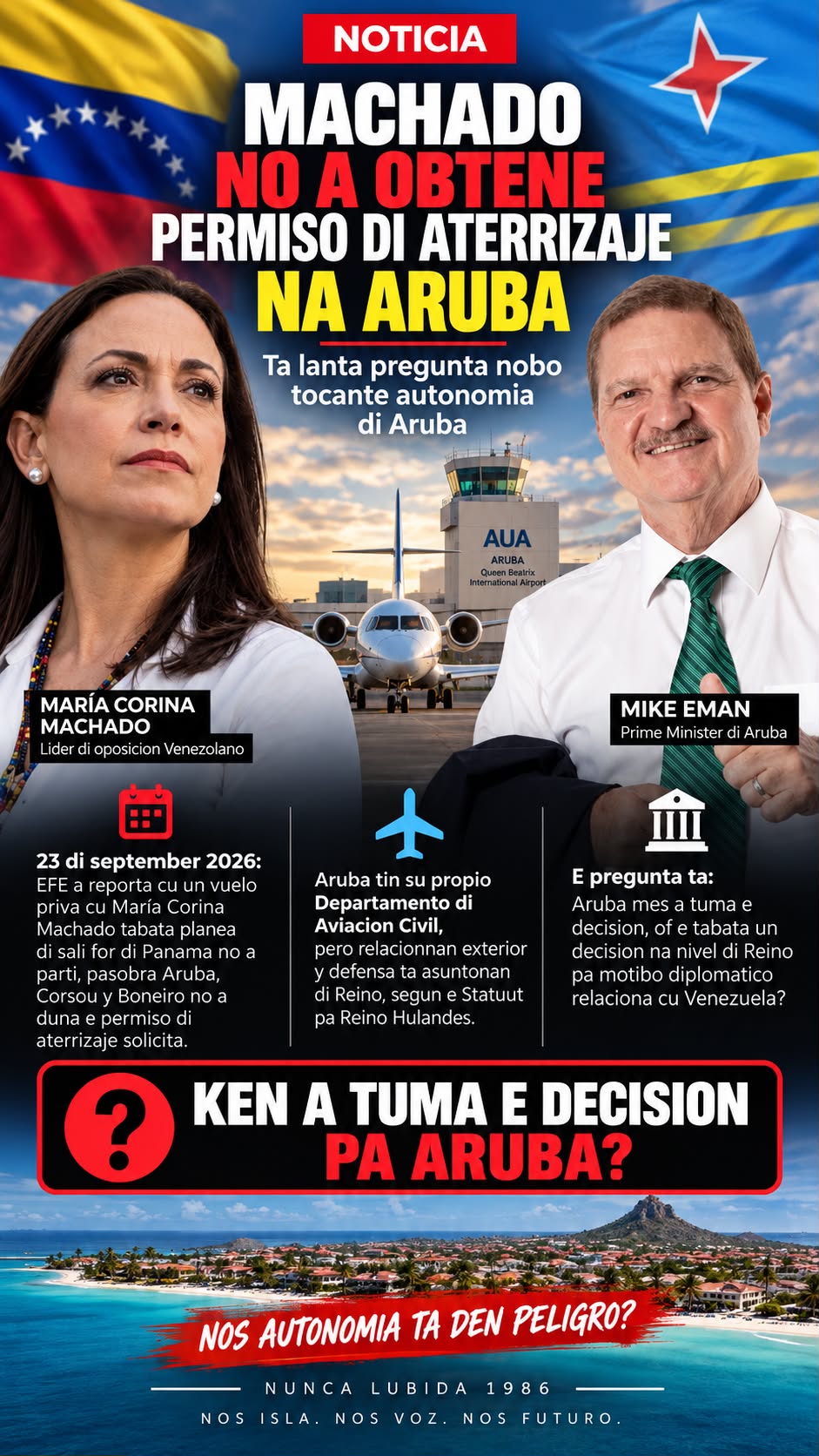
The reported refusal to allow a private flight connected to Venezuelan opposition leader María Corina Machado to land in Aruba has opened a much larger discussion for our island: who actually made the decision, and how much control does Aruba still exercise over matters affecting its own territory?
On September 23, 2026, EFE reported that a private flight intended to carry Machado from Panama as part of an attempt to return to Venezuela did not depart because Aruba, Curaçao, and Bonaire did not grant the requested landing permission. A person familiar with the operation told EFE that the three islands were being considered as potential transit points.
Separately, Reuters confirmed that Machado made several unsuccessful attempts to return to Venezuela. However, its reporting did not establish which specific authority was responsible for blocking each attempted route.
This brings Aruba directly into an important constitutional discussion.
Aruba has its own Civil Aviation Department, established when Aruba obtained its autonomous status within the Kingdom in 1986. In ordinary civil aviation matters, Aruba therefore possesses its own institutions and responsibilities.
At the same time, the Kingdom’s constitutional structure is complex. Article 3 of the Charter for the Kingdom of the Netherlands establishes that foreign relations and defense are Kingdom affairs. The Dutch Government also indicates that foreign policy for the Kingdom as a whole is a Kingdom responsibility, while Aruba retains responsibility for many of its own internal affairs.
This leaves the central question unanswered: Did Aruba itself reject Machado’s landing request, or was the decision influenced or determined at the Kingdom level due to diplomatic implications related to Venezuela?
To date, this has not been publicly established. And that distinction matters.
The Charter itself recognizes that when foreign relations specifically affect Aruba’s interests, or when a decision could have significant consequences for those interests, Aruba is considered directly affected by the matter.
Therefore, the issue goes far beyond María Corina Machado. It is about Aruba’s autonomy, accountability, and our voice within the Kingdom.
For critics of the current Mike Eman government, this incident adds to an existing political debate over whether Aruba is sufficiently safeguarding the autonomy it built over decades. This is a political interpretation, not something proven by the reports. What the reports do establish is that Aruba was among the destinations that did not grant the requested landing permit, while the public still lacks clarity on exactly who made the decision and why.
This lack of clarity deserves an answer.
If the Government of Aruba independently decided to reject the landing request, then the government itself must explain the legal basis for the decision.
If it was a decision made at the Kingdom level, then the Government of Aruba must explain what role Aruba played, whether Aruba was consulted, and whether the Government of Aruba agreed with the decision.
And if Aruba was simply informed of a decision made elsewhere, that would raise a much more serious constitutional discussion about how Aruba’s autonomy functions in practice.
Never forget what Aruba achieved in 1986
This is also why Aruba must never forget the significance of January 1, 1986, when Aruba obtained its Status Aparte within the Kingdom and ceased to be part of the Netherlands Antilles. That achievement was not merely symbolic; it meant that Aruba would have its own government, its own Parliament, and responsibility for its own affairs within the broader constitutional framework of the Kingdom.
For generations of Arubans, autonomy has represented the principle that decisions regarding Aruba should not simply be made elsewhere without Aruba having a meaningful voice.
That is why incidents like this warrant investigation and transparency. It is entirely legitimate for Arubans to ask whether today’s political institutions and leaders are protecting the constitutional standing that previous generations worked to establish.
The political question for the Eman Government is simple: What happened with Machado’s flight, who made the decision, and what role did Aruba itself play in it?
The public should not be left guessing. Aruba’s autonomy should not be merely a ceremonial phrase repeated during national holidays. It only holds value when Aruba participates meaningfully in decisions affecting our island, and when our elected government can explain and defend those decisions before the Aruban people.
Regardless of what one thinks of María Corina Machado or Venezuelan politics, this matter is bigger than a single individual. It concerns the relationship between Aruba and the Kingdom, the accountability of our own government, and the constitutional legacy established in 1986.
Never forget what previous generations achieved for Aruba. Autonomy must be understood, exercised, and protected; and when major decisions affecting our island are taken, the people of Aruba deserve to know who made them.
Besides everything else, María Corina Machado is not a diplomatic figure to be treated as such; she is a human being like any other who wishes to return to her country. The question remains: why is she being treated as though she were a diplomatic person?