

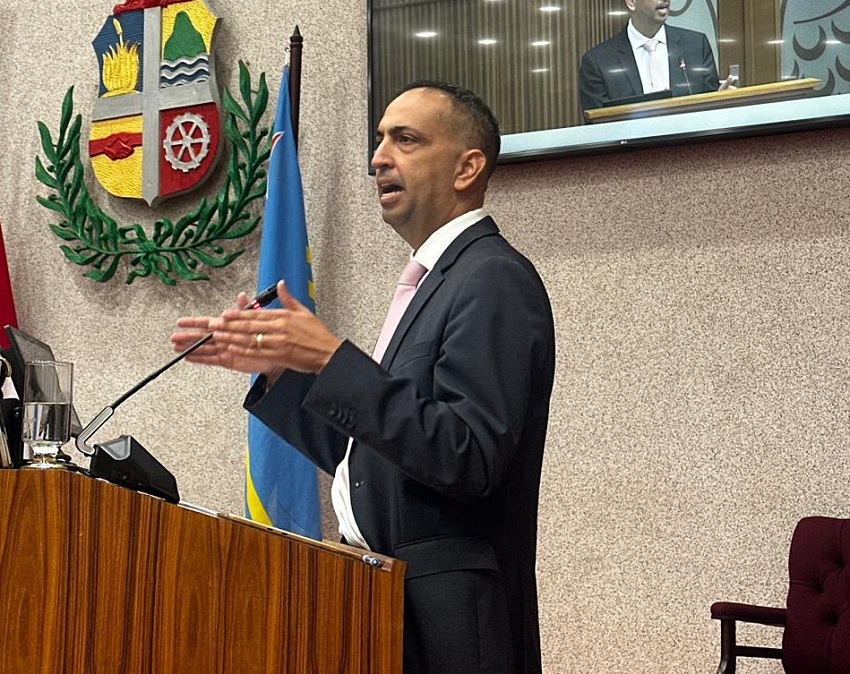
During a parliamentary meeting on amendments to the Top Incomes Standardization Act (Landsverordening Normering Topinkomens – LNT), Member of Parliament Dangui Oduber strongly challenged Minister Geoffrey Wever and the Government regarding the management of exemptions under this law. The MP emphasized the stark contrast between the preferential treatment granted to the CEO of the Aruba Airport Authority (AAA) and the approach currently proposed for local professionals.
Government’s double standard between local and foreign professionals According to Oduber, the Minister appeared in Parliament yesterday to gauge the sentiment (gevoelens) regarding LNT changes targeted at local professionals, questioning where that same sense of urgency and attention was when the Government made its decision regarding the Schiphol-appointed CEO at the Aruba Airport Authority (AAA) in November 2025. He noted that in that instance, neither parliamentary approval nor stance was requested beforehand; instead, a salary of 1.2 million florins was granted, while regrettably excluding any other local professional at AAA from eligibility for a similar exemption.
Furthermore, the MP stressed that Parliament only became aware of the November 2025 National Decree (Landsbesluit) through an official publication, questioning why such a significant matter was not brought before Parliament first. He stated: “For a professional from abroad, the Government was able to act and deviate from the LNT law, but now that it concerns local professionals, the Minister wants to know what Parliament thinks first. It is clear how the Government treats its own people.”
Actions speak louder than words According to Oduber, the Government must clearly explain the criteria used to determine who receives an exemption under the LNT and who does not, questioning why the proposal before Parliament fails to provide ATA and IMSAN with the flexibility required by their specialized mandates: “Who decides who qualifies and who doesn’t? What are the criteria? Why not ATA? Why not IMSAN? These decisions cannot be based on arbitrary choices. There must be objective, transparent, and defensible criteria.”
For the MP, these two institutions in particular warrant deep analysis, as ATA must operate within a competitive international tourism market, while IMSAN needs the ability to attract and retain specialized medical professionals. Oduber emphasized: “We can establish standards and controls, but we cannot build a system that ultimately restricts our own institutions from competing for talent. The Minister must demonstrate that the decision to exclude ATA and IMSAN will not jeopardize their operational capacity.”
Other major decisions also require transparency Oduber drew a parallel between this situation and his previous criticism of the Kingdom Law HOFA (Rijkswet HOFA) process: “The Minister said yesterday that he needs to come to Parliament first to hear sentiments on the LNT issue. However, the same principle of parliamentary involvement must apply when dealing with other major decisions that directly impact Aruba’s autonomy and financial future.”
According to the MP, the Government cannot apply parliamentary participation only when it is convenient. Democratic rules must remain consistent; Parliament’s role and involvement cannot be valued and consulted in one instance and ignored in another.
“Transparency is not something you apply depending on who is standing in front of you. If we want a credible system, the same rules, transparency, and accountability must apply to everyone,” Oduber concluded.
Being Aruban should not work against you in your own home The contrast is clear: the Government facilitates legal exemptions for an overseas CEO at AAA to earn 1.2 million florins without seeking Parliament’s input, while refusing to make the necessary adjustments for our own local professionals. Such a policy is a clear demonstration of a Government that mistreats, disrespects, and discriminates against its own people.