

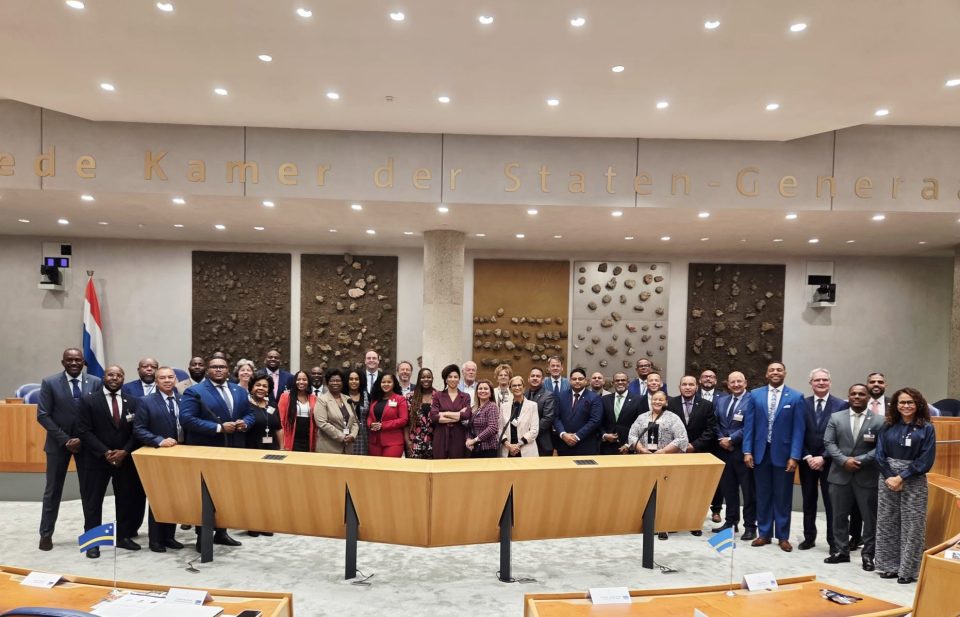
The recent Interparliamentary Kingdom Consultation (Interparlementair Koninkrijksoverleg – IPKO), held from June 5 to 8, 2026, in The Hague, marked a significant turning point in parliamentary relations between the Netherlands, Aruba, Curaçao, and Sint Maarten. With the introduction of a new format focused on a central theme and a formal-informal dialogue with the Kingdom Government, the delegations sought a closer way to structure their cooperation. However, behind the facade of institutional optimism, the debates exposed the inherent tensions of the so-called “democratisch tekort” (democratic deficit), imbalances in data protection legislation, and deep diplomatic distrust caused by the Netherlands’ unilateral decision to abstain from voting on the United Nations declaration regarding slavery.
A New Format for Real Impact
This IPKO served as a testing ground based on proposals by the President of the Parliament of Sint Maarten, Mrs. Sarah Wescot-Williams. Her report, titled “IPKO: Samenwerken aan zichtbare resultaten die tellen” (Cooperation for visible results that count), was adopted as the primary guide for future meetings. The central goal of these怎样 reforms is to give topics more substance and prevent conversations from remaining purely deliberative without concrete results.
As part of this innovation, the delegations utilized interactive methods to work on the central theme: “Cooperation within the Kingdom and in IPKO.” One of the most notable innovations was the informal conversation with the State Secretary for Kingdom Relations and Digital Government, Mr. Eric van der Burg. Although constitutionally the State Secretary does not have a formal relationship with IPKO, his presence paved the way for a direct exchange on what is structurally necessary to elevate mutual trust. Van der Burg committed to presenting a request to the governments of Aruba, Curaçao, and Sint Maarten to involve parliamentarians in the upcoming Kingdom Conference.
The Political-Technical Challenge of Basic Data Protection
One of the weightiest points on the agenda was the analysis of personal data protection, a prerequisite for proper cooperation in the areas of national security and the exchange of crucial information. The evaluation showed that while all four countries have existing laws on this matter, the legal frameworks vary greatly among them, creating an unbalanced level of protection.
Aruba’s Minister of Justice and Social Affairs, Mr. Arthur L. Dowers, along with his counterparts from the other countries, foresaw the need to harmonize these regulations—possibly through a consensus Kingdom Act (consensusrijkswet)—to comply with the standards of the Council of Europe’s Convention 108+. To structurally prevent a stagnation in organic information flows, IPKO unanimously decided to send a formal letter containing four key questions to the Kingdom Government to clarify whether information flows (especially regarding security) would be adversely affected or limited in the future.
Democratic Deficit and the Scars of the Colonial Past
The IPKO was also confronted with historical tensions that still define structural relations within the Kingdom. The Expert Group on the Democratic Deficit in the Kingdom (Deskundigengroep Democratisch tekort in het Koninkrijk) — composed of Dr. Rachnilda Arduin (Sint Maarten), Mr. Johan Sjiem Fat (Aruba), Prof. Dr. Leonard Besselink (Netherlands), and Mr. Dr. Aubrich Bakhuys (Curaçao) — presented an overview of the status of their work and how they will use the remaining time to submit their final formal report.
The cultural and political tension became more evident when discussing the sub-theme of prejudice and image-forming derived from the shared colonial past. During the sessions, a lack of mutual trust at the political level came to light. The delegations agreed to request their respective parliamentary committees to continue this dialogue in order to break stigmas and strengthen mutual respect.
Voting Abstention on Slavery: A Diplomatic Blow
One of the most tense moments during the IPKO was the presentation of a resolution by the Caribbean countries (Aruba, Curaçao, and Sint Maarten) during their tripartite meeting. This resolution refers to a United Nations decision in March of this year, which officially declared the transatlantic slave trade as “the most serious crime against humanity” in history. While two-thirds of the UN member states voted in favor, the Kingdom of the Netherlands decided to abstain from voting, alongside 51 other nations.
What caused serious outrage among the delegations of Aruba, Curaçao, and Sint Maarten was the fact that the governments of these three Caribbean countries were not consulted in advance (vooraf) by the Netherlands before this diplomatic decision was made on behalf of the entire Kingdom. For the islands, this lack of consultation represents a vivid example of the democratic deficit and the lack of equity in the management of foreign affairs.
Conclusion and the Next Venue
The June 2026 IPKO ratified that to achieve truly structural cooperation within the Kingdom, it is necessary to overcome not only legal and technical differences, but also cultural and historical ones. The signing of the structural agreement list was sealed by the delegation leaders: Mr. Alfred M. Sneek (Aruba), Mr. Fergino H.E. Brownbill (Curaçao), Mrs. Sarah A. Wescot-Williams (Sint Maarten), and Mr. Peter Nicolaï (Netherlands).
The horizon is now set on Sint Maarten, where the next IPKO will take place from January 13 to 15, 2027. The islands will wait until then to see if the rhetoric of cooperation can translate into real political equality within the Kingdom.