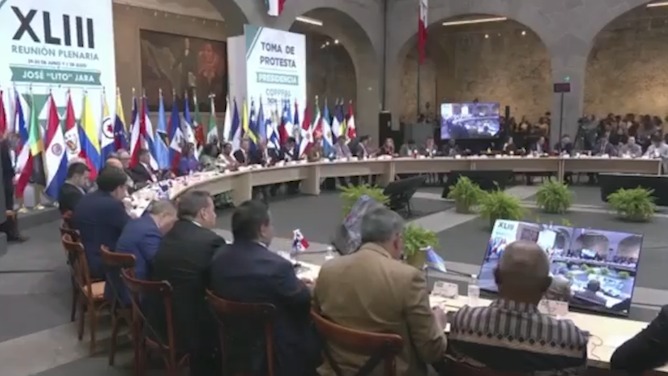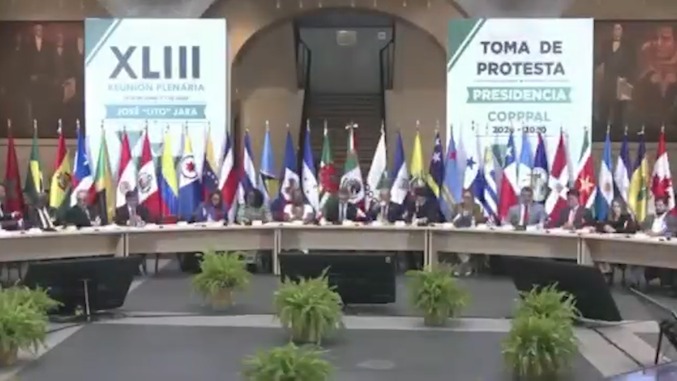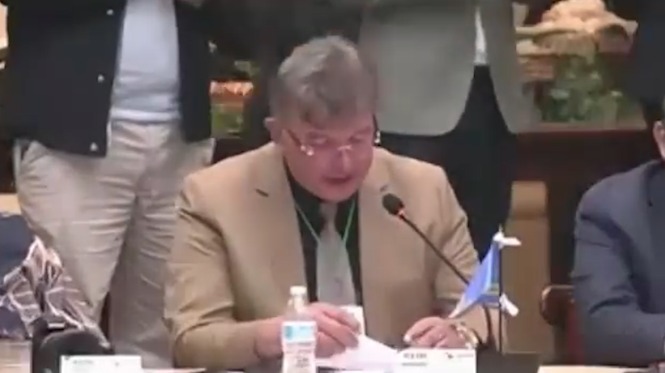
In a firm statement during the last meeting of the Permanent Conference of Political Parties of Latin America and the Caribbean (COPPPAL), Joe Koolman, President of the Commission on Decolonization and Colonialism, emphasized the urgency of respecting the autonomy of the islands in our region, particularly Aruba and Bonaire. The world must be aware of what the AVP-FUTURO Government and the Netherlands are creating for Aruba, pushing the country backward instead of forward.
Koolman, who leads the commission’s efforts, stressed that the decolonization effort is a commitment that does not allow for silence. According to the commission leader, the fight against “neocolonialism” and “re-colonialism” is fundamental to the survival of our nations.
The four unbreakable pillars During his speech, Koolman highlighted four non-negotiable pillars for the existence of our countries:
• Democracy: The foundation of our political system.
• Sovereignty: The right to decide our own destiny.
• Territorial Integrity: Respect for our borders and our space.
• Self-determination: The inalienable right of every people.
These principles are agreed upon in the UN Charter and governed by Resolution 1514 of 1960, which states that “all peoples have the right to self-determination.”
The fight for Aruba’s autonomy Regarding Aruba, Koolman reminded the audience that the 1983 Kingdom Statute is a pact between four countries, not a relationship of province or colony. Koolman argued that Aruba does not meet the two conditions for intervening in our autonomy: there is no “financial collapse” nor a “blow to democracy.” “We are not a province, we are not a colony, we are a country,” Koolman stressed, demanding respect for the autonomy of the Aruban people. The commission president expressed concern that Dutch policy views financial aid as an “opportunity” to exert control, which he finds unacceptable and labels as “modern slavery.”
A call for respect Koolman concluded his speech with a message for the rulers in the Netherlands, reminding them that respect must “start at home.” He emphasized that “respect for the rights of others is peace” and that sovereign equality can only exist with mutual respect.
Joe Koolman pointed out that the Rijkswet HOFA is a Kingdom Law that would place Aruba’s financial control in the hands of the Netherlands. The parliamentarian questions the motive for the financial aid, suggesting it is being used as pressure to accept this law. Koolman argues that these laws facilitate “neocolonialism” as they threaten the constitutional authority of our Parliament. He emphasized that this effort contradicts the principles of the Statute, which recognizes Aruba as an independent country with equality within the Kingdom, but the Netherlands—working with the current AVP-FUTURO government—does not or will not respect this, distorting the truth and reality of Aruba to bring about unwanted changes that the people have repeatedly rejected by saying “NO” to HOFA.