

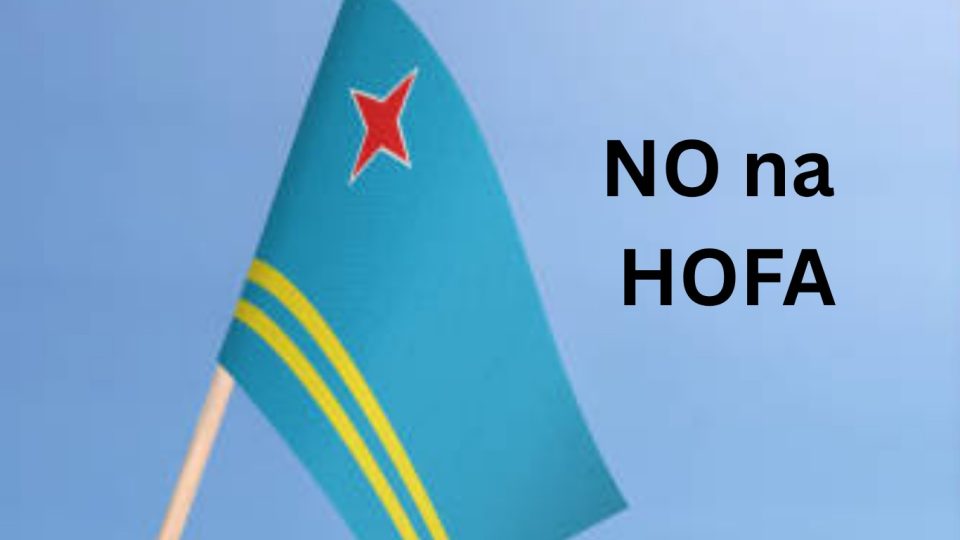
The Parliament of Aruba recently addressed the consensus Kingdom Law HOFA. Unfortunately, a majority of 11 parliamentarians voted in favor, allowing the government to proceed with the process alongside the Netherlands. This is a regrettable situation for Aruba, as the country risks losing its financial autonomy—one of the most essential pillars of being an autonomous country within the Kingdom of the Netherlands.
Opposition parliamentarians, however, refuse to give up the fight and will use every available tool to secure a majority against the Kingdom Law in its current form. At present, 10 parliamentarians have expressed concerns and voted against the law; these include members of MEP, PPA, and Mike de Meza from AVP.
Because the government has already submitted the proposed law to the Netherlands, there is little that can be done at this stage—at least until the law reaches the Dutch House of Representatives (Tweede Kamer). Once it is handled there, Aruba can submit a formal report indicating that its Parliament does not agree with the law. This is only possible if one more parliamentarian becomes aware of the serious negative consequences the law carries for Aruba. By agreeing to it, Parliament is making a grave mistake and forgetting the struggle of our ancestors that ultimately led to the Status Aparte.
Aruba’s Autonomy Under Pressure
The fight for Aruba’s autonomy began long before the Status Aparte was achieved. More than 80% of the population voted in a referendum in favor of becoming an autonomous country. One of the key motivations for this change was Aruba’s position prior to 1986, when the Netherlands issued instructions through Curaçao, preventing Aruba from making independent decisions for the wellbeing of its people. Comparing the situation before and after 1986 clearly shows how Aruba’s economy grew and the country developed exponentially.
With the Kingdom Law as it currently stands, the Aruban government once again agrees to give the Netherlands the final word on Aruba’s financial decisions. A country cannot be managed without control over its finances. By accepting the law, Aruba is effectively handing over its autonomy.
Autonomy Is Critically Important
The HOFA Kingdom Law proposes placing the power to implement changes in the hands of the Kingdom Council of Ministers. This council consists of more than twenty Dutch ministers and three Ministers Plenipotentiary—one from Curaçao, one from Sint Maarten, and normally one from Aruba. However, Aruba currently has no one in this position because the current government has not yet appointed a Minister Plenipotentiary. Additionally, when decisions are made by the Kingdom Council of Ministers, a country does not have voting rights on issues that affect itself.
Therefore, it is crucial that the people rise up and question the parliamentarians and government who support this law. They must be urged, as representatives of the people, not to surrender the autonomy that Aruba fought so hard to achieve. There is still a possibility to stop this law—if just one more parliamentarian voices concerns and votes against it.