

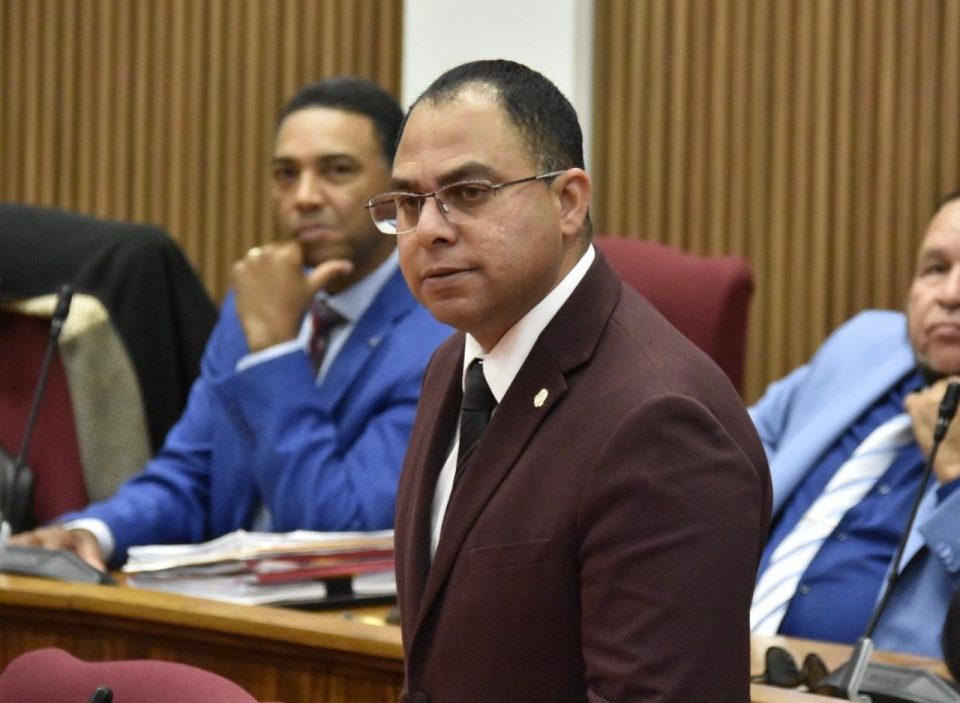
During the second session, Parliamentarian Eduard Pieters of the PPA faction expressed his concern: “Mr. President, today we see clearly that the struggle for power within the AVP–FUTURO coalition continues.” With this observation, Pieters highlighted a reality that can no longer be ignored. Aruba is witnessing firsthand a coalition that should be governing, trapped in distrust, contradiction, and lack of direction—at a historic moment when serious leadership is more necessary than ever.
A Motion Without Unity
The fact that the AVP faction, without its partner FUTURO, submitted a motion urging the government to appoint a plenipotentiary minister is telling. As the saying goes, “Better late than never.” However, according to Pieters, this is “incomprehensible and intolerable” when considering what is happening in the Dutch Kingdom and our region. A government that debates whether the position is necessary, while ministers publicly contradict each other, is a government without coordination and internal respect.
Two Versions, One Government
Minister Gerlien Croes stated that a plenipotentiary minister would cost too much, while Prime Minister Mike Eman insisted the appointment was necessary. “Due to the stipulated conditions and power struggle, there is no communication,” Pieters emphasized. The situation became so absurd that the FUTURO faction leader questioned the Prime Minister instead of engaging in dialogue with their own coalition partner. According to Pieters, “here we can conclude that the dispute within the coalition has reached a very advanced state.”
Institutional Distrust
The insistence of AVP on the motion, despite supposed internal agreements, confirms “total distrust between AVP and FUTURO,” according to Pieters. With the approval of the LIM, the Prime Minister would lose the central role in Kingdom relations, and the motion for a plenipotentiary minister becomes a type of “political oversight.” This is not governance; this is political survival.
The Amendment: Equality Within the Kingdom
Pieters shifted focus to a matter of principle: equality within the Dutch Kingdom. “Equality in the Kingdom is something each country must fight for,” he said. The proposed amendment is based on Article 39 of the Kingdom Statute and addresses a serious inequality: the lack of modern legal protection for ministers and parliamentarians of Aruba, Curaçao, and St. Maarten, comparable to that of the Netherlands.
The amendment does not create immunity. “This is not a waiver,” Pieters clarified. It establishes a clear, independent, and neutral procedure through the Procurator General of the High Council, in line with international treaties such as the ICCPR and ECHR. This prevents politically motivated persecution and protects institutional integrity in a small community, where reputations can be easily destroyed.
Aruba is not at a moment for power struggles. In a world full of geopolitical tension, we need clarity, unity, and respect for principles. “PPA will never allow anyone to abuse our principles,” Pieters declared. The message is clear: less internal struggle, more responsibility. The people of Aruba do not want power; the people of Aruba want a fixed and solid direction.