

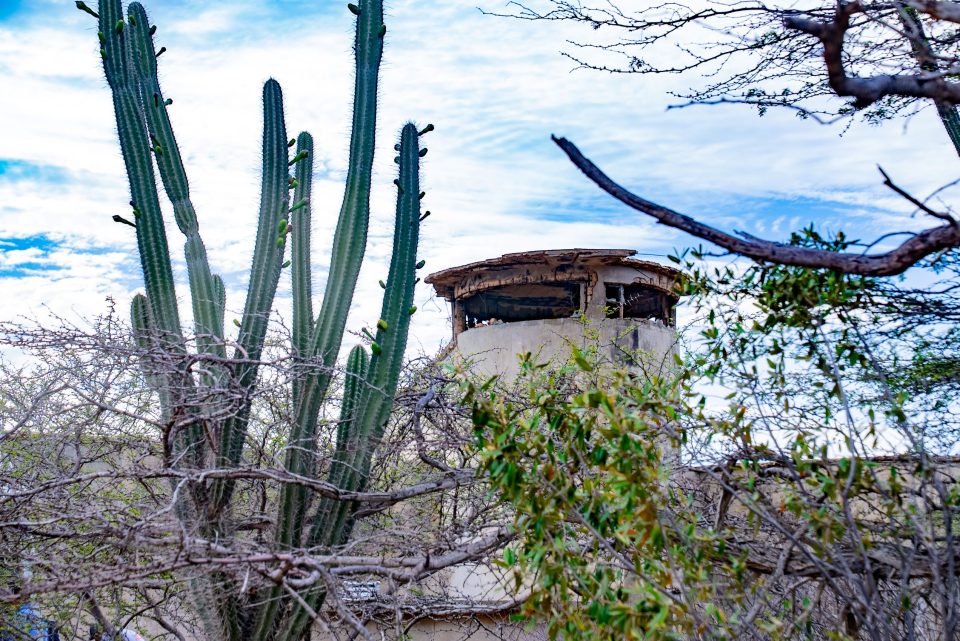
A site that nearly a century ago was essential to guaranteeing Aruba’s water supply is now preparing to receive a new purpose: preserving the country’s history, memory, and knowledge for generations to come.
On Wednesday afternoon, Prime Minister Mike Eman attended the official ceremony in Kibaima regarding the next phase of the restoration and adaptive reuse of the historic water tanks, with the vision of housing the National Archives of Aruba (Archivo Nacional Aruba) and creating a modern center for knowledge and heritage.
During the ceremony, both a Long-Term Lease Agreement (Erfpachtovereenkomst) and a Cooperation Agreement (Samenwerkingsovereenkomst) were signed between the Country of Aruba and the Aruba Monuments Foundation (Stichting Monumentenfonds Aruba), formalizing an important step in the development of the project.
For Premier Eman, who also carries responsibility for Culture, the significance of this moment goes far beyond the restoration of a monument. He invited those present to imagine an Aruba of the past, when turning on a tap and getting clean water was not automatic. On a dry island like Aruba, previous generations experienced periods of severe scarcity, failed crops, and difficulty securing enough water. The Kibaima tanks stand as a testimony to that period, but also to how Aruba searched for solutions.
According to Premier Eman, that history is precisely what must be preserved. “It connects us to the story of who we are, where we came from, and how citizens who lived in this country developed the resilience to overcome these types of challenges,” Eman expressed.
From preserving water to preserving knowledge
For the Prime Minister, there is special symbolism in the new function the tanks will receive. Where the reservoirs once formed part of an infrastructure that preserved water for the community, the same historical structures will now contribute to the preservation of knowledge and heritage.
Eman emphasized that Aruba is naturally a forward-looking community that focuses heavily on the future. However, precisely within that process, there is a risk of forgetting where we came from. That is why he highlighted the work done by institutions like the National Archives of Aruba, the National Library of Aruba, and the Aruba Monuments Foundation to preserve the collective memory of the country.
A document, a building, an object, or other historical material can tell a story about the Aruba of yesterday and help the next generation better understand the society they inherited. The Premier expressed special appreciation for the work of the National Archives and National Library in making historical materials more accessible through Coleccion Aruba.
A home for the National Archives
Director of the National Archives of Aruba, Drs. Raymond Hernandez, described the moment as particularly emotional. After around 30 years of searching for a suitable location to preserve national heritage, the project at Kibaima brings the National Archives closer to finally having a facility that matches its responsibility.
Hernandez emphasized that a modern archive is not merely a place to store paper. It preserves documents, photographs, videos, audio recordings, maps, books, and other materials that tell the story of Aruba. His vision is for Kibaima to eventually become a center for knowledge and heritage, open to the community, schools, students, teachers, and researchers. In the words of Hernandez, the site that once held water to sustain the population can now become a source of knowledge for young and old alike.
A second life for heritage
Minister Rene Herdé focused on the opportunity to give the monument a second life. According to Herdé, preserving heritage is not simply repairing concrete or storing old materials; it is preserving the richness of knowledge, culture, memories, and experiences that previous generations left behind. The project allows Aruba to continue building upon the work and vision of those who came before.
On behalf of the Aruba Monuments Foundation, Director Petra Davis explained that the restoration and adaptation of the tanks will take place in different phases, paying close attention both to their monumental value and to the specific requirements of a modern archival facility.
Knowledge as an opportunity for the future
Premier Eman also saw the potential for the development at Kibaima to connect with other knowledge initiatives in the area, including Smart Community. His aspiration is that Aruba can continue to develop knowledge centers that not only serve our own community, but eventually allow our island to share and export knowledge.
In conclusion, Premier Eman expressed gratitude to all institutions and individuals who contributed to the project, and particularly to the Dutch Government for the financial support provided.
With the agreements signed, the Kibaima tanks enter a new chapter. A monument that tells the story of how Aruba fought to guarantee something as essential as water is now preparing to preserve something equally essential: the memory of who we are, where we came from, and the knowledge we want to pass on to future generations.