

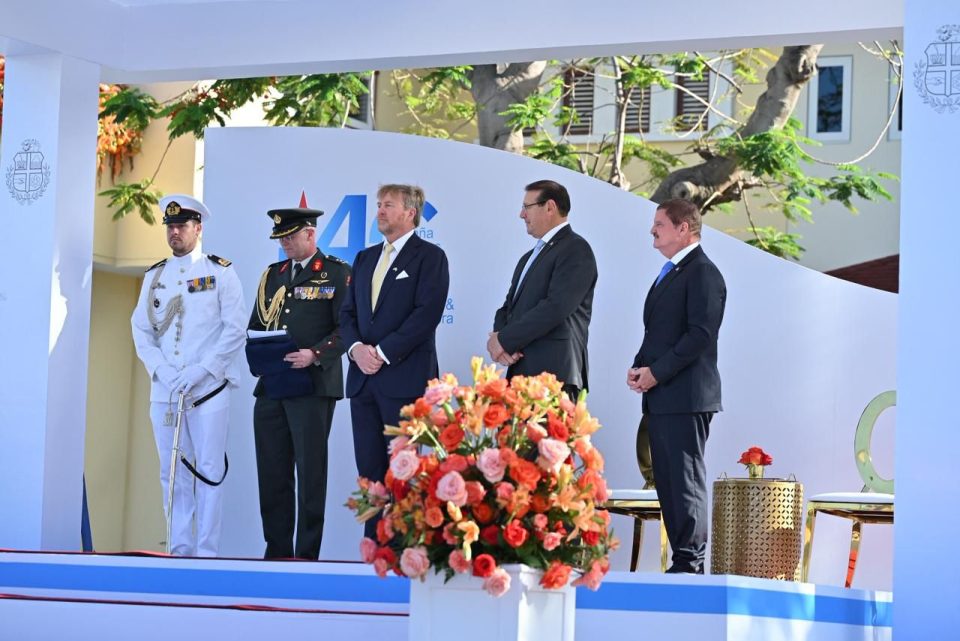
On March 18, His Majesty King Willem-Alexander paid an official visit to Aruba in the context of two important historical occasions: the 40th anniversary of Status Aparte and the 50th anniversary of Aruba’s national flag and anthem. The visit emphasized the country’s constitutional development and national identity, while also highlighting its ongoing relationship within the Kingdom of the Netherlands.
The official program began at the Governor’s Office, where Governor Alfonso Boekhoudt received the King. Afterwards, the delegation moved to the Government Office (Bestuurskantoor), where a traditional cultural presentation took place, showcasing Aruba’s heritage and national pride. Later, the King attended a groundbreaking ceremony at the Roly Bislik Olympic Pool in Savaneta, marking an important investment in sports facilities for the community.
During the visit, the King also met with various authorities, including representatives of the Aruban government and military leaders of the Kingdom of the Netherlands. They exchanged views on topics such as security, cooperation, and regional development. This meeting highlighted the importance of continued collaboration between Aruba and the Netherlands.
However, alongside the official program, the visit was marked by a passive demonstration organized by labor unions. The action was related to the HOFA situation and became a significant moment for Aruba.
According to Jose Figaroa, president of the FTA union, the protest was not massive but was effective. He stated that the number of participants was sufficient to ensure the message was heard not only in the Netherlands, but also by the Parliament and Government of Aruba. According to Figaroa, the main goal raising awareness and applying pressure regarding the current issue was achieved, as well as highlighting what Aruba stands to lose if the Rijkswet HOFA becomes a reality.
The demonstration remained peaceful but carried a clear message: unions are seeking attention for the impact that decisions like HOFA could have on the working class—the people of Aruba and they insist on dialogue and concrete action.
The visit of King Willem-Alexander thus combined a historic celebration with an expression of social concern, reflecting both national pride and the challenges Aruba continues to face in its development.