

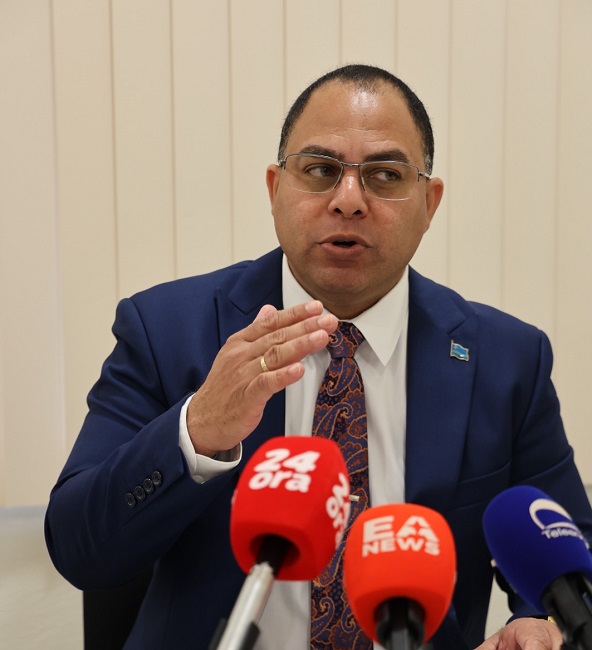
The HOFA Rijkswet is not simply an agreement for Aruba to get a lower interest rate or put its finances in order. According to PPA faction leader Eduard Pieters, the debate touches on something much more fundamental: Aruba’s autonomous position within the Kingdom of the Netherlands and the authority of the Parliament of Aruba according to our Constitution.
Pieters devoted an important part of the PPA press conference to explaining why the PPA is against the Rijkswet and that it cannot be presented as if the PPA were against supervision, financial discipline, or cooperation with the Netherlands. “We are not against supervision. We are not against interest reduction. We are not against putting our finances in order.” The question, according to Pieters, is whether the chosen construction respects our Statute, our Constitution, and Aruba’s autonomy.
Article 3: Aruba’s finances are not a Kingdom affair Pieters went back to the constitutional basis of the Kingdom. He pointed out Article 3 of the Statute, which determines which matters are the responsibility of the Kingdom, including defense, foreign relations, and the nationality of the Kingdom of the Netherlands. His political point is that Aruba’s internal financial management is not mentioned as a Kingdom affair. For Pieters, that is crucial. Aruba fought for and freely accepted its position as an autonomous country within the Kingdom. Cooperation has its place, but Aruba’s authority that is NOT surrendered to the Kingdom cannot simply be added via a financial construction through a Kingdom law (Rijkswet).
Article 38: cooperation must be truly free Pieters then pointed to Article 38 of the Statute, which offers the possibility for countries within the Kingdom to work together via mutual agreement. The key words, according to Pieters, are freely and cooperation. Pieters argues that cooperation loses its voluntary character if a country in economic crisis gains access to financing only under the condition that it accepts a profound change in its local laws and Statute. He placed the context in the COVID period, when Aruba’s economy suffered an extraordinary blow. “You are on your knees, your economy has fallen, you need money. And then they say: I will lend to you, but you must agree to surrender your dignity and break your Constitution. Is that ‘vrije samenwerking’?” For Pieters, that is the question the Government cannot avoid.
If you want to change the relation, the Statute has a procedure Pieters also pointed to Article 55 of the Statute, which regulates the procedure for amending the Statute. His argument is simple: if Aruba wants to surrender or modify a fundamental part of its autonomous authority anchored in our Constitution and Statute, it cannot do so indirectly. There is a long and rigorous procedure when a change is desired. If a change is desired, use that procedure. For Pieters, this is exactly why the debate surrounding HOFA cannot be reduced to “The Netherlands offers a lower interest rate.” The question is what Aruba structurally accepts in return.
Bypassing Parliament But Pieters’ criticism is not directed only at the Netherlands. He directly holds Aruba’s current Government responsible. According to Pieters, the current Government approved the Rijkswet proposal and forwarded the process at the Kingdom level without bringing the matter in time to our Advisory Council (Raad van Advies) and first to the Parliament of Aruba for substantial debate. Pieters considers this particularly concerning because some of the same politicians who are ministers today previously supported the agreements made during an IPKO that, among other things, every Consensus Rijkswet must get Parliament’s support before going to the Council of Ministers of the Kingdom. “Now that they are ministers, they have forgotten what they themselves agreed upon.”
Once the proposal is in the Kingdom legislative process, Pieters points out, the direct influence of the Parliament of Aruba becomes much more limited. Precisely for that reason, he went to the Netherlands earlier in April 2026 to speak with political factions there and explain Aruba’s constitutional, statutory, and developmental concerns within the Kingdom of the Netherlands.
Not a fight against the Netherlands Pieters also rejects any attempt to present his position as anti-Netherlands. Aruba forms part of the Kingdom on a basis of equality, equity, and cooperation. Precisely for that reason, the relationship between the countries must respect the legal framework they agreed upon themselves.
For the PPA, the line is clear: Supervision yes. Cooperation yes. Financial discipline yes. But do not bypass the Statute, Constitution, Parliament, and autonomy to achieve it.
Because, according to Pieters, the decision being made today is not just for the current Government. It can determine how much authority Aruba will have tomorrow. Is this what we want to leave as a legacy to our children? How sustainable is this? The AVP-FUTURO Government’s decision harms Aruba’s Constitution, which was fought for so hard, and we cannot leave it for our future generations.
“This is not just a matter of finances. It is a fundamental question of our autonomy and the Government cannot surrender that without the people’s voice, via its Parliament, since Parliament has the first word.”