

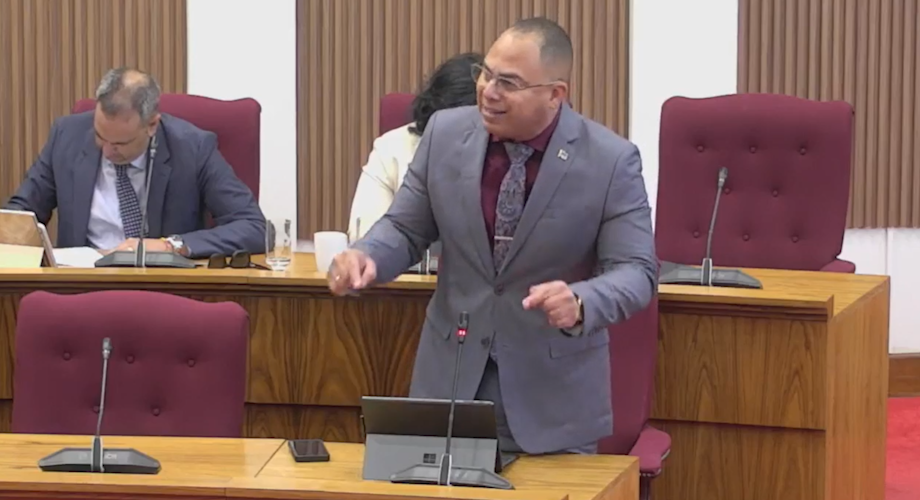
During Tuesday morning’s meeting regarding AWSS in the Parliament of Aruba, MP Eduard Pieters of the PPA faction sent a direct message: when the government fails to fulfill its basic responsibility, Parliament must intervene. This matter is not just a social concern but a serious governance problem, showing how the system is not functioning as it should.
Rules ignored, trust weakened According to Pieters, the problem does not start in the neighborhood, but in the process itself. According to the Rules of Order, a request for a public meeting must be addressed within 30 days; however, in this case regarding AWSS and waste management, it took nearly 9 months. For Pieters, this is not a simple administrative delay, but a dangerous sign of institutional negligence. He questioned how a country can speak of serious governance if its own rules are not respected, as every time the system fails, the people’s trust is weakened.
Neighborhoods pay the price of inaction The harshest reality is felt in neighborhoods like Cas Paloma, Ser’i Teishi, Parkietenbos, and Simeon Antonio, where Pieters personally went to speak with residents and see the real situation with his own eyes. In this delicate matter, history repeats itself: once again, promises are made during campaigns, but concrete solutions never arrive. The dominating feeling is one of exhaustion and frustration because these people are not asking for luxury; they are asking for something basic: a government that responds.
Politics vs. Responsibility Pieters made it clear that this is not a party fight. “This isn’t about MEP or AVP; this is the people suffering,” he emphasized. However, at the same time, he indicated where the responsibility must lie: with the government. Lack of action cannot be normalized or justified, as governing is not an option—it is an obligation that comes with the people’s mandate.
PPA demands action, not promises In this context, the PPA faction supported the motion demanding a clear and immediate action plan. For Pieters, this is not symbolic, but necessary to force movement. The people are not asking for more studies, reports, or promises; they demand concrete results that can change their reality. Without action, every word remains empty.
Ultimatum: The people’s patience has reached its limit During the voting process, the tone became forceful. The people of Cas Paloma, Ser’i Teishi, Parkietenbos, and Simeon Antonio cannot continue to wait indefinitely. Pieters let it be known that if the government does not act with urgency, Parliament will do everything in its power to ensure that call is not ignored. His final message summarized the situation bluntly: the people are not asking, the people are demanding, and a serious government must respond with action, not silence and pretty speeches.