

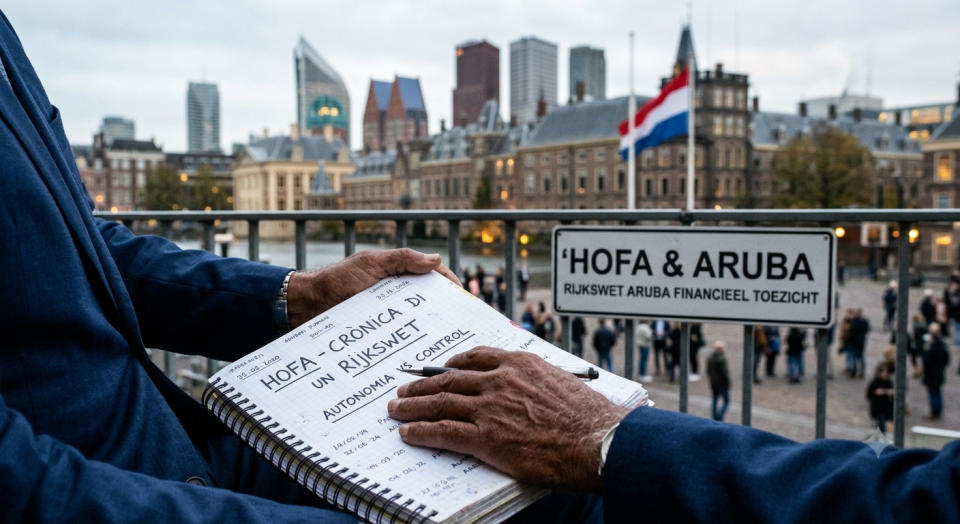
After several months of silence and exclusion, the debate surrounding the Kingdom Act on Aruba Financial Supervision (HOFA) has once again entered a phase of political consternation. Recently, the President of Parliament, Marlon Sneek, broke his silence to give statements that, to many observers, seem like an attempt to “wake up from a slumber” after allowing the institution he claims to represent to be sidelined for months.
On several occasions, the same criticisms have been launched, indicating that the HOFA process has de facto silenced the Parliament of Aruba. “THERE IS NO CONSENSUS.” As previously pointed out, politicians like Minister Geoffrey Wever, Gerlien Croes, and Mike Eman have been accused of betraying the country, going behind the backs of the Aruban people to seek a consensus in the Netherlands without having the consensus of the Parliament of Aruba.
However, Sneek’s latest statements do not only draw attention because of his effort to live with the current reality, but also because, as a politician, he frameworks his discourse by using commercial business associations as a shield, indicating that they agree with the law regardless of the fact that this could mean Aruba loses its own sovereign decision-making rights. Even more serious: a deep analysis of his own words clearly shows that the President of Parliament structurally misunderstands the core substance of HOFA.
The Contradiction in His Own Transcription
In an attempt to give a lesson in constitutional law, Sneek tried to explain the process by dividing the law into two paths:
“The Kingdom Act (Rijkswet) is not voted on in Aruba… it is in the House of Representatives (Tweede Kamer) where the formal debate takes place… What Aruba gets to deal with is the National Ordinance (Landsverordening)?.”
Sneek uses the legal term of a “hybrid Kingdom Act” to justify that the Netherlands votes on one part and Aruba on another. But what the President of Parliament inherently forgets, either due to a lack of knowledge or for political convenience, is the real weight of a national consensus.
When a consensus Kingdom Act enters into force, the legal superiority of the Kingdom binds the hands of the Parliament of Aruba. To bring the matter down to an understandable level: even though Aruba must vote on a National Ordinance, our Parliament does not have the real freedom to deviate from what has already been agreed upon in the Kingdom Act in the Netherlands without facing a structural Kingdom conflict. To sell the idea that “we still have control” simply because Parliament has to vote on a local ordinance is a dangerous reductionism of the matter.
Hiding Behind Business Associations and “Formal Steps”
Another point that raised many eyebrows in the community is how easily Sneek speaks on behalf of the trade associations, confirming that the commercial sector “does agree with the law.” This statement exposes an analytical divide: while the labor unions are fighting for the right to self-determination and the protection of workers against external dictates, the leadership of Parliament seems more content with decisions being made from The Hague, as long as the business associations are happy. Sneek forgets that the very seat he sits on today is at risk.
At the end of his statement, Sneek calls for following the advice of the Advisory Council (Raad van Advies) in Aruba and the Council of State (Raad van State) in the Netherlands. Meanwhile, time keeps ticking. The impression left behind is that, instead of a defensive leader of the first organ of the national State, Aruba has a President of Parliament who has recently risen from the grave to accept reality, but who still lacks the capacity or the will to listen to the real danger that HOFA represents to our country’s autonomy.
However, several questions arise based on the statement recently given by the President of Parliament, regarding whether President of Parliament Marlon Sneek is truly aware of HOFA and his duties as president.
Questions
On the “Right to Vote” and Parliamentary Autonomy
-
Question 1: “Mr. President, you explain that the Parliament of Aruba will vote on the National Ordinance and the Tweede Kamer on the Kingdom Act. But structurally speaking, if the Parliament of Aruba votes against or asks to change essential articles of the National Ordinance, will the structural Kingdom Act in the Netherlands not be affected? Do we have the real freedom to change the conditions, or has our Parliament simply become a ‘rubber stamp’ (stempelmachine) to legalize what has been decided in the Netherlands?”
-
Question 2: “If the Kingdom Act is legally superior to our National Ordinance, how can you assure the public that Aruba is not losing its right to make decisions, when legally the National Ordinance must be unjustifiably tied to what the Tweede Kamer has already approved?”
On the Defense of Business Associations vs. The People
-
Question 3: “You mentioned in your statement that the commercial business associations ‘do agree with the law,’ while the unions do not agree. As the President of Parliament who supposedly represents the entire population and not just one sector, why does the opinion of the commercial sector carry more weight for you than the concerns of the unions regarding the loss of self-determination?”
-
Question 4: “Do you believe that the economic well-being of commercial trade associations should be placed above Aruba’s constitutional right to govern its own finances?”
On the Accusation of “Silence and Political Betrayal”
-
Question 5: “Politicians from various sectors accuse ministers and parliamentarians of betraying Aruba by going behind the backs of the people to seek a consensus with the Netherlands on the HOFA matter. Why did Parliament take so long several months to structurally spark this public debate, given that the danger to our status aparte has been coming from way before?”
-
Question 6: “If you are aware that the formal and constitutional debate must be protected, why did you not convene structural meetings or assemblies earlier to debate HOFA structurally, instead of waiting until the law is practically closed (clausurado/finalized) in the Tweede Kamer? Is this a practice of working for the people, or a betrayal of the people?”
Exposing the Flaw in His Definition of a “Hybrid Law”
-
Question 7: “The term ‘hybrid Kingdom Act’ is being used. Constitutional law experts argue that this ‘hybridity’ is just a nice way to sell the loss of autonomy. If the ultimate goal of the law is for a supervisory body (like CAft or the new structural version) to dictate our budget, where does the ‘hybrid’ part benefit Aruba, and where does it structurally benefit the Netherlands? Who really benefits from the HOFA Kingdom Act proposal?”