

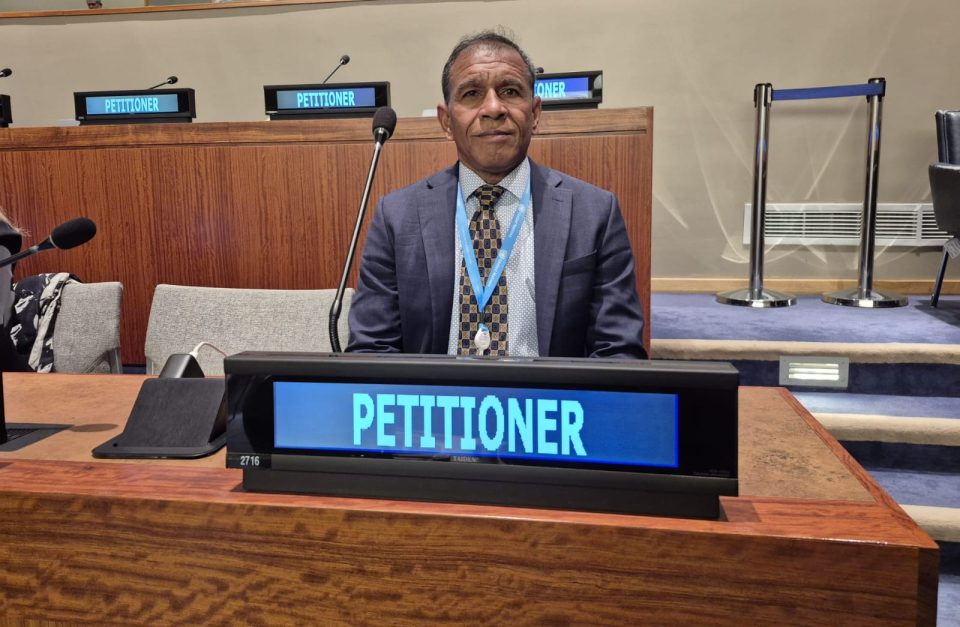
James Finies, founder of the Bonaire Human Rights Organization and leader of the Pueblo Progresivo Party, has sent a letter of objection to Bonaire’s Gezaghebber, Mr. John Soliano, expressing concern over the Dutch legislative proposal that would grant the Lieutenant Governors of Bonaire, St. Eustatius, and Saba the authority to order the removal of online content if they deem it a threat to public order. Finies argues that giving a single appointed official—who was not democratically elected—this kind of power, without prior judicial approval or intervention from the justice system, resembles the authority of a colonial administrator or authoritarian ruler rather than the kind of governance expected in a democracy based on the rule of law.
Finies’s letter of objection to Gezaghebber Soliano follows his previous letter dated June 28, 2026, addressed to the Prime Minister of the Netherlands, the Minister of Justice and Security, members of the Dutch Parliament, and the Human Rights Council, in which he expressed serious concern about the expansion of Dutch penal laws criminalizing the glorification of terrorism and public expression on Bonaire.
Saba, with a population of roughly 2,000, St. Eustatius with roughly 3,000, and Bonaire—which had approximately 10,000 residents in 2004 and now over 25,000—have always been peaceful and hospitable Caribbean communities, without significant terrorist activity that could justify such broad restrictions. The United Nations Special Rapporteur on Counter-Terrorism and Human Rights has repeatedly warned that overly broad counter-terrorism laws can suppress dissent, limit civic participation, criminalize legitimate political expression, and should never be used to justify increased state control over public debate or to weaken fundamental freedoms.
Finies emphasizes that the issue goes far beyond social media. The people of Bonaire have seen their democratic choices and collective decisions silenced, their human rights denied, and their island placed under external governance in a constitutional status they did not freely choose. To this day, the people of Bonaire are governed from The Hague without an effective voice or representation in the decisions shaping their laws, institutions, rights, and future.
While Bonaireans must endure this continuous marginalization, Finies asks why Dutch laws imposed from The Hague are treated and prevail for Bonaire’s public authorities, while international human rights and treaty obligations that the Kingdom of the Netherlands is bound to uphold are neither considered nor respected.
Public question to Gezaghebber Soliano:
“Whom do you serve? Do you primarily defend and comply with laws established by Dutch politicians thousands of kilometers away from Bonaire, or do you defend with equal strength the democratic rights and human rights of the people of Bonaire under the Charter of the United Nations, international law, and international human rights treaties?”
Finies notes that even in the Netherlands itself, this law has raised constitutional concerns. The Temporary Committee of the House of Representatives (Tweede Kamer) on fundamental rights and constitutional revision warned that this law affects freedom of expression and the right to demonstrate, therefore requiring stronger legal protections.
Finies emphasizes that Articles 19 and 25 of the International Covenant on Civil and Political Rights (ICCPR), together with Articles 19 and 21 of the Universal Declaration of Human Rights (UDHR), protect freedom of expression and the right to participate in public affairs. Any restriction must be legal, necessary, proportional, and compliant with international human rights standards.
Respect for the rule of law requires more than simply implementing laws imposed by Dutch politicians in The Hague. It requires equal respect for the democratic will of the Bonairean people, their right to participate in governance, and the higher obligations stemming from international law and human rights treaties that the Kingdom of the Netherlands is obligated to follow.