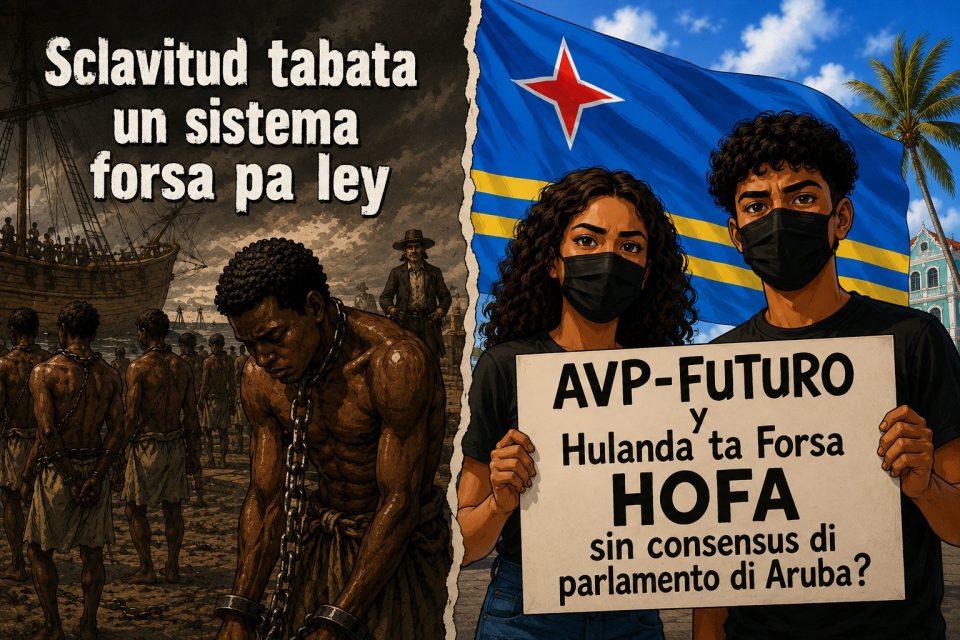
Within the framework of the symposium “Bridges Between Generations,” well-known speaker Fredy Gonzales presented a profound reflection on the history of slavery in the Caribbean region. Gonzales emphasized that the goal of this symposium is to unite the community in reflecting on what truly happened in our history, our origins, and the inalienable right that our children and grandchildren have to know the truth about our past. Slavery was a system enforced by governments; while we must take pride in the descendants who moved forward, we must look at today: is the AVP-FUTURO government, together with the Netherlands, repeating the history of slavery in a modern jacket?
Gonzales opened his speech by stating that this history should not bring us shame, but on the contrary, it should give us a sense of pride. He explained that although a large number of people were brought to this land by force, their descendants managed to overcome adversity, move forward, and today we are living witnesses to that achievement. “You are proof of that, you are here,” the speaker expressed to the audience. The terrible life that enslaved people endured and lived must never happen again; they fought, and today, because of that struggle for freedom, we live a better life.
During his presentation, Gonzales explained that the figures for the slave trade are approximate, as it is very difficult to know exactly how many people were taken from Africa against their will. However, researchers calculate that a highly credible figure is 12.5 million people ($12,500,000$) captured over a period of roughly 300 years. These 300 years, representing three centuries of history, were the time when many European countries actively participated in this trade, including Portugal, Spain, France, the Netherlands, and England.
To provide a clear definition of what an enslaved person was in this historical context, Gonzales explained:
“An enslaved person was someone hunted, kidnapped, abducted, and sold by force… lacking freedom of physical movement, of opinion, and of legal protection. They did not own themselves and were forced to work without pay.”
One of the most important points Gonzales raised is that slavery was a norm and a formal law authorized by the governments of that era. He firmly clarified that this was not a divine mandate or an order from God, but a decision made by human beings in government functions to permit the capture, uprooting, and transport of people from their homelands.
This system in the Americas functioned because people were taken from their homes and transported in ships during long two-month voyages to a place completely unknown to them. The majority submitted in order to save their lives, but Gonzales also recalled the resistance: many people threw themselves from the ships, preferring to drown rather than live in slavery, while others died during the crossing due to disease or hunger.
Finally, the speaker highlighted a crucial aspect that is often forgotten: “None of this was voluntary.” He even explained how many kings of African tribes participated in this system, receiving money from Europeans to capture members of other tribes and sell them in chains. Gonzales concluded by reiterating that the entire structure was structurally enforced through the political and economic power of that time.
Slavery Was a Legally Enforced System: Are We Repeating the Past in a Modern Form via the HOFA and the AVP-FUTURO Coalition with the Netherlands?