The judicial management surrounding the calls for the execution of prison sentences called “vrije voeters” remains under pressure. The 2025 annual report of the Public Prosecution Service (OM) reveals that although the execution of sentencing judgments from 2024 and 2025 has started, the limited capacity in KIA (Correctional Institution Aruba) remains a major obstacle to meeting the established goal.
What is a “vrije voeter”? In Aruba’s judicial context, a “vrije voeter” refers to a suspect or convict who, after spending a period in pre-trial detention (voorarrest) during the criminal process, was released or remains free pending the definitive execution of a judge’s sentence. Often, these are cases where the imposed sentence was equal to, or less than, the days already spent in pre-trial detention.
However, there are cases where a person received a prison sentence but remains temporarily at liberty due to a lack of space or because of execution planning.
The Public Prosecution Service’s call system and awareness of consequences When a citizen receives a definitive judicial sentence and is formally summoned by the Public Prosecution Service to report and serve their prison sentence, the process requires strict obedience to the judicial order.
If a person chooses to ignore the call from the Public Prosecution Service and fails to appear on the stipulated date, the consequences are severe:
• Warrant for arrest (Gevangenneming / Gijzeling / Signalering): The Public Prosecution Service can order the Aruba Police Force (CPA) to search, detain, and imprison the person immediately.
• Extension of legal trouble: A non-cooperative attitude can turn the person into a fugitive from justice, lowering the probability of any favorable measure in the future.
• Forced execution: The sentence must be executed, and avoiding the call only delays the inevitable while adding the crime of disobedience or complicating one’s legal status.
Many critics point out that while some individuals from the same case have turned themselves in, others are traveling and enjoying life, making a mockery of Aruba’s judicial system, or simply because there is no specific place for them in KIA?. The magnitude of the Avestruz case has impacted the community given that public funds and land are involved, and in this case, the public has a right to know about the process of the last person who, to this day, remains untraceable (spoorloos) in the public eye and is not serving the punishment handed down by the judge.
But what actually happened with this? Did they receive a judge’s punishment but are not serving it? The public knows that two individuals complied with their summons and are currently serving time, but it remains unknown to the public why the third did not comply, or whether the Public Prosecution Service even summoned the woman. The people of Aruba are still awaiting an answer from the Public Prosecution Service in this case.
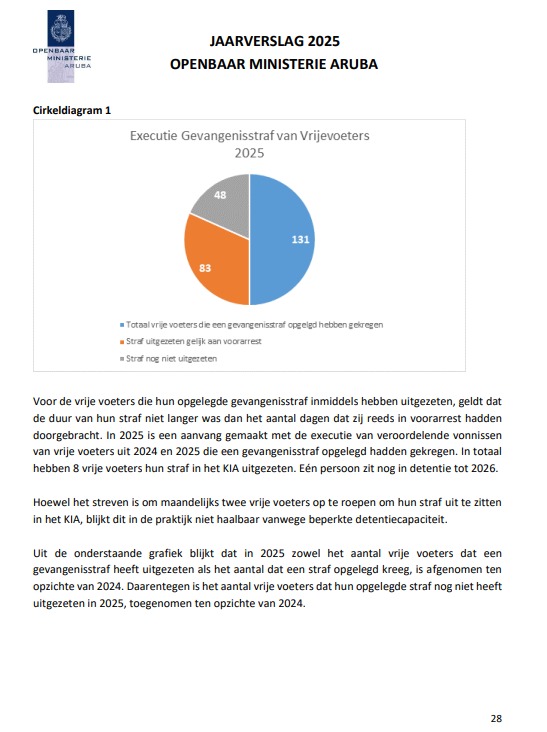
According to reports in the Public Prosecution Service’s 2025 annual report, the reality in practice shows a disconnect between the goal and daily operations. The initial goal was to summon two “vrije voeters” monthly to enter KIA and serve their sentences. However, in practice, this has not been consistent nor achievable due to limited detention capacity at KIA.
Key highlights from 2025 include:
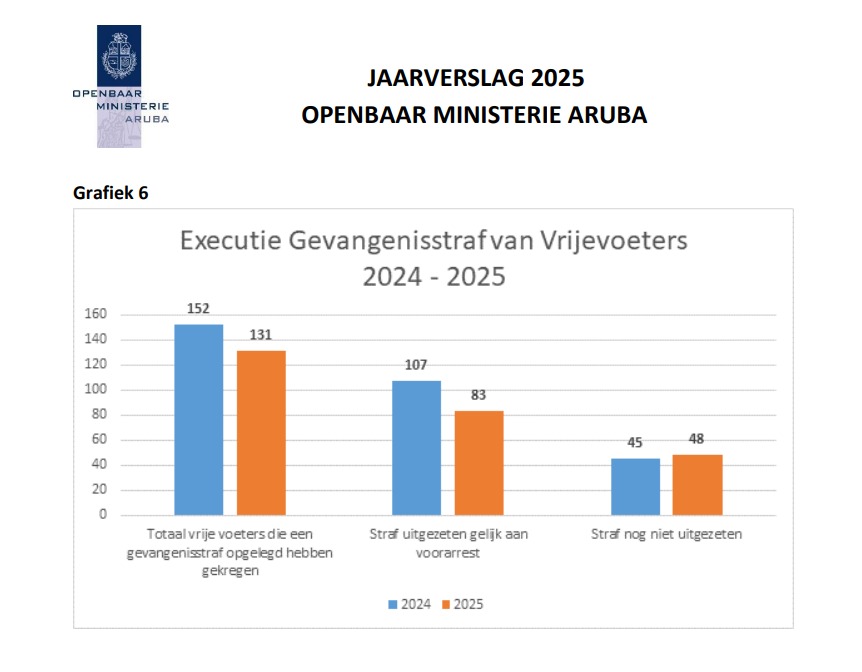
• Limited execution: The execution of “vrije voeters” sentences from both 2024 and 2025 was initiated.
• Compliance figures: In total, 8 “vrije voeters” successfully served their sentences in KIA, while one person was still in detention as of 2026.
• Statistical trend: Compared to 2024, both the number of “vrije voeters” who served a prison sentence and those who received an imposed sentence decreased in 2025.
• Pending challenges: Due to operational and space limitations, the number of “vrije voeters” who have not yet served their imposed sentence saw a comparative increase in 2025.
The situation clearly signals that the judicial chain is facing structural challenges regarding detention facility capacity, which continues to put pressure on the efficient and effective execution of criminal laws in Aruba.
Now, looking at this flaw, for those who have a sentence that cannot be called due to a lack of capacity, does the sentence expire (verjaard) after 5 or 10 years? What does this mean then? Does the person get a free ride? Or does the sentence never expire? These are questions that have yet to be answered by the Public Prosecution Service.