

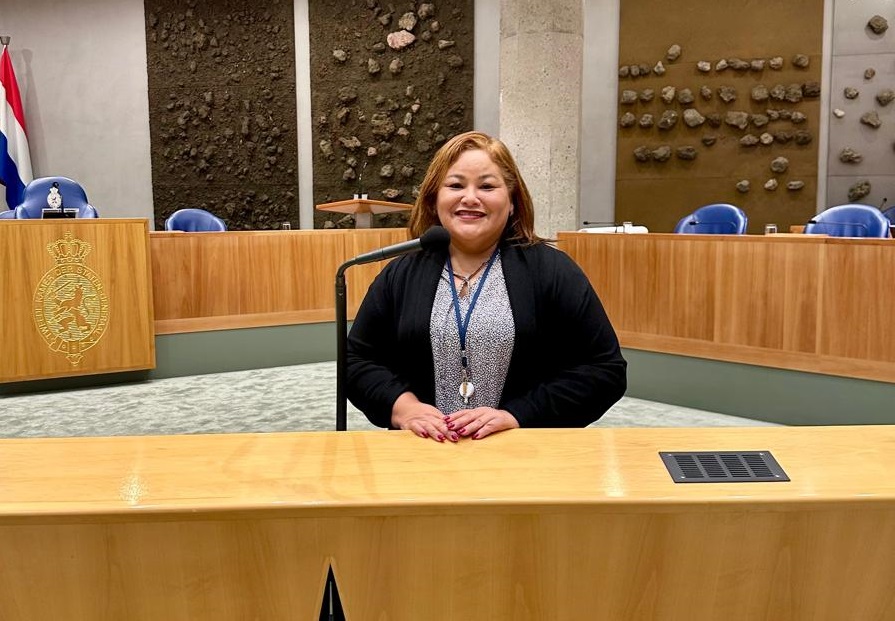
Member of Parliament Drs. Shailiny Tromp-Lee issued a statement from The Hague, where she denied that the negotiations surrounding the Kingdom Act HOFA (Rijkswet HOFA) took place on the basis of free will. Tromp-Lee emphasized that from the very beginning, Aruba has been placed in a situation of coercion (dwang) to accept unfair conditions, and that this same pressure continues now in the form of a punitive interest rate (strafrente).
Coercion from the very first moment The Member of Parliament clarified that the facade of structural cooperation does not align with historical reality. The 2024 Administrative Agreement (Bestuurlijk Akkoord), signed under pressure within the context of post-pandemic recovery, was not the expression of a free consensus; it was the result of a situation where Aruba was “punished” with a punitive interest rate.
“This is not based on own and free will. From the very beginning, we were in a situation of coercion: take it or leave it. First, it was so we could receive emergency financing, and now, at the time of repayment, they are imposing a punitive interest rate on us because we did not agree to the RAft. The question that must be answered is: if an agreement lacks free will as its foundation, how can it be called a consensus?” Tromp-Lee declared.
Unequal negotiations While Curaçao and Sint Maarten received debt relief in 2010 when they obtained a status comparable to what Aruba has already had since 1986, Aruba did not receive any comparable benefit. Now, under HOFA, Aruba is required to follow the same restrictions, but without the same foundation of economic-financial support.
The facts speak for themselves: this year marks the third consecutive year that Aruba is paying a punitive interest rate on the COVID debt. This is despite having reduced its debt from 117% to 61% of its GDP—as confirmed by the Council of State (Raad van State)—and having complied with all budgetary norms on time. “We are the only country in the Kingdom being punished while we are complying. Same obligations, but not the same treatment,” Tromp-Lee explained.
Our right to decide for ourselves For the Member of Parliament, the core of the matter is a constitutional one. Aruba has held a Status Aparte since 1986, 24 years before the other islands received something comparable. This right includes the freedom to decide how to manage our own finances, especially when the results speak for themselves.
“We cannot accept being punished as a country while we comply with all our obligations. Supervision (toezicht) is understandable. But this instrument, a Kingdom Act imposed without free will, is neither necessary nor fair. And we will continue to explain this, clearly and with solid arguments,” Tromp-Lee concluded.