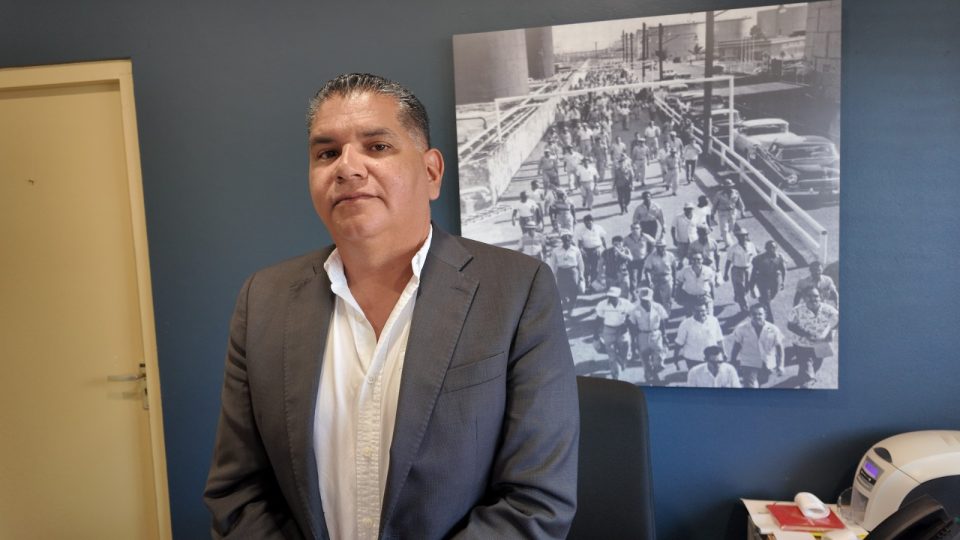
The President of the FTA union, Hose “Jomar” Figaroa, has made a strong appeal to the Government of Aruba to structure and clarify its permit policy before starting to implement sanctions or fines on employers.
According to the union leader, the country can no longer afford to act solely in moments of crisis or at the last minute, because this lack of preventive planning is precisely what has led Aruba to its current dilemma.
Clear policy before sanctions
In his statement, Figaroa explained that before the executive can transition into a phase of punishment or applying fines, it must ensure there is a legal framework and a unified, transparent, and “crystal clear” policy.
“Before you can move on to saying that you are going to issue a fine or impose certain sanctions, you must start by having a transparent policy on what needs to be complied with, what is required, and how you are going to filter who enters and who does not enter,” Figaroa emphasized.
The FTA leader recalled that, formally, the country has taken steps in the past, such as the general amnesty anchored to legalize a fairly large group of people. These individuals signed on their own behalf and received an opportunity to be legalized for one year, under the condition that they had to find a legal employer to formalize their status once that year expired. However, the expiration date for this first group legally begins in the months of July and August, which raises the question of how prepared Aruba is to handle those who did not manage to find an employer.
Figaroa gave a vivid example of how a lack of long-term vision affects the government apparatus itself, illustrating that when the permit policy was introduced for this group, the consequences were not properly anticipated.
“It created a certain bottleneck. At the moment the policy was introduced, they did not think through what the consequence would be. They thought about the departments needed to grant the permit, but they forgot that once that permit is issued, the person has to go to Civil Registry (Censo) to register,” Figaroa explained.
As a consequence of this, the departments responsible for issuing permits were supposedly equipped, but when the mass of people arrived at Censo, they encountered massive congestion because Censo was not prepared for that influx. “That is a failure of ours as a country, that we wait until the last minute to start regulating a situation,” he added.
What concerns the union most is that this need for labor is no surprise to the governing authorities. Through statistics, the Government has known for years that the expansion in the hotel sector and the construction of extra rooms would require a massive number of additional workers. Similarly, Censo data already shows that Aruba’s population is aging, meaning that over the next 10, 15, to 20 years, a large number of local workers will exit the labor market.
Despite having this data available for more than a decade, the union laments that the choice was made to wait until “the cow is drowning” to then rush into finding a solution to import people. Figaroa concluded his statement by pointing out that these rushed decisions, lacking a solid foundation, harm the country, referencing the popular Aruban proverb: “Sopi purá ta sali salo” (Rushed soup turns out salty).
Hose Figaroa (FTA): Government must make its policy crystal clear before imposing sanctions; “rushed soup turns out salty”