

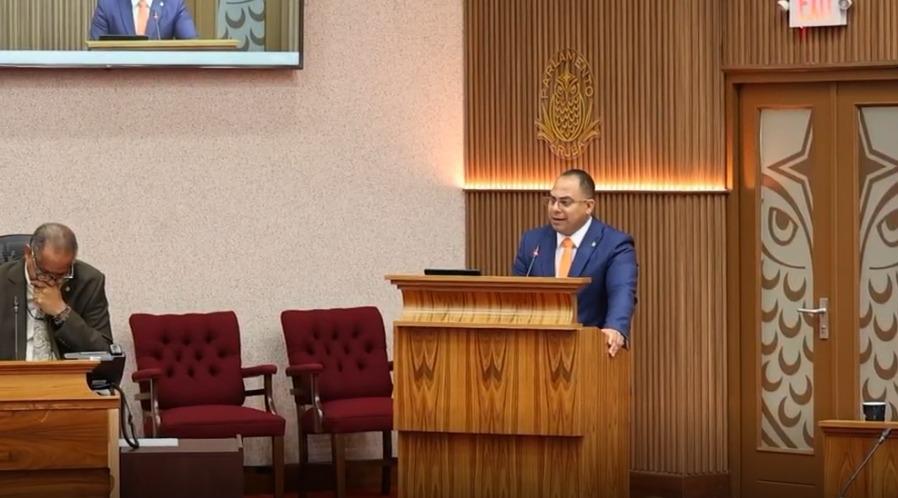
With this phrase, PPA faction leader Eduard Pieters concluded his second intervention in Parliament, transforming a debate regarding a waste management contract into a much larger issue: What limits does the Government have when using public funds? According to Pieters, no one is arguing that Aruba needs to be clean. The objective is correct. But, according Pieters, a good goal can never justify violating the law or weakening Parliament.
ATA was not created to be a Government bank
In his reply, Pieters issued a strong warning. According to the MP, if the Government can use ATA’s funds to finance waste management, the question becomes: Where is the limit? “If today ATA can pay for garbage containers, tomorrow will it be able to pay for road asphalt, school renovations, police body cameras, elderly care, or any other expense that is the responsibility of another ministry?”
Pieters stated that if we follow this logic, ATA loses its original mission and simply becomes an alternative source of financing for the Government. “Well, now we can indeed confirm that Aruba has a new bank: ‘ATA Bank’.”
According to the faction leader, this is not just a sarcastic comment, but a political warning.
Parliament cannot simply be sidelined
Pieters expressed concern that, according to him, Parliament still lacks clarity on how the 16 million florins will be used. “Parliament controls the people’s money. Not a ministry.”
According to Pieters, the danger is that the noble intention of keeping Aruba clean cannot be used as an argument to create exception after exception until Parliament loses control over public spending. “The end does not justify the means.”
The destination of public funds must also follow the law, and for that reason Pieters questioned the decision not to follow a full public tender process, as stipulated by Article 21 of the ATA Establishment Ordinance (Landsverordening Instelling ATA). According to Pieters, a public tender is not created to ensure a single company wins, but to guarantee equal opportunity.
“Now I have received calls from various companies that were also interested in participating. But they were never given the equal opportunity as stipulated by the law.” This is precisely the problem, because it is not just a question of who got the contract, but who never got the opportunity to compete.
A strong Parliament protects good governance
In his final message, Pieters stated that a strong opposition should not be an obstacle to governing. It is a requirement for good governance. “You cannot speak of good governance with a weak Parliament.”
Therefore, PPA will continue to question every decision where there are doubts regarding transparency, legality, and the use of public funds. Because, for Eduard Pieters, the principle is simple:
“A government can have good intentions. But when the law is set aside, Parliament has the obligation to stop and do its job properly and not just agree with everything simply because you support the government, as is the case now.”