

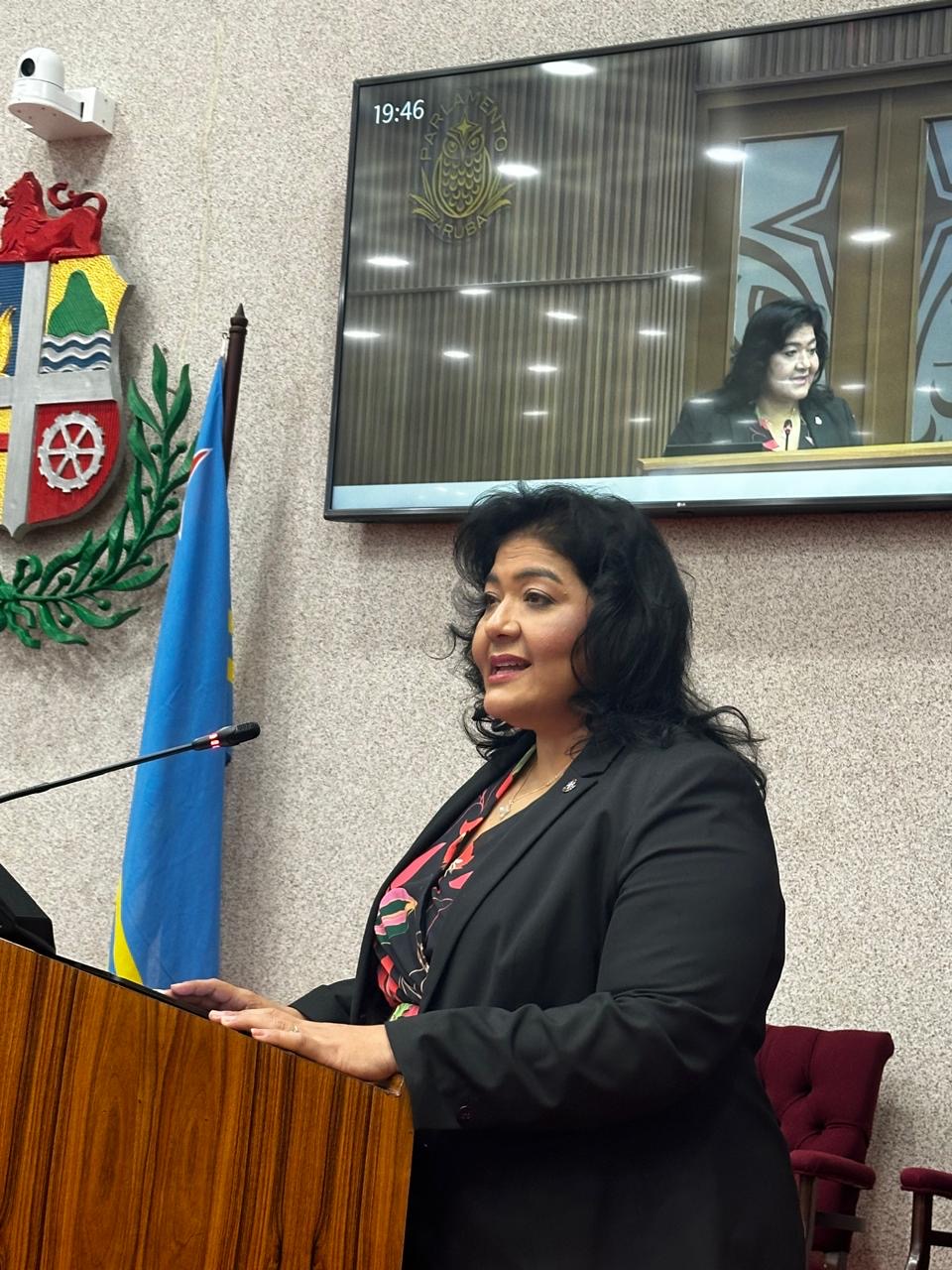
During the first round of the public meeting regarding the situation at the Korrectie Instituut Aruba (KIA), Member of Parliament Xiomara Maduro focused her speech on the financial cost of the crisis and the Government’s responsibility in managing security. According to Maduro, the debate was not just about a prison, but about how the Government protects both safety and the people’s money. “Security is not free, but insecurity costs much more,” Maduro declared.
MP Maduro pointed out that, according to an official statement from the Dienst Gevangeniswezen Aruba (DGWA), the control gates and luggage scanners at KIA were removed without an operational system in place to replace them. According to Maduro, this not only creates security risks but could also result in additional expenses for the public. Therefore, she requested that the Government provide clarity on several important points, such as who made the decision to remove the equipment, whether a risk assessment was conducted, if there was a contingency plan, and if there was a budget to replace the security system.
Another point of concern was the possibility that the current situation could be declared an emergency to make urgent purchases. Maduro stated that an emergency should never be a reason to set aside transparency rules. Maduro also asked if there is an intention to enter into an “emergency contract” or make an “urgent purchase” and, if so, how much it would cost and how it would be guaranteed that the people get the best price.
In the final part of her speech, Maduro returned to the work done by the United Nations Office for Project Services (UNOPS). She recalled that Phase 0 of the project for a new prison had already been completed with funding from the Netherlands, and that the report includes a roadmap, an implementation plan, and an investment calculation of approximately 119 million dollars. According to the report, a modern prison could also reduce operating costs by around 18% per year.
Maduro expressed concern that, despite meetings the Minister held in the Netherlands with the Ministry of Kingdom Relations (BZK) and with UNOPS, Parliament has still not received the documents that were promised. According to Maduro, the public has a right to know what has changed concretely after those meetings and how much the delay in decision-making costs the people of Aruba each month.
MP Maduro concluded that the people of Aruba are paying twice: for a crisis that, according to her, could have been avoided, and for a solution that is not progressing. Maduro emphasized that a lack of decision-making always leads to extra expenses that are ultimately paid by the people of Aruba. “The people are not asking for miracles. The people are asking for responsibility, planning, and transparency. In the end, the bill always lands with the people,” she concluded, insisting that the Government must provide clear answers regarding who will take responsibility for the cost of the current crisis and the delay in the UNOPS action plan.