

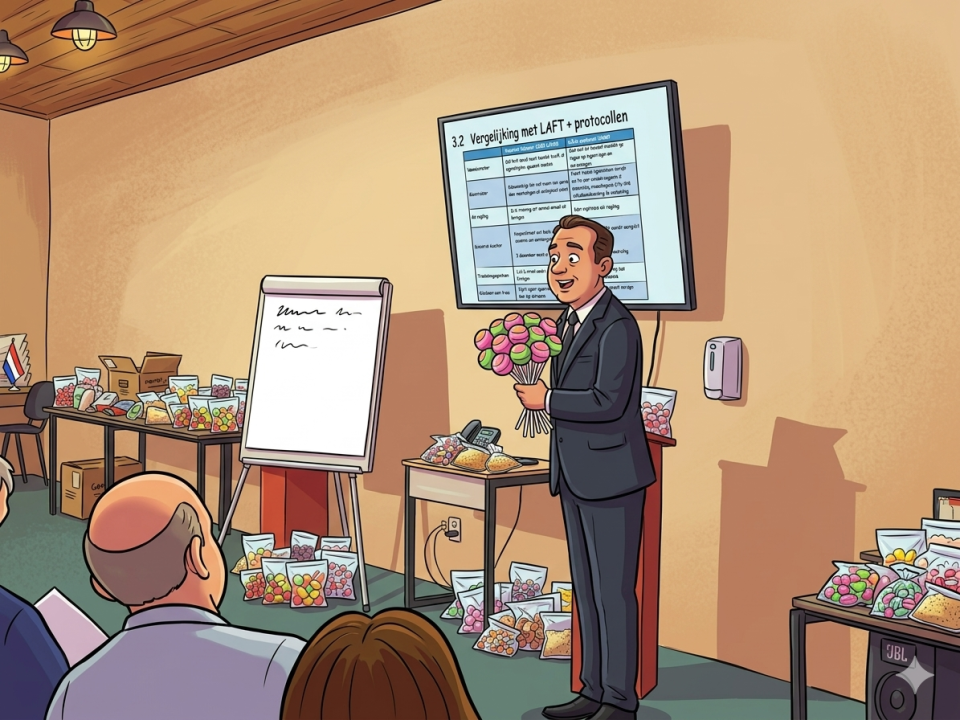
The way in which the Minister of Finance and Culture, Geoffrey Wever, is conducting the information campaign regarding the Kingdom Law HOFA (Rijkswet HOFA) continues to generate strong questioning within the community and political circles. Critics accuse the minister of visiting various local groups completely on his own, trying to convince the public that the law will bring benefits to Aruba—which detractors describe as an attempt to “hand out candy and lollipops” without any structural, technical foundation.
The main point of criticism is that the minister structurally visits these institutions without being accompanied by the legal or financial experts who have actually studied the text of the law in depth. According to protesting voices, the lack of a neutral technical panel raises doubts about the transparency of the presentations.
Questioning over the lack of experts In a debate that is constitutionally as heavy as a Kingdom Law (Rijkswet), the presence of tax experts, economists, and specialists in constitutional law is considered crucial to providing a balanced explanation. Opponents of the minister’s direction point out that these informative meetings are completely one-sided:
- Lack of balanced debate: The law is being sold as a ‘solution’ without presenting the risks or the loss of autonomy that other institutions have already warned about.
- Persuasion strategy: The word “benefit” is being used in a generalized way, which detractors describe as a political attempt to calm the serious concerns that exist among the public and specialists.
Context: What does the HOFA discussion entail? The Rijkswet HOFA is the legal framework that the Netherlands is demanding so that financial supervision in Aruba permanently enters into a Kingdom Law. While the Government advocates that this sends a signal of stability to international markets and lowers interest rates on debts, opponents and some constitutional experts are sounding the alarm. They argue that this law structurally surrenders a portion of the autonomy of the Parliament of Aruba to a supervisory body (such as the CAft) that has more ties to The Hague than to local democratic institutions.
Tension remains high as the public and local groups continue to demand a reality check and concrete data, instead of a purely political and propagandistic campaign from just one side.
To this day, the AVP-FUTURO government has not held an official press conference to inform the people of Aruba about what the Rijkswet HOFA law truly entails. Instead, Minister of Finance Geoffrey Wever goes out completely on his own to tell only one side of the story—what he personally believes is good—without taking into account the constitutional legal advice and various reports already issued stating that the HOFA Law strips Aruba of its autonomy and is not good for Aruba.