

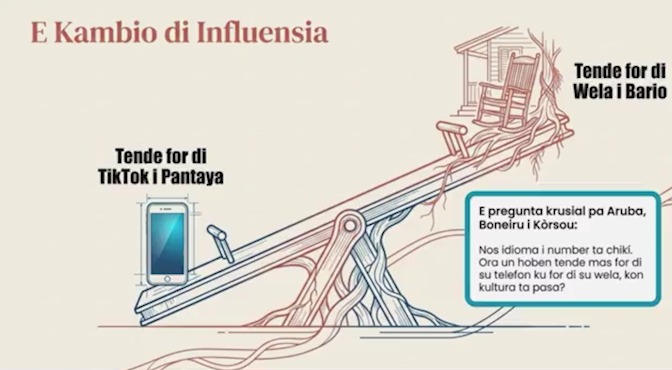
During his recent presentations in Aruba, Jason Fullink, former president of the slavery platform in Curaçao, shared a profound scientific and cultural analysis. He demonstrated that knowing one’s history and maintaining strong intergenerational bonds is not merely a matter of folklore, but rather a determining factor for the mental health of young people.
According to Fullink, the connection between generations has a direct impact on the psychological wellbeing of a population. To support his argument, he cited research conducted by scientists Chandler and Lalonde involving various indigenous groups. These studies proved that in communities where family and cultural ties between elders and youth are strong, young people exhibit better mental health, and suicide rates are drastically lower compared to communities that have lost that connection.
Your Perspective on the World Depends on Your Identity
Fullink explained that identity is the primary tool that structures how a human being perceives their surroundings. “Your perspective is built on the identity you hold,” he affirmed. He used a local example to legacy this point: an Aruban views the world completely differently from someone else, precisely because their perspective is constructed upon their cultural identity.
This identity is reflected in the smallest details of daily life:
• The unique way language is used.
• The local style of humor and joking.
• Traditional food and culinary habits.
• Shared codes of mutual respect.
• Spiritual memories and family stories.
Fullink warned that when these elements are lost, and the knowledge of how to relate to one’s land and sea vanishes, people lose their core essence:
“When that happens, you simply become an extension of another community, losing exactly what makes you unique.”
Integration: Erikson’s Psychological Formula for the Future
Faced with the challenge of how today’s youth can form their identity in a globalized world, the former platform president referenced the theories of the renowned psychologist Erik Erikson. He explained that the most successful development within these groups does not come from blindly assimilating external cultures, nor does it come from trying to repeat the past in an exact, rigid manner.
The best path forward, according to Fullink, is integration. This model implies that the youth take the history and heritage passed down from previous generations, respect that foundation, and then contribute their own modern experiences to transform it for the future.
“Integration is the best approach: protect your foundation while simultaneously embracing what is new. That yields the best psychological outcome,” Fullink concluded, offering a roadmap toward better mental health for generations to come.