


Drs. Melva Croes-Yánez Celebrates Her 35th Professional Anniversary
As a Pioneer of Neuropsychology in Aruba
Through her specialized clinic, the Neuropsychological Ambulatory Aruba (N.A.A.) / Ambulatorio di Neuropsicologia Aruba (A.N.A.), Drs. Melva Croes-Yánez has dedicated herself for over three decades to providing accurate, evidence-based, and culturally adapted neurocognitive diagnostics for the multilingual population, including the Papiamento-speaking residents of the island. She emphasizes that a reliable neuropsychological diagnosis is the foundation for distinguishing mild cognitive decline from major disorders (such as a neurocognitive disorder due to Alzheimer’s disease), thereby ensuring dignified and timely medical intervention.
In 1990, after graduating in the Netherlands, she returned to Aruba. When she applied for a job. At the time, she was told she was overqualified for the island. Undeterred by this, she refused to give up and founded her own clinic 35 years ago: the Ambulatorio di Neuropsicologia Aruba (A.N.A./N.A.A.).
As a resilient Aruban, she fully financed her studies in the Netherlands herself. In those days, not everyone qualified for an Aruban student grant; these were reserved for a specific category of students at the time. She was told back then that she did not receive a grant because her father was a laborer. The first few years in the Netherlands were not easy either; she was viewed and treated as a “foreigner” at the time. Despite this, she managed to pass both her propedeuse (first-2 years general psychology diploma) and her doctoral exam within the nominal study duration. She achieved this by attending university during the day and doing cleaning work through a temp agency in the evenings at the tax authority in Eindhoven.
During her doctoral phase, one of her tasks consisted of translating and culturally adapting test batteries into Papiamento for Aruban patients with a stroke (CVA) or a neurocognitive condition. Additionally, the original test materials (no copies!) in English, Dutch, and Spanish were adapted to various neurological conditions, the Aruban culture, and local Papiamento.
Throughout her career, Drs. Croes-Yánez has performed countless neuropsychological evaluations for various conditions and pathologies in children, adults, and the elderly. She did this under the peer supervision (intervision) of Professor Van der Vlugt and his department, the “Tilburg Ambulatorium for Neuropsychology” (TAN). This intensive collaboration between TAN and A.N.A./N.A.A. continued for 22 years, until the passing of Professor Van der Vlugt in 2016. This partnership formed the key to developing neuropsychology as a recognized profession in Aruba. Professor Van der Vlugt traveled to the island two to three times a year to co-organize workshops for general practitioners, social workers, and teachers, among others, in both Aruba and Curaçao. Their joint participation in high-quality international and local congresses and courses (including in the Netherlands, the United States, Canada, Mexico, and Hawaii)
demonstrates their deep commitment to bringing the most advanced scientific knowledge to the practice of the N.A.A. and aligning it with the local reality.
What is Neuropsychology? Simply put, neuropsychology is a specialized branch of neuroscience that combines psychology and neurology. It studies how the structure and function of the brain influence our behavior, emotions, and cognitive abilities. The neuropsychologist does not examine the brain physically (the hardware, such as with an MRI scan) but assesses how the brain functions in daily life (the software). This is done through specialized, valid, and reliable tests that measure specific brain functions, such as:
*Memory and attention.
• Language and communication (both verbal and non-verbal).
• Problem-solving ability and planning (executive functions).
• Changes in personality or behavior following brain injury or due to degenerative brain diseases.
The Neuropsychology Study Program The curriculum to obtain the doctoral title in neuropsychology (the doctoral program prior to the bachelor-master structure) in 1990 consisted of:
*Neuroanatomy and Neurophysiology: Medical knowledge regarding the structure and function of the human brain and the nervous system. This also includes the basic principles of neuroimaging and the electroencephalogram (EEG), which allow for the assessment of anatomy (structural) or metabolism and cell activity (functional) (e.g., MRI, fMRI, PET, CT, and EEG).
*Neuropsychological Diagnostics: Theory and practice on how and when to deploy specific test batteries. The main goal is not only to detect organic damage but to accurately map the patient’s functional profile, including their strengths and weaknesses.
*Clinical Neuropsychology/Neuropathology: The study of specific brain diseases and brain injuries (such as aphasia, amnesia, neurocognitive disorders—formerly referred to as dementia—and the consequences of a CVA or trauma).
*Psychofarmacology: The study of the mechanism of action and effects of medications and chemical substances on the central nervous system and human behavior.
*Advanced Statistics and Computer Applications: In-depth methodology focused on experimental and clinical neuropsychological research through standardized tests, interviews, and the analysis of medical history.
*Differential Diagnosis: Training to determine whether a cognitive problem (such as a memory disorder) is due to an irreversible neurodegenerative process or a reversible condition (such as a psychological factor like depression or severe stress).
Why is Neuropsychology Crucial in the Neurological Care Chain? Neuropsychology plays an indispensable role in:
*Accurate early diagnostics: Detecting severe or mild neurocognitive disorders when the first cognitive or behavioral changes manifest, even when the brain still appears normal on a structural scan (such as an MRI).
*Evaluation after a CVA or brain trauma: Following a stroke or a severe blow to the head, the neuropsychologist maps out exactly which functions are impaired and which remain intact.
*Personalized treatment and rehabilitation: Based on the patient’s unique strengths and weaknesses, a specific cognitive rehabilitation plan can be drafted so that the individual learns to cope with the situation and maintains the highest possible degree of autonomy.
A common complaint is that patients are quickly told by a doctor after an initial screening that they have Alzheimer’s disease, mixed dementia, or a “normal sign of aging”. Sometimes they are immediately told that nothing more can be done, followed by advice to register at a daycare center, prepare for admission to a nursing home, or even consult a notary…
It should be clear that a low score during an initial evaluation (screening) does not automatically mean that Alzheimer’s is present. Conversely, a perfect score does not guarantee that nothing is wrong either. A screening or initial evaluation is solely intended as an initial signaling tool (indication) to detect potential risks or bottlenecks. It establishes whether there is a cause for concern but does not provide a definitive answer regarding the exact cause or nature of the problem. A conclusive diagnosis may only be made after comprehensive, specialized follow-up research by a qualified professional authorized to do so.
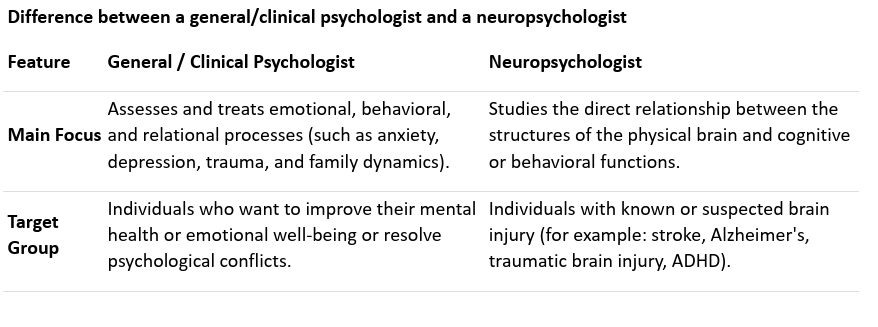
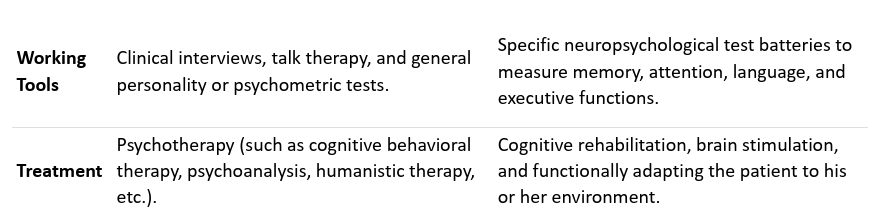
The Difference Between a Psychologist and a Neuropsychologist
At the baseline, a neuropsychologist is a psychologist, but not all psychologists are neuropsychologists. The difference lies in the specialization and the content of the field. A neuropsychologist is a specialized psychologist who masters the complex relationship between the physical brain and human behavior. They focus specifically on how brain health affects thinking, mood, and daily functioning. Upon graduation or graduation with a PhD, Neuropsychologists can obtain a university doctoral or doctor’s title (Ph.D., Psy.D., dr., or drs.) supplemented by a chosen advanced, specialized training.
Difference between a general/clinical psychologist and a neuropsychologist
The Difference Between Screening and a Neuropsychological Evaluation An initial, superficial cognitive test (a screening) is used to detect global problems with memory or thinking. A neuropsychological evaluation, on the other hand, is an in-depth investigation lasting several hours that analyzes how the brain functions in detail. Although both methods assess mental abilities such as attention, they differ completely in their purpose, duration, and the professional conducting the examination.
Initial, superficial cognitive test/ Questionnaires (Screening) such as the MoCA or MMSE test
*What it entails: These tests briefly assess orientation, language, and short-term memory.
*When it is used: During routine medical consultations to determine whether a patient needs to be referred to a specialist (such as a neurologist). It is a very important first step in the process.
*Limitations: Due to its short duration, a screening can overlook mild problems, particularly in people with a high level of education.
Neuropsychological Evaluation (NPE):
*What it entails: An extensive battery of standardized tests that measure intelligence quotient (IQ), executive functions, advanced memory, fine motor skills, and emotional state. The results are statistically compared with norm data from people of the same age and educational level.
*When it is used: To accurately diagnose diseases, disorders, or neurocognitive conditions (such as Alzheimer’s, ADHD, the consequences of a head trauma, learning difficulties, etc.).
*Advantages: It identifies the exact strengths and weaknesses of the mind to establish a specific, targeted treatment or rehabilitation plan.
Situation and Healthcare Infrastructure Regarding Neuropsychology in Aruba
The main role of the Ambulatorio di Neuropsicologia Aruba focuses on functional diagnostics and neuropsychological rehabilitation. Because there are no medical doctors employed at the clinic, no medications are prescribed and no surgical interventions are performed. Normally, medical specialists (such as neurologists, general practitioners, geriatricians, and neurosurgeons) refer patients to a neuropsychologist when they require clarification regarding potential cognitive decline, a neurocognitive disorder due to Lewy bodies, non-acquired brain injury (NABI), epilepsy, etc. Common conditions that a neuropsychologist evaluates include traumatic brain injury (TBI), concussions, neurodegenerative disorders (such as Alzheimer’s, Parkinson’s, etc.), cerebrovascular disorders, developmental and learning disorders (such as ADHD and autism), and seizure disorders.
Unfortunately, since 2014, neuropsychological examinations are no longer reimbursed by the AZV in Aruba. Instead, the AZV advises patients to report to a daycare facility. General practitioners must adhere to the rule that they are not allowed to refer directly for a neuropsychological evaluation (NPE). They are allowed to refer to the Centro di Memoria, where only a basic screening takes place. Here, however, the patient does not receive the complete, in-depth diagnostics nor the diagnosis they are entitled to.
When someone requires a full neuropsychological evaluation—for instance, after an accident, for a ‘second opinion’, or to follow up on treatment, it is of great importance to go to a neurologist first, who will perform a neurological examination, possibly with a scan or EEG, etc. When the neurologist deems specific neuropsychological tests necessary, a referral to a neuropsychologist follows. Drs. Croes-Yánez is currently the only graduated neuropsychologist with a standardized, adapted test battery in Aruba.
A Practical Example: How the Steps Transition into One Another
Suppose a parent or relative repeatedly forgets where the car keys are located.
*Step 1 (Screening): The general practitioner administers the 10-minute MoCA test in the consulting room or refers the patient for a basic screening (this is therefore not a full NPE). The score turns out to be lowered (for example, 22 out of 30 points), which indicates that something is wrong.
*Step 2 (Diagnostics): The general practitioner refers the patient with an official referral letter for a full neuropsychological evaluation (and thus not directly to a daycare center). The neuropsychologist then conducts an in-depth investigation lasting approximately 5 hours. The neuropsychological results determine that structurally, forgetfulness does not stem from stress or depression, but that further differentiation is required. This study can, for instance, demonstrate or rule out a subtle onset of Alzheimer’s, or another (whether reversible or irreversible) neurocognitive condition.
Important Notes for You as a Patient:
*It is of great importance that you ask about the background, titles, diplomas, and experience of the professional when you are referred to for a neuropsychological evaluation. This prevents you from being sent from pillar to post, placed on the unnecessary long waiting list, avoid repetitive consultations, and ensures that you receive a reliable diagnosis in a timely manner.
* Keep in mind that a reliable and urgent neuropsychological evaluation is NOT covered by the AZV in Aruba.
*For an initial, subsidized cognitive evaluation (a screening that does not serve as a diagnosis), you can visit the Centro di Memoria. Step 2 (the necessary specialized diagnostics) is unfortunately since 2014 to currently made impossible within the regular system in Aruba.


