

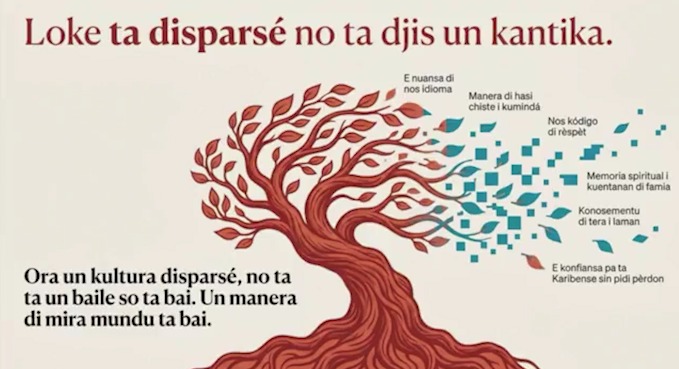
One of the central themes that has recently emerged within the framework of the commemoration of the abolition of slavery is the importance of preserving living history and cultural identity across generations. Jason Fullink, former president of the slavery platform in Curaçao, shared a profound reflection on how the structure of our communities has changed radically with the introduction of modern technology and how this affects our social connection.
According to Fullink, before technology dominated daily life, the neighborhood played a crucial role in shaping human beings. “Before technology entered, your neighborhood was very important. The neighborhood and/or neighborhood center was the school that shaped the community,” Fullinck explained. He recalled how community life centered around harvest festival assemblies, neighborhood centers, church, tambú events, the baseball field, and the home kitchen. All of these were places where the community came together and where culture was passed down from one generation to the next.
The former president emphasized the value of neighborhood centers as the meeting point where different generations met and interacted. However, he expressed his concern about the current reality:
“Unfortunately, that is slowly becoming less because there is technology. And technology causes you to lose that contact with each other from generation to generation.”
For Fullinck, this direct contact is extremely important for the survival of a people’s identity and culture.
Freedom, Resistance, and the Power of the Tambú In his speech, Fullink also referred to the significance of Emancipation Day and the abolition of slavery. He explained that although abolition broke the physical chains, the freedom the people regained went much further than simply stopping forced labor. It encompassed the right of the community to live, speak, and pass down their culture with dignity and without limitations.
As an example of this resistance, he mentioned the tambú instrument:
“We talk about how the tambú survived, because many still came together to contain the tambú. Because the power that the tambú has was something they considered dangerous. Since they could not understand it, nor could they control it, they had to prohibit it.”
Despite attempts to suppress this cultural expression, the tambú survived anyway. Fullinck insists that when we talk about freedom, we cannot remain still, because a free person is always in motion and fights to maintain their heritage.
From “Slave” to “Survivor and Rebel” A key point that Fullinck brought forward is the way language is used to describe the period of slavery. He agreed with the thought that the terminology must change. Instead of speaking of “slave blood,” one should speak of “the blood of a person, the blood of a survivor.”
“Slave was what they went through, but what they are, are survivors, what they are, are rebels,” Fullink firmly declared.
He explained that these individuals rebelled and survived a situation that was normally designed to liquidate them.
Finally, Fullinck raised questions regarding the official figures of the slave trade. He explained that the figures we structurally know are only those that were ‘registered’. However, there was a large amount of piracy where different nations went to the coast of Africa to steal people. Since this merchandise was not sanctioned by governments and operated in an illegal market, many of those real figures never appeared in official registries.
“The fact that these people went through everything they went through for 300 years of struggle, and that even so they managed to make something of their roots survive, that is the heritage we must ensure continues to exist,” Fullink concluded.