

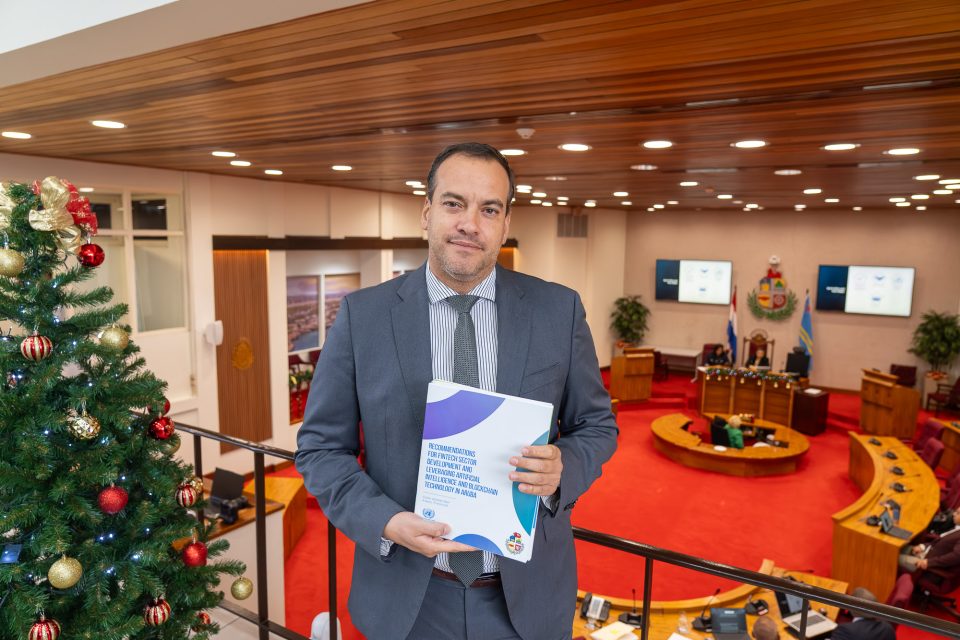
Financial technology, FinTech, is presented as a strategic opportunity for concrete economic diversification, innovation, and export growth. FinTech refers to a broad range of technological innovations within the financial sector that improve or transform how financial services are delivered in order to make them more efficient, accessible, and user-friendly.
As part of Minister Geoffrey Wever’s vision and policy, a study was financed and conducted by the United Nations Economic Commission for Latin America and the Caribbean (UN-ECLAC) in 2025, identifying the opportunities, risks, and obstacles within Aruba’s FinTech sector. UN-ECLAC assessed the ecosystem, conducted stakeholder consultations, performed a comparative OECD and Caribbean-SIDS analysis, mapped the regulatory and institutional environment, and developed a strategic synthesis using global frameworks.
The results of this study form the basis for designing an implementation strategy for the FinTech sector in Aruba, which will be developed jointly with the Netherlands through the Aruba Landspakket. This summary highlights the main results and recommendations. By scanning the QR code below, readers can access the four reports derived from the UN-ECLAC study. Through the …(LINK), the full documents can also be consulted.
Regulatory environment
The analysis highlights significant gaps in Aruba’s current regulations, particularly in areas such as universal service, digital inclusion, e-commerce supervision, and privacy protection. A broader regulatory framework is needed, focusing on better supervision, market incentives, and strategic reforms to stimulate financial innovation. Addressing these gaps and promoting competition could foster an environment conducive to FinTech expansion and modernization of the financial sector.
Opportunities and risks
Stakeholders perceive strong potential for Aruba to become a base for export-oriented ICT services, benefiting from strong infrastructure and a well-trained workforce. However, challenges were also identified, including regulatory and institutional limitations, limited job opportunities, and risk of brain drain. The study emphasizes the need for supportive regulation and initiatives that stimulate innovation and competition within the ICT sector as important pillars of economic diversification.
Strategic recommendations
Strategic recommendations include development of the FinTech sector with focus on the use of AI and distributed-ledger technologies. Aruba’s position within the ICT and financial sectors was evaluated and compared with Curaçao, Jamaica, Trinidad & Tobago, and the Kingdom of the Netherlands. Strengths such as political stability, high education levels, and a robust banking sector were highlighted, along with weaknesses such as small market size and lack of ICT regulation.
The report advocates for regulatory modernization, including broader liberalization of telecommunications, establishment of regulatory sandboxes, and government interventions to support FinTech growth. Ethical use of AI is emphasized, as well as the development of a roadmap for establishing a central-bank digital currency (CBDC). Aruba’s potential to become a digital financial hub is strongly underscored.
Presentation to Parliament
On Tuesday, November 25, 2025, Minister Geoffrey Wever, together with UN-ECLAC representatives Dale Alexander and Kwesi Prescod, presented the study’s findings to the Parliament of Aruba and officially handed over the four reports.
Key recommended actions include:
· Implementing a regulatory reform program with regional partners such as CTU and ECLAC.
· Establishing financing modalities for ICT and FinTech through investors in Aruba.
· Revising free-zone legislation with focus on ICT-oriented incentives.
· Accelerating completion of the G2G and G2C transactional e-Government models.
UN-ECLAC also recommended the following quick wins and next steps:
· Finalizing the “consensus Kingdom law.”
· Conducting a pilot regulatory sandbox with Pay.aw and PSPs.
· Strengthening public-private partnerships.
· Formalizing Free-Trade-Zone incentives.
· Establishing an inter-agency FinTech task force.
Dale Alexander:
“Despite some strategic gaps and constraints, Aruba is well-positioned to develop FinTech services and leverage AI and DLT. There is already some FinTech activity, but the regulatory environment needs strengthening. Our findings provide a strategic blueprint to mitigate challenges and enable the ecosystem as part of Aruba’s broader digital transformation.”
Minister Geoffrey Wever:
“One of the biggest challenges in governance is turning vision into tangible results. I am grateful for our strategic partners — UN-ECLAC, the Netherlands, and our local stakeholders — for working with us in developing Aruba’s FinTech sector. This is not an easy or quick process; it is complex and requires careful, deliberate steps.”
Press Release Minister Geoffrey Wever