

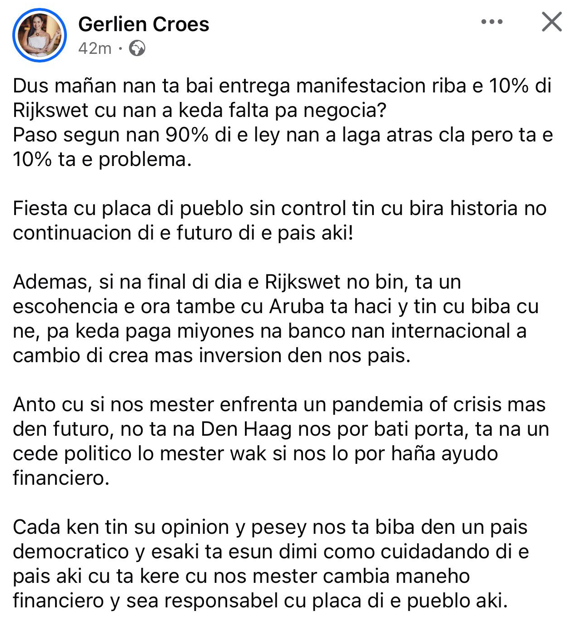
Recently, statements made on social media by Minister Gerlien Croes where she questions the negotiations surrounding the Kingdom Law (Rijkswet) and the remaining 10% that needs to be agreed upon, while claiming AVP-FUTURO failed to negotiate a non-binding Administrative Agreement (Bestuurlijk Akkoord) before it becomes a Kingdom Law have sparked major controversy in the local political sphere. The minister is being reminded that the financial supervision Aruba lives under today has its roots in the very same party she sits with now, which forms AVP-FUTURO.
A Look Back at 2015: The Birth of Supervision
The current discussion surrounding the Kingdom Law on Financial Supervision for Aruba (RAft) cannot be separated from the chronological history of our island’s public finances. It is important to emphasize that the Law on Financial Supervision (LAft) was introduced in May 2015, followed by the installation of the Board of Financial Supervision for Aruba (CAft) in August of the same year.
These decisions were made during the administration of the AVP party—the exact same political constellation that Minister Gerlien Croes is a part of today. Analysts point out that this supervision was the direct consequence of the debt management policy pursued during that period (reckless spending), which forced the Netherlands to intervene to guarantee better control over the people’s money.
Incongruence in the Political Discourse
The primary criticism against the minister is based on what many consider a “lack of historical memory” or simply an attempt to deflect attention away from financial realities. According to critics:
- Shared Responsibility: Questioning the lack of an agreement on the final 10% of the Kingdom Law is viewed as a “sell-out” move, especially when the very party that put Aruba into this debt position is the one now calling for more external control.
- The Risk of “Looking Foolish”: Within journalistic and political circles, it is mentioned that as a minister and a legal expert, Croes should have a deeper understanding of the legal implications and the origins of the crisis. “It is better to stay quiet and not look foolish,” was the sentiment expressed by some opponents who feel the minister is not weighing the gravity of her words when speaking about “partying with the people’s money.”
Challenges in the Negotiations
While the minister argues that Aruba needs this supervision to prevent future waste and to avoid being excluded from financial aid in the event of a new pandemic, this stance remains a subject of formal debate. The point of contention remains Aruba’s sovereignty versus the structural conditions that the Netherlands imposes to refinance debts—debts that were accumulated precisely during the years when supervision was first introduced.
For many, Minister Gerlien Croes’s position lacks political ethics, considering she sits in a government line-up linked to the same past that led Aruba to the very financial supervision she now defends as a “necessity.” The debate over the Kingdom Law remains a sensitive topic that will continue to dominate headlines.