

The debate surrounding the Kingdom Law on Financial Supervision for Aruba (RAft), locally known as the HOFA law, has reached a crucial point where the figures and the most respected institutions of our country speak for themselves. When the highest advisory body of the Government, the labor unions, and thousands of citizens unite in a single voice, the question is no longer just legal, but a matter of democratic legitimacy.
An Unprecedented Alliance of Resistance
It is not every day that we see such a broad union in public and institutional opinion. The resistance against HOFA does not just come from one political corner, but from the very foundations of our society:
- Council of Advice (Raad van Advies – RvA): As the highest advisory body, the RvA gave a legal slap to the proposal, indicating a clear “NO”. When the highest legal and constitutional experts sound the alarm, ignoring them is an act of governmental irresponsibility.
- United Labor Force: No fewer than 13 unions, representing the pillar of our economy and the well-being of thousands of workers, have declared themselves against this law. This reflects a real fear for the autonomy and the economic future of the average citizen.
- The Voice of the Citizen: With more than 12,000 signatures collected, the people themselves put their names on paper to say “enough”. In a democracy, this amount of signatures must carry decisive political weight.
Parliament: The Numbers Do Not Lie
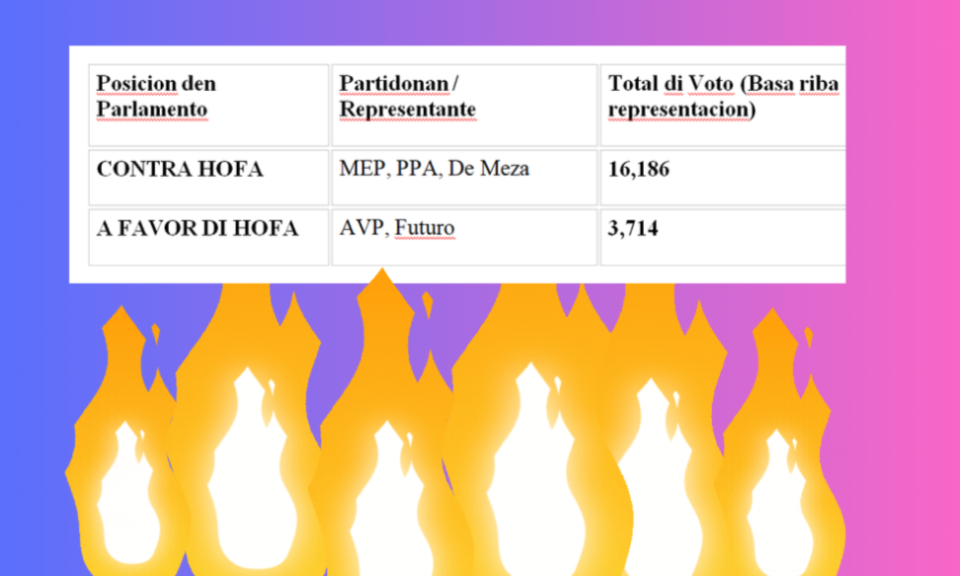
If we analyze the current representation in Parliament based on the last election results of the representatives who have already stated their positions, the difference is striking and alarming for the parties that still support HOFA.
| Position in Parliament | Parties / Representatives | Total Votes (Based on representation) |
| AGAINST HOFA | MEP, PPA, De Meza | 16,186 |
| IN FAVOR OF HOFA | AVP, Futuro | 3,714 |
This contrast of 16,186 against 3,714 shows that support for this law is minimal compared to the massive rejection. How can a minority claim to impose a law that has such a profound impact on our constitution and financial autonomy?
Conclusion: Autonomy is Non-Negotiable
The argument and the way Minister Geoffrey Wever is acting—with an arrogant attitude of “only we are right and the rest are wrong”—no longer holds water. When 10 out of the 21 Parliamentarians, almost the entire opposition, the advisory bodies, and the people on the street say “NO”, the Government must stop and reflect.
The HOFA Kingdom Law, in its current form, is not only seen as a threat to the budgetary rights of Parliament, but as a violation of the popular will. Aruba has spoken, and the message is loud and clear: HOFA has no place in our constitutional future, especially regarding Article 38. Financial supervision, yes, but Article 38 in the HOFA must be evaluated.
The presented data underlines the need for a true national dialogue where the interest of the Aruban people comes before external demands. A national front must be formed to safeguard the Country of Aruba.
As the figures show in parliament, MEP, PPA, and Mike de Meza must be able to come together for what their hearts beat for today: their people.