

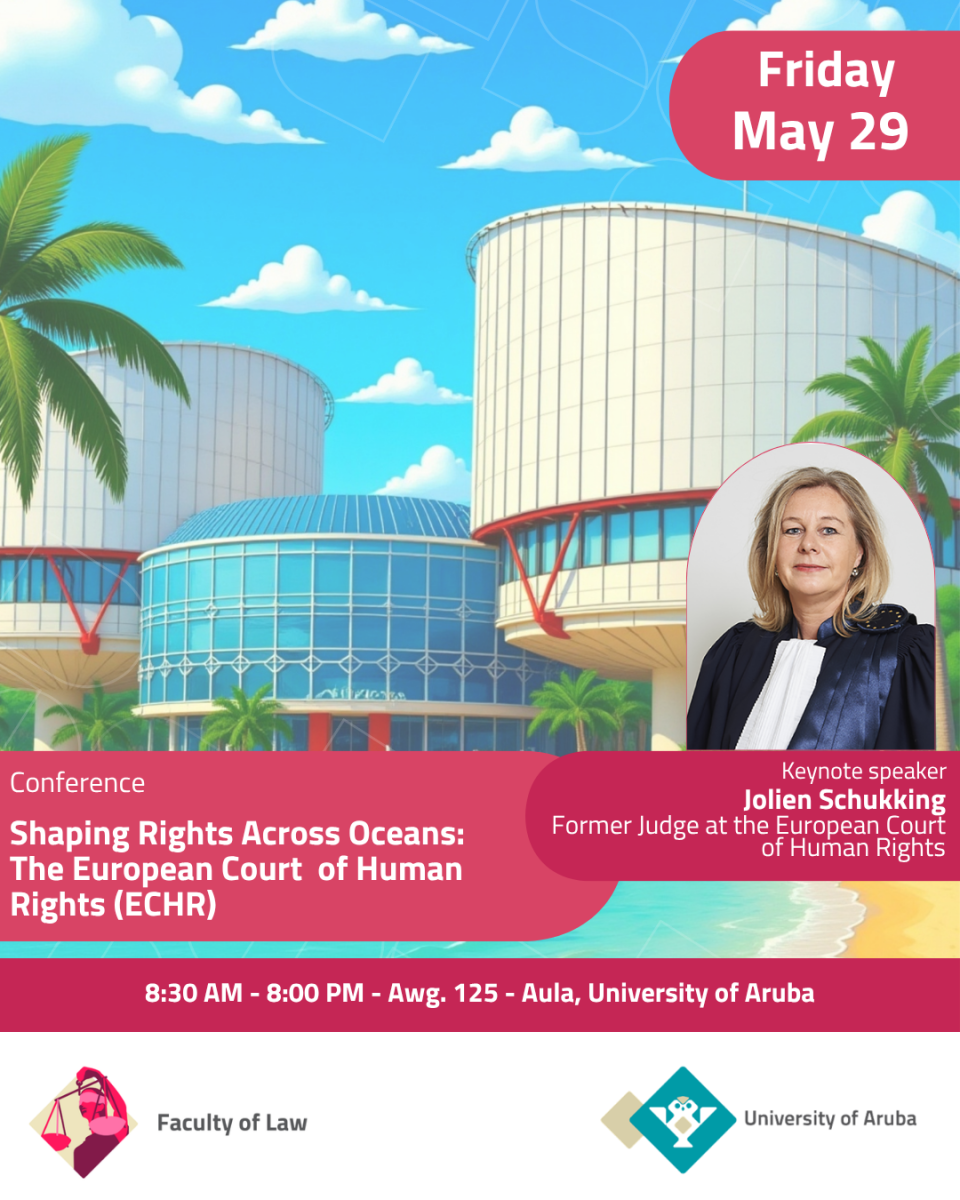
On November 4, 2025, the European Convention on Human Rights (ECHR) celebrated its 75th anniversary since it was first drafted and signed by the members of the Council of Europe. The ECHR is also applicable to the Caribbean overseas territories of certain European States, namely France, the Netherlands, and the United Kingdom. The applicability of the ECHR in the Caribbean territories has not drawn significant attention in the Court’s jurisprudence and scholarship, raising important questions: Are the rights under the ECHR effectively accessible, invoked, and enforced in the Caribbean territories? Do political choices, local constitutional arrangements, or governance structures influence when and how the ECHR is used? Is the ECHR integrated into local legal cultures, legal education, advocacy strategies, and public discourse?
The University of Aruba is organizing a one-day multidisciplinary conference on May 29, 2026, exploring the influence of the European Convention on Human Rights in the Caribbean. The primary language of this conference will be English. The main objective is to bring together diverse professionals and legal experts to analyze how the rights guaranteed in the ECHR are interpreted, contested, and realized in the courtrooms and communities of Caribbean territories. The University of Aruba invites everyone in our community who is interested in gaining more knowledge on this topic to participate in this informative and educational conference on May 29. For more information, you can contact us at cll@ua.aw.
Keynote Speaker
Jolien Schukking served as a judge at the European Court of Human Rights (ECtHR) (2017–2026) and sat on the Dutch bench from 2009 to 2026. Her distinguished career includes serving as the Agent for the Netherlands before the ECtHR and United Nations bodies, and as Senior Legal Advisor for the Ministry of Foreign Affairs. A prominent lecturer on human rights law, she has chaired numerous international legal groups, including the Judges for Judges Foundation. She has also served with the Permanent Court of Arbitration and holds a law degree specializing in Dutch and Aruban corporate law.