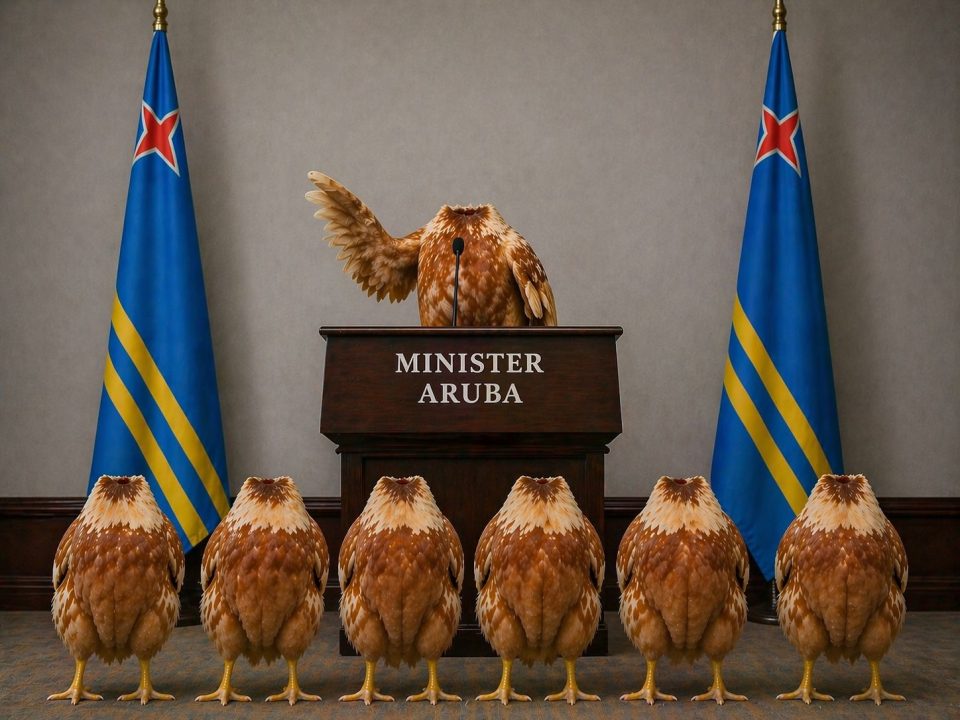
As the political landscape in Aruba continues to transform, serious concerns are arising within the community regarding the current government’s lack of direction. The introduction and discussions surrounding the Kingdom Law (Rijkswet HOFA) and the National Law (LWHO) have generated a wave of questions. A large portion of the public and analysts criticize the lack of transparency from political leaders, labeling the current situation as one of the weakest periods in the island’s recent political history.
Uncertainty surrounding financial future and autonomy
One of the strongest points of criticism is directed at the lack of concrete, real information regarding the impact of the HOFA. The leaders of the governing coalition are not providing clarity on the final stages of the LWHO. There is serious questioning that, if this law passes in Parliament, it could formally limit the legislative body’s capacity to voice opinions and decide on its own budget. Once the LWHO takes effect, it will create a structure where structural decisions will remain tied to the conditions of the Kingdom Law (Rijkswet), restricting local competence (bevoegdheid) until that legal framework expires—a scenario that, given current demands, does not look easy to escape.
A legitimate fear exists within economic sectors that the implementation of these laws could compromise public finances and, consequently, the well-being of the ordinary citizen. The lack of structured and assertive communication with the public leaves much to be desired. Today, June 6, 2026, after more than a year of the AVP-FUTURO administration, there is still no Management Plan outlining what the Kingdom Law HOFA and the LWHO entail. Furthermore, the National Performance Framework (Landsbesluit Inrichting Management – LIM) has formally not been officialized, which raises legal questions about the basis of various adopted decisions. The lack of a formal plan is popularly debated as a state of institutional disorder. Parliament, for its part, is questioned for its lack of fiscal oversight, acting on many occasions simply as an approval body for the Executive.
Individual actions and ministerial controversy
The lack of a unified direction is evident in the way ministers function within their respective portfolios, exposed by isolated decisions and public controversies:
• Minister Geoffrey Wever: He is being questioned for an active campaign to promote the HOFA product, which several sectors consider harmful to the financial stability of Arubans. Additionally, his “Agri-enovation” policy is receiving criticism for allegedly pushing local companies and farmers aside to clear the path for external investors. Furthermore, a trip to the Netherlands regarding the refinery has been questioned, given that this area falls under Minister Dowers.
• Minister Gerlien Croes: She faces severe criticism within political circles for her lack of experience, freshness, and her answers to formal questions asked by Parliament regarding the controversy surrounding her trips in a private jet. Her bad decisions include closing a youth and children’s department without a proper foundation. As minister of education, for the first time in Aruba’s political history, there is allegedly a large number of teachers leaving the education field.
• Prime Minister Mike Eman: Marketing himself in neighborhoods, he is criticized for executing a purely populist policy in local communities without giving a real alternative or a concrete plan to confront the HOFA and LWHO, and without assuming the legislative leadership role that the country needs at this moment.
The greatest weakness of the current administration is the internal dynamic among the ministers. It is evident that there is an overlapping of functions (a “criss-cross”) where ministers intervene in each other’s portfolios without central coordination from the prime minister’s office. This lack of consistency—where one day a stance is declared and the next day actions contradict it—weakens institutional trust. For many, this lack of cohesion gives the impression of an unstable cabinet, devoid of a real, long-term vision for Aruba.
The alleged violation of rules, the ignorance of administrative procedures, and the lack of respect for national laws structurally lead to the conclusion that Aruba is facing one of the most inefficient administrations in its democratic history. To restore trust, political games and the lack of accountability must stop, clearing the way for a serious, transparent governance committed to its people.
Editorial: Aruba at a Crossroads: Lack of Transparency Regarding HOFA and LWHO, and the Institutional Governance Crisis