

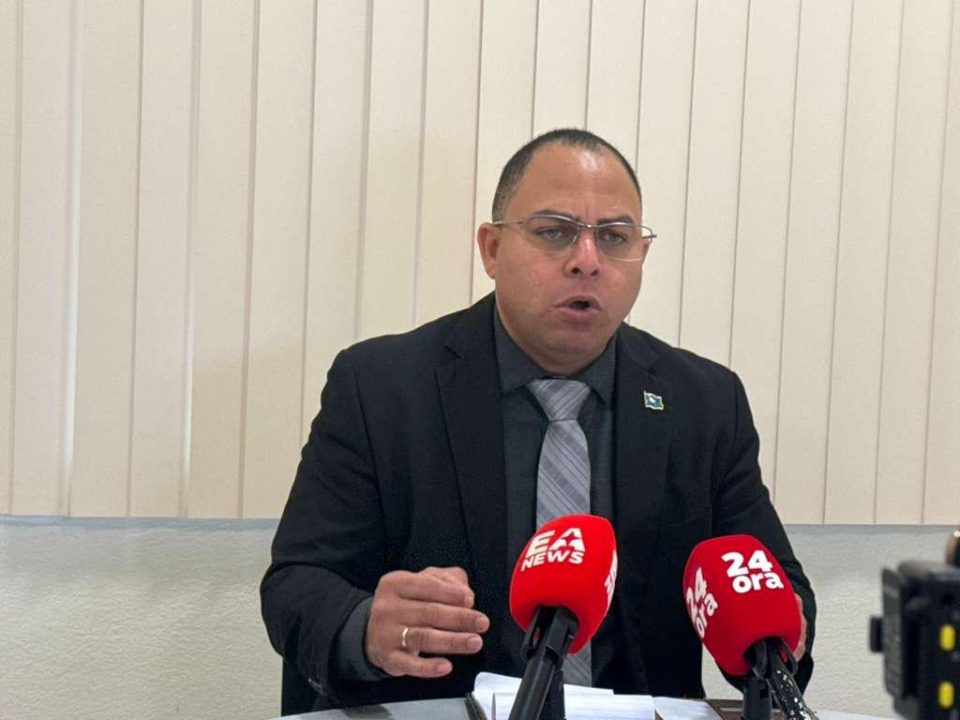
There are moments in the political history of Aruba where silence becomes complicity. For the PPA faction, the recent declaration by State Secretary Eric van der Burg in the Netherlands is precisely one of those moments. According to Member of Parliament Eduard Pieters, the statement not only confirmed that the Kingdom Law HOFA (Rijkswet HOFA) continues to advance within the Dutch Kingdom, but it also revealed something much more serious: that the government of Aruba has permitted a process without democratic consensus, without broad support, and possibly outside the constitutional framework.
Which consensus?
According to Van der Burg, consensus exists because Minister Plenipotentiary Schwengle presented the Rijkswet HOFA in the Kingdom Council of Ministers (Rijksministerraad), and there they reached a consensus for the process to proceed to the Council of State (Raad van Staten). But for the PPA, this statement is a head-on collision with the political and constitutional reality of Aruba.
“Which consensus?” Pieters asks. “At no point did the Parliament of Aruba approve the Rijkswet HOFA, nor did it give a formal instruction to the government to send this law to the Kingdom Council of Ministers, which contests the agreements made in IPKO in 2022.”
According to Pieters, this is the central point that the government is avoiding. Parliament, as the direct representative of the people, never voted on or approved the process. Without that democratic step, the PPA argues that there is no constitutional legitimacy or broad support to say that Aruba has given consensus.
Advisory Council called this process worrisome
Pieters placed emphasis on the devastating advice from the Advisory Council (Raad van Advies), which strongly criticized the way the government handled the process. According to the Advisory Council, the government did not wait for that constitutional institution to issue its advice and sent the law to the Kingdom Council of Ministers without prior counsel.
But the strongest criticism was directed at the principle of the “Nemo-plus principle” (Nemo-plus-beginsel), where the Advisory Council indicated that a minister has authority defined in the Constitution, but cannot create additional authority for themselves outside the constitutional framework and apply conditions tied to a law.
“So, what are we seeing today?” Pieters questioned. “A government that bypasses Parliament, bypasses the Advisory Council, and seizes power that is not anchored in our Constitution.”
The people have already said no
For the PPA, Van der Burg’s statement creates a false perception that Aruba has already accepted HOFA. However, Pieters emphasizes that the social and political reality is exactly the opposite.
“There are more than 10,000 signatures against the Rijkswet HOFA. There are 13 unions that have publicly declared that this law goes against our Constitution. We have a populace that clearly does not agree.” According to Pieters, the resistance against HOFA has already transcended political colors. “There are people from all political parties approaching the PPA to state clearly that they do not want Aruba to surrender its autonomy.”
Status Aparte is not negotiable
One of the points that concerns the PPA the most was Van der Burg’s statement that through HOFA, the countries within the Kingdom would finally become “equal”. For Pieters, this is a direct threat to Aruba’s Status Aparte.
“Since 1940, our people have fought for more autonomy, and in 1986 Aruba achieved its Status Aparte, becoming a country within the Dutch Kingdom alongside the Netherlands Antilles and the Netherlands. Now, they cannot come and change that via a kingdom law without following the procedures required by our Statute and Constitution.”
Pieters recalled that Article 55 of the Statute requires a much more rigorous process to change Aruba’s constitutional position, including two parliamentary readings and a two-thirds majority to approve the change. “It is not something that can happen secretly in an office in The Hague,” he declared.
The people will take a stand
In his final message, Pieters launched a strong political warning to both the government of Aruba and the Dutch Kingdom. “We are not talking about a financial law only. We are talking about autonomy, about democracy, and about respect for our Constitution.”
According to the PPA, if the government and Parliament continue to ignore the constitutional and social concerns surrounding HOFA, the people themselves will take a stand. “The history of Aruba has shown one thing clearly,” Pieters concluded. “When the leaders do not protect the country, the people will do it themselves.”