

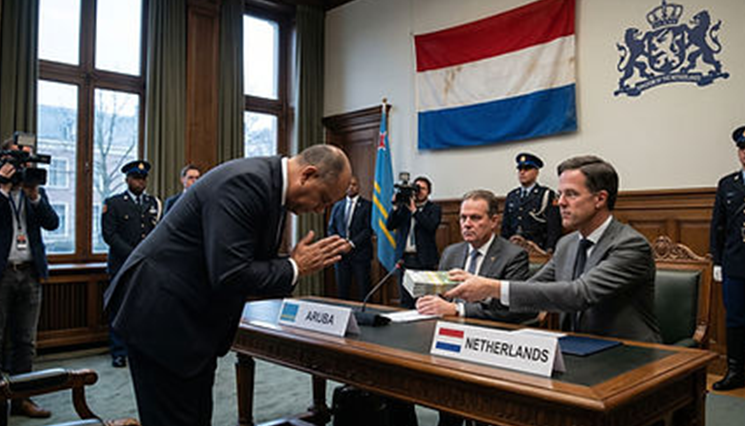
Within the context of the impasse between Aruba’s autonomy and the financial supervision from the Netherlands—particularly since 2015—HOFA emerges. The cardinal question remains: if Aruba does not sign HOFA, what happens next?
What is HOFA and what happens if Aruba does not sign?
What is HOFA? First of all, what is the Rijkswet HOFA? In simple terms, it is a Kingdom Law (enacted by Aruba and the Netherlands together) that sets financial rules for Aruba. It sets a limit on Aruba’s debt, demands a realistic budget, and requires the government to be regularly accountable.
An independent commission would review the budget and advise the Netherlands on whether Aruba is complying. If Aruba complies, it gains access to “cheaper” loans. If not, there is more supervision (read: control). This latter part gives many people the feeling of “if you fail, you get punished,” adding fuel to the fire of the entire discussion.
If Aruba does not sign? Now the million-dollar question: what happens if Aruba does not sign HOFA? Basically, there would be more political freedom in the short term. Aruba could decide what it wants to do and where it spends its money. Aruba could decide to borrow without obtaining lower interest rates, and life goes on. Financially, this is not very attractive, but it gives Aruba the maneuverability of complete autonomy.
However, as I explained in Part 1, trust from the Netherlands will remain low. That could result in other or stricter control mechanisms at a time when Aruba is in a bind and needs to borrow again. Due to this low trust, the Netherlands might only be willing to provide guarantees under much harsher conditions next time.
In other words, we are cornered. After 40 years of lacking financial and political discipline, Aruba is in a corner. If we do not strengthen our country, some form of supervision becomes inevitable, whether in the short or long term. Looking at the conflict in the Middle East, it seems more likely to happen in the very short term, as this is the most realistic situation.
Weak Institutions What specifically contributed to this situation is the decolonization process, which never truly finished. This is not just a historical fact; it lives within our institutions to this day. Aruba still lives with a colonial mentality, where we react more with emotion rather than structure or demonstrating that we have done our part.
This makes it difficult for institutions to function optimally or fully professionally. Why? Because institutions fall under political dominance. It is clear that politics is governed entirely by emotion and populism instead of sound judgment. In the quest to score points and win “at all costs,” justice is forgotten, and the rights and futures of our children, the vulnerable, the elderly, and citizens who are afraid to speak their minds openly are trampled upon.
I have said this before and I will say it again: we are living in a form of silent tyranny due to the culture of fear created by the system. This cannot be separated from the colonial past we inherited. We have created our own elite that rules, and now that “the cow is drowning,” they want us to either embrace the Netherlands as our savior or become patriotic to stop HOFA at all costs, claiming it would send us back to the colonial era. Meanwhile, the People are confused and no longer know who or what to believe.
What Now? The colonial mentality exists within the people as well. It is reflected in the way we vote, how we complain without demanding accountability through healthy discussion, and how we spend money. But we must not remain in a victim mentality forever. We have the option to consciously choose a better future.
My advice: consider accepting HOFA under strict conditions that help Aruba. Not as something imposed, but as a conscious decision. Not for the Netherlands, but for ourselves.
However, there is a catch! This decision must have CLEAR conditions that Aruba chooses for itself. HOFA must have a clear goal: to strengthen our own institutions—the Central Bank, the General Audit Chamber, government departments, and the Public Prosecutor’s Office. These must be institutions that can monitor, correct, and act without political pressure from any party, cabinet, or the current Parliament.
The People Have the Power I propose a 10-year CLAUSE.
During these 10 years, Aruba can strengthen its institutions, improve financial discipline, and increase transparency. The process could even have phases: strong supervision (years 0-3), followed by reduced supervision (years 4-7), and a final evaluation (years 8-10). The end must have objective criteria: debt is under control, the budget is balanced, and independent oversight is functioning well.
HOFA with Conditions If we comply, HOFA can terminate automatically at the end of 10 years. Not by political will, but by measurable and concrete results. This is not pro-Netherlands; it is strictly pro-Aruba.
Autonomy doesn’t come from confrontation; it comes from competence. To show that we are capable of doing our job and doing what is right. The final test of autonomy is this: the decision is now in our hands.
Jayburtt J. Dijkhoff, PhD Expert in Health Rights, Quality of Care, and Social Reflection