

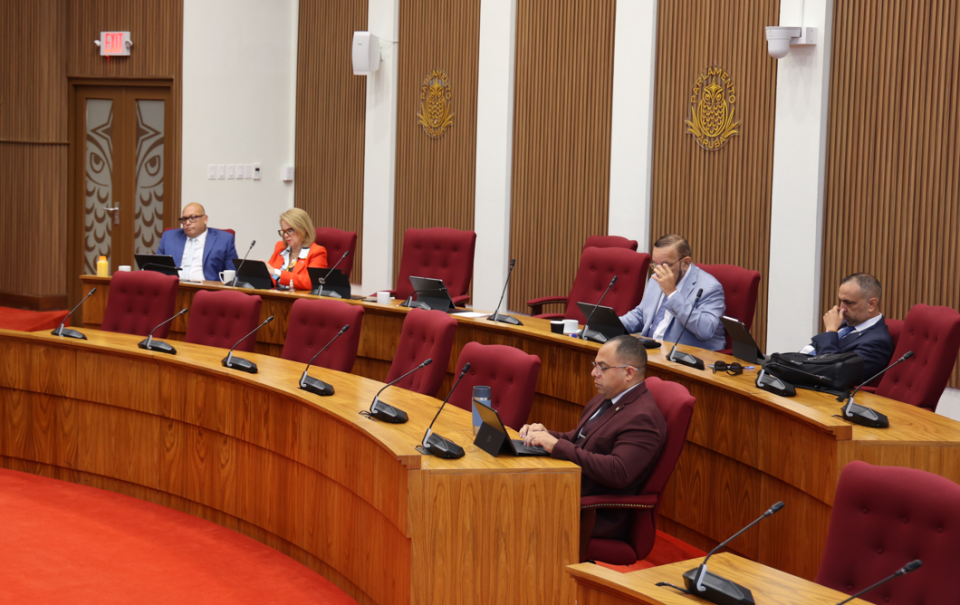
The debate surrounding the contract for waste management under the instruction of Minister Cicilia, financed by the Aruba Tourism Authority (ATA), has continued to dominate public opinion. However, according to Parliamentarian Eduard Pieters, leader of the Aruban Patriotic Party (PPA) fraction, many people still do not see the real problem.
According to Eduard, the issue is not a debate between the Government and a private company, nor is it a question of containers or neighborhood cleanliness. The main issue is much larger: Did the Government follow the law, or did it choose which part of the law it wanted to apply?
During an interview on Enfoke 90, Pieters stated that the PPA fraction has never opposed the goal of achieving a cleaner Aruba. On the contrary, according to Pieters, waste management is a national challenge that requires sustainable solutions. But a good goal cannot serve as a justification for casting aside the legal procedures that protect the people’s money.
“The end does not justify the means.”
With this phrase, Pieters synthesized his entire political argument. According to him, this principle is the foundation of the Rule of Law. If the Government can ignore a law because the final outcome is positive, then no law will have real value. For Pieters, the question the minister must answer is not whether Aruba needs better waste management. The question is much simpler and much more serious: Did the Government follow the law?
Did the Government follow the law?
The PPA maintained in Parliament that Article 21 of the Aruba Tourism Authority Establishment Ordinance (Landsverordening Instelling Aruba Tourism Authority) clearly stipulates that Minister Cicilia and ATA must ensure that public bidding procedures (destaho publico) are followed when dealing with contracts exceeding a certain financial threshold.
According to Pieters, after two days of debate and various requests for documentation, the PPA has still not found evidence that the mandatory public bidding process was fully followed. Consequently, Pieters formally requested that the Government provide additional documentation and a full explanation in writing.
“The debate is not against a company, nor is it against the director or individuals on ATA’s board. It is not against making Aruba clean. The debate is whether the Government ensured it followed what the law dictates.”
For Pieters, this is not merely an administrative matter; it is a constitutional precedent. The parliamentarian warned that accepting an exception today opens the door to many other exceptions tomorrow. “If we accept that the Government can bypass the law because the goal is good, tomorrow the same argument can be used for another contract, another ministry, and another public fund.”
Democracy loses its value
According to Pieters, the concern grows even greater because Aruba is a country based on trust in its institutions. Public bidding laws were not created to complicate the Government, but to protect taxpayers, guarantee fair competition, and prevent any suspicion of favoritism or conflict of interest.
The parliamentarian indicated that precisely in moments like this, Parliament must stand firm. “If there are no questions, there is no control. If there is no control, transparency becomes an empty word.” Pieters also noted that the PPA did not rush directly to court or other authorities; instead, they preferred to use the democratic instruments available to Parliament: requesting public meetings, demanding documentation, and giving the Government an opportunity to clarify the situation.
If the procedure violates the law, the decision must be declared null and the responsible minister held accountable. “We are not looking for confrontation. We are looking for clarity.” For the PPA, the true danger is not just the current contract, but normalizing the idea that the Government can interpret the law however it wishes when it deems the objective important enough. That, according to Pieters, would fundamentally change how the Government functions.
Pieters concluded that the answer to this question determines not only the future of the ATA contract, but also how much value Aruba will continue to place on its Rule of Law, its democracy, and the fundamental principle that no Government is above the law.