

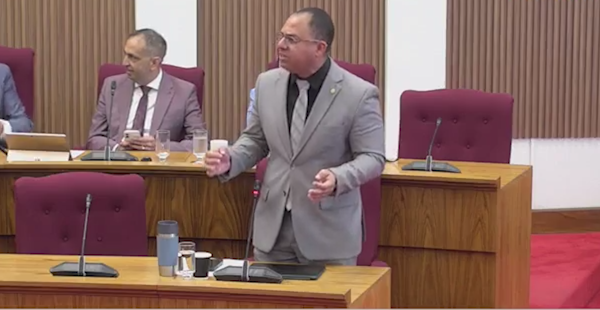
PPA confronts Government on LNT: “For the airport and HOFA, they didn’t ask our opinion. Why today, suddenly, are our ‘feelings’ important?”
When the Government made an exception to the Top Incomes Standardization Act (Landsverordening Normering Topinkomens – LNT) for the airport director, Parliament was not consulted at any point. When the HOFA Kingdom Law (Rijkswet HOFA) proceeded to the Kingdom Council of Ministers (Rijksministerraad), according to PPA parliamentarian Eduard Pieters, Parliament was likewise given no opportunity to provide its opinion beforehand.
Yet today, as the Government seeks to amend the LNT, it has the audacity to stand before Parliament and ask: what are your ‘feelings’? For Pieters, this contradiction is too significant to ignore and resembles a mockery of Parliament.
When the Government does not need Parliament Pieters brought up the HOFA matter directly in the debate as an example. According to Pieters, the Government did not come to Parliament first to seek its opinion on the HOFA Consensus Kingdom Law (Consensusrijkswet HOFA), as was agreed during an IPKO. They merely informed Parliament that the proposal had already been sent to the Kingdom Council of Ministers.
Pieters poses the same question regarding the LNT, where the Government previously authorized an exception for the compensation of the Aruba Airport Authority’s CEO without prior consultation with Parliament.
“Parliament is not a rubber stamp” For PPA, this is the fundamental problem. The Government cannot bypass Parliament on sensitive decisions and later seek its backing only when it needs to amend a law.
“We are not here to be used solely when it is convenient for the Government.” For Pieters, Parliament is not a political rubber stamp to legitimate decisions the Government has already decided to make. It is a democratic body tasked with holding the Government accountable.
Who is going to earn more? Pieters’ primary concern centers on proposal number 4 in the AVP-FUTURO Government’s plan for revising the LNT: the introduction of differentiated and tailored standardization, taking regional context into account.
However, PPA wants to know what this means in practice. Who will benefit? Which director? Which entity? How will the salary be calculated, and who will determine the amount? What criteria will be established? How and by whom will the standards be enforced?
Pieters also questions what the Government means by “region.” “Which region are we comparing ourselves to? The Caribbean? The Netherlands? The United States?” For Pieters, Parliament cannot approve a concept without knowing the criteria that will subsequently dictate how much a top official can earn.
What happens to vital institutions? Pieters mentioned A.T.A. and the Central Bank of Aruba as institutions holding unique positions that must compete internationally for high-level professionals.
He wants to know which state-owned companies, entities, or roles the Government intends to eventually bring under this new system. Therefore, PPA demands a full list and total clarity before expressing any positive stance.
Transparency before “feelings” For Pieters, the Government cannot ask Parliament for an abstract opinion without detailing what the change will actually produce. “Before we offer any positive sentiment, we demand total transparency. How was the LNT evaluated? Who is going to earn more? Who is this for? And why?”
The debate is therefore not merely about salaries; it is about how the Government treats Parliament. If Parliament’s opinion matters, it cannot matter only when the Government needs a “yes.” Parliament is not a rubber stamp. Parliament exists to hold the Government accountable, especially when the Government would prefer not to be controlled.