

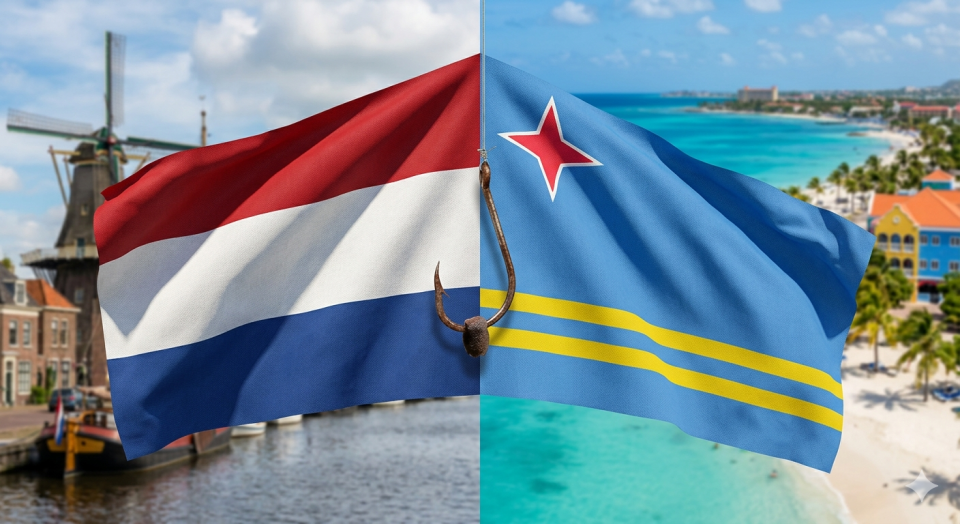
From the official spheres of the Netherlands, the argument sounds extremely tight and convincing on paper: borrowing money through the Netherlands means paying half the interest compared to the American or international market. According to calculations by State Secretary Eric van der Burg in The Hague, this would mean savings of tens of millions of florins that could be injected into infrastructure, house construction, and the remediation and investment in the refinery—a topic that Dutch sources themselves confirmed was part of recent conversations with Mike Eman (AVP) in the Netherlands.
However, we must not forget that it is an open secret that this vision reminds the community that this formula is structurally identical to the 2014-2017 period. Back then, under the AVP administration, astronomical sums were borrowed that plunged the Country of Aruba into an unprecedented debt crisis, which is precisely what opened the door for the Netherlands to step in with supervision. The current promise of multi-million dollar investments in the refinery, financed with new debt—even if the interest rate is lower—is seen as a comeback of that very same management. The AVP-FUTURO government is plunging Aruba into astronomical debt once again, but who will have to pay for this sooner or later?
The Radical Condition: No Money Without LAft/RAft
The Netherlands does not hide the fact that this favorable interest status, based on their ‘Triple A’ financial rating, carries a very high political price tag. This “cheap money party” is legally tied to a definitive condition: the approval of the National Ordinance (Landsverordening) in the Parliament of Aruba and the structural dynamics of the Kingdom Law (HOvA/RAft) in the Senate (Eerste Kamer) and House of Representatives (Tweede Kamer) in the Netherlands.
“If they reject the National Ordinance over there, the Kingdom Law will not pass either. And if the National Ordinance is rejected, then they simply have to borrow on another market,” the State Secretary emphatically declared.
Aruba’s Dilemma: Proud Autonomy or Economic Dependence
With this scenario on the table, the choice for the future of Aruba is formulated into two radically opposed options:
Accept structural supervision: Align with the plan that AVP has been preparing, opting for cheap Dutch money to execute large projects (such as the refinery), but accepting that The Hague gets the structural ‘Masterlock’ to decide on Aruba’s finances, and will decide in the future what is/is not allowed in Aruba.
Seek the international market: Reject the demands of the Netherlands to protect the Constitution (Staatsregeling), with the direct consequence that Aruba would have to borrow at much higher interest rates, limiting public spending capacity but conserving its legislative sovereignty and allowing it to borrow internationally. Taking the stance that the Netherlands is not respecting how to treat others according to the Charter (Statuut).
The situation in the Parliament of Aruba is described from The Hague itself as “very tense indeed.” While the Netherlands uses its world-class interest rates as an ace up its sleeve, the people of Aruba face the decision of allowing a structural “Debt 2.0” or standing firm in defense of its constitutional autonomy, where they pay the Netherlands back and then run on their own profit without depending on the Netherlands.