

A recent incident or calamity at a nursing home located in Tanki Leendert, which put the life of an elderly person in serious danger, has raised a wave of concern in the community of Aruba, even leading to the disqualification of the nursing home’s management. This calamity, which directly put the safety of the residents at risk, brought to light a structural problem: the risky combination of vulnerable elderly adults together with a person suffering from severe addiction, which may have caused a sudden aggressive outburst. The mentioned event is a demonstration of the lack of capacity and structural tools of this nursing home’s management to responsibly handle the safety of its patients.
Relatives of the residents and the community in general are demanding an immediate answer as to how a situation of this magnitude was allowed to escalate, and are asking, “What on earth is a person with an addiction problem doing together with (vulnerable) elderly adults as patients?” They also wonder if this addict could have combined his medication and/or drugs with another patient’s medication, which could have caused his abrupt aggression. Thus, many unanswered questions remain.
Regular nursing homes are designed to offer a calm, peaceful environment with preventive or maintenance medical care for our elderly. Introducing a person with one or another severe addiction into this same space, without adequate staff and infrastructure, is a recipe for disaster. The lack of specialized supervision results in situations where the elderly person, who is in a vulnerable position, is exposed to tension, insecurity, and the danger of physical abuse, as well as emotional/psychological abuse. This, in turn, will certainly influence the mental state of the nursing home’s residents, who must also receive professional care, preferably not with more medication added to the amount the patient is already taking.
1. Lack of capacity and responsible care management
The calamity in Tanki Leendert underscores the urgent need for the Minister of Public Health, Social Affairs, Elderly Care, and Addiction Management, their departments, and the nursing home management itself to reevaluate their policies. Aside from the lack of trained staff to handle addiction crises, the lack of professionalism is glaring. A regular nursing home cannot and should not function as a rehabilitation center or mental crisis center without the required certification and security measures.
Demand for immediate action
This incident must serve as a point of maximum urgency for this ministry and competent authorities in Aruba. It is imperative to:
*Separate the two types of care: It is not permissible to mix patients with intensive needs with fitter patients. This creates structural insecurity among residents.
*Implement strict protocols: Establish very clear guidelines on who may and may not be admitted to work in an elderly nursing home.
*Better evaluate safety: The Government must review the management capacity of all nursing homes to ensure such a situation never happens again.
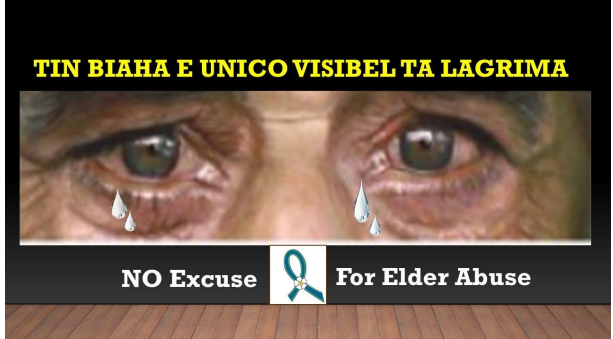
Since 2012, the Alzheimer Foundation Aruba (F.A.A.) has been active on the topic of Elder Abuse. In this framework, it launched the Project “SAY NO TO ELDER ABUSE” under the motto “NO EXCUSE FOR ELDER ABUSE!”. Not a week goes by without F.A.A. receiving complaints of abuse or being notified of it. Within this group, there are also people who express fear of stepping forward when they are abused or neglected as patients—fear for reasons such as retaliation, threats, etc., of going through the same thing or worse at the hands of a professional.
The anguish and anger expressed also in social media point toward the direction that it is time to show discontent and speak out against abuses committed against the Elderly, giving a voice to those suffering in silence.
Right to optimal care:
Every elderly person deserves a dignified life of quality, with adequate nutrition for their health, and respectful treatment. The reason is that they built the society that the community enjoys today. Most elderly people gave all their effort to help build the Aruba of today, paid taxes, educated our youth, and (many of them) saved what little they could to have something for tomorrow to leave for their children. Therefore, it is the duty of a responsible government to comply with and respect the human rights of every citizen and ensure a life with dignity and good health.
For those who must go to a nursing home, the government’s task must be to fulfill the obligation and responsibility of how nursing homes are operated, in accordance with legally proclaimed laws (landsverordening) and the rules of a transparent government. The Government will fail if there is no sufficient and adequate control over deficient care and Elder Abuse.
Important laws of the Inspectorate of Public Health Aruba (IVA) related to nursing homes:
Several reports have been published, including: Kwaliteitszorg (LV 2014 no. 74) and Verzorgingshuizen (LV 2015 no. 61). Since 2017/2018, IVA has published various reports related to care in nursing homes, for example: “Eindrapport Langdurige zorg” (2018), “Als zorg levens kost: calamiteiten in verzorgingshuizen” (Report Inspectorate of Public Health Aruba GEH-2025/2439; Definitive November 24, 2025).
The results of these reports require more action and guidance for proper management and training of employees in nursing homes. These reports speak of the need to execute a system of learning from the mistakes of incidents/calamities in practice. Here, there is a need to introduce strong actions to successfully prevent Negligence and Elder Abuse.
2. It is regrettable that in 2026 in Aruba there are still too many incidents and calamities in care (in nursing homes, at home, in the hospital, etc.) that are not acceptable and constitute Abuse and Neglect of the Elderly.
Some examples include, among others: the number of elderly people expressing discontent and distrust, which continues to rise drastically for the main reason that no necessary steps are taken to stop the uncontrolled growth of nursing homes staffed by non-professional people (without sufficient knowledge on how to care for an elderly and vulnerable person, how to distribute medication to patients in the nursing home, etc., etc.).
What is lacking is a focus on well-defined actions (for example, S.M.A.R.T. type: Specific, measuring progress, implementation, achievable, realistic, and tangible).
The calamity of a few days ago, with severe consequences of mistreatment of an Elderly person who fears for their life, resulted in the imprisonment of the aggressor to investigate the event. In the community, questions exist as to what could have caused the sudden change in behavior of the aggressor (could this be their medication in combination with drugs?, etc.). Another question is: “What on earth is an addict doing in an elderly nursing home?” And also: Will there be—alongside the criminal and civil investigation—an internal investigation by IVA and the care instance, as described in the IVA report mentioned above?
Is the Minister of Public Health, Social Affairs, Elderly Care, and Addiction Management and their departments responsible for complying with what is stated in the law and rules for, among others, nursing homes and businesses (with unqualified workers springing up like mushrooms) and acting accordingly?
There are elderly people who do not have the financial means to keep the patient at home and must take the step (not desired) of letting their loved one go to a Nursing Home, knowing that in that sector a lot of abuse and neglect occurs, and remaining with a feeling of guilt for not being able to fulfill the wish of dignified care in a familiar and safe environment.
Moreover, it is precisely the patients in a “deficient” nursing home, those dependent on home care businesses, and their families, who do not experience a dignified life with the safety of their loved one, becoming victims of abuse and neglect due to mismanagement and a shortage of sufficiently trained professionals.
In short: The safety and dignity of our elderly cannot be put at stake due to a lack of legal and administrative management! Therefore, the Management of the Minister of Public Health, Social Affairs, Elderly Care, and Addiction Management and their departments (incl. IVA) are responsible and have the duty to “ACT” and serve the wellbeing and provide optimal quality of life and health for every tax-paying citizen and resident of Aruba!
For reactions to this article: alzheimeraruba@gmail.com